
More than 60 percent of American e-commerce businesses now rely on AI-powered chatbots for customer support. Choosing between a chatbot and live chat can impact efficiency, cost, and customer satisfaction in big ways. This introduction uncovers how each solution addresses real customer needs, helping you identify the smartest support options for your business.
Table of Contents
- Chatbot vs. Live Chat Explained
- Core Capabilities and Unique Features Compared
- Real-World Applications in E-Commerce
- Cost, Scalability, and Customer Satisfaction
- When to Choose Chatbots or Live Chat
Key Takeaways
| Point | Details |
|---|---|
| Chatbots provide 24/7 support | Chatbots handle routine inquiries efficiently, offering instant responses without staffing limitations. |
| Live chat offers human empathy | Live chat is essential for complex interactions requiring emotional intelligence and personalized guidance. |
| Implement a hybrid support model | Combining chatbots for routine tasks with live chat for nuanced issues can optimize customer support efficiency. |
| Cost-effectiveness of chatbots | Chatbots significantly reduce operational costs by managing high volumes of inquiries without increasing staffing needs. |
Chatbot vs. Live Chat Explained
The world of customer support is rapidly evolving, with businesses increasingly turning to digital communication solutions like chatbots and live chat. Understanding the nuanced differences between these technologies can help you select the most effective approach for your specific business needs. Website chatbots are transforming how companies interact with customers by providing instant, scalable support solutions.
Chatbots represent an automated communication system powered by artificial intelligence, capable of handling multiple customer inquiries simultaneously without human intervention. These digital assistants can provide instant responses, answer frequently asked questions, and even guide customers through complex processes like product selection or troubleshooting. Unlike traditional live chat, chatbots operate 24/7, ensuring consistent availability and reducing wait times for customer support.
Live chat, in contrast, connects customers directly with human customer service representatives in real time. While more personalized, live chat requires human staffing and has inherent limitations like restricted operating hours, potential response delays, and higher operational costs. Human agents can handle complex, nuanced inquiries that might challenge an AI system, but they cannot match the immediate responsiveness and scalability of chatbots.
Pro tip: Consider implementing a hybrid support model that combines chatbot efficiency for routine inquiries with live chat options for more complex customer interactions.
Core Capabilities and Unique Features Compared
Chatbots and live chat systems offer distinct technological capabilities that significantly impact customer support strategies. Systematic research comparing AI chatbots reveals complex variations in their core functionalities, highlighting the importance of understanding each platform’s unique strengths and limitations.

For chatbots, advanced natural language processing enables sophisticated interactions that go beyond simple scripted responses. These AI-powered systems can interpret context, learn from previous interactions, and provide personalized recommendations based on customer data. Key capabilities include instant response generation, multilingual support, seamless integration with existing customer relationship management (CRM) systems, and the ability to handle multiple concurrent inquiries without performance degradation.
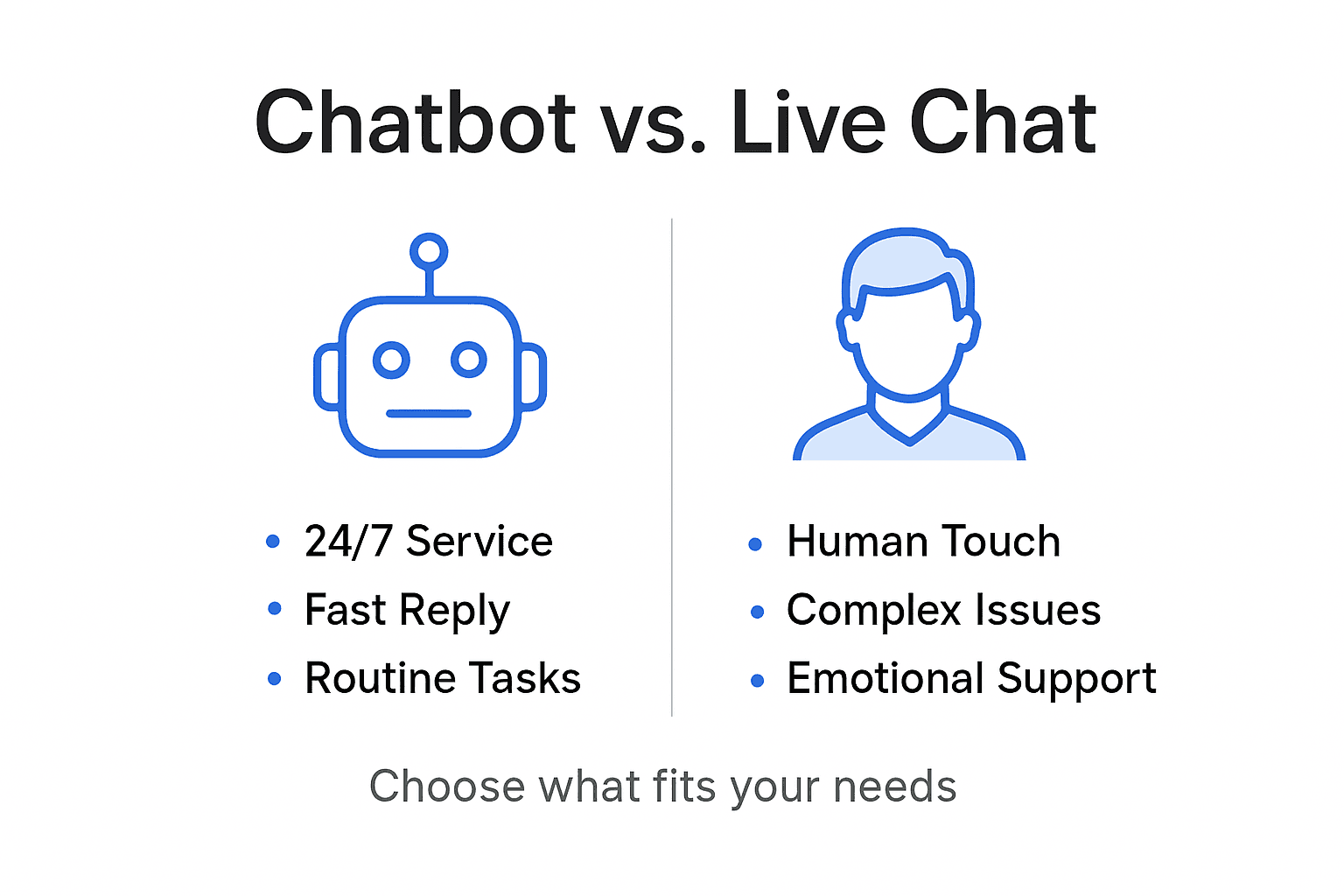
Live chat systems, by contrast, rely on human expertise and emotional intelligence. Their core features include real-time communication, screen sharing capabilities, comprehensive problem-solving for complex scenarios, and the ability to build genuine rapport with customers. While less scalable than chatbots, live chat offers nuanced understanding and empathy that current AI technologies cannot fully replicate. The human touch remains critical for addressing intricate customer concerns that require deep contextual comprehension.
Pro tip: Evaluate your specific business requirements and customer demographics to design a balanced support strategy that strategically leverages both chatbot automation and human live chat capabilities.
Real-World Applications in E-Commerce
E-commerce platforms have rapidly embraced both chatbot and live chat technologies to revolutionize customer interactions and support strategies. Systematic research reveals how AI chatbots are transforming digital commerce through advanced customer service automation, offering unprecedented capabilities for handling complex customer engagement scenarios.
In practical e-commerce applications, chatbots excel at managing routine yet critical tasks such as order tracking, return processing, and addressing abandoned cart scenarios. These AI-powered systems can instantly provide shipping updates, generate return labels, and even send personalized reminders to customers who have left items in their online shopping carts. By integrating seamlessly with inventory management and customer relationship databases, chatbots enable businesses to maintain real-time communication and streamline operational workflows without requiring constant human intervention.
Live chat remains indispensable for more nuanced e-commerce interactions that demand human judgment and emotional intelligence. Advanced studies demonstrate chatbots’ significant impact on customer trust and sales conversion rates, particularly when deployed strategically alongside human support channels. Complex scenarios like product customization, high-value purchase consultations, and resolving intricate customer concerns still benefit immensely from direct human interaction, where empathy and contextual understanding play crucial roles.
The following table outlines common e-commerce scenarios and ideal support approaches:
| Scenario | Best Solution | Rationale |
|---|---|---|
| Order Tracking | Chatbot | Quick answers, instant updates |
| Product Customization | Live Chat | Needs personalized guidance |
| Abandoned Cart Recovery | Chatbot | Automated, timely engagement |
| High-Value Purchase | Live Chat | Builds trust with human touch |
| Simple FAQ | Chatbot | Efficient and immediate |
| Complaint Resolution | Live Chat | Empathy is essential |
Pro tip: Design a hybrid customer support model that leverages chatbots for initial screening and routine inquiries, while reserving human live chat agents for complex, high-value customer interactions that require personalized problem-solving.
Cost, Scalability, and Customer Satisfaction
How AI chatbots improve customer support response times reveals the critical economic advantages of modern customer communication technologies. Chatbots and live chat systems present fundamentally different approaches to managing customer interactions, each with unique implications for business operational costs, scalability, and customer satisfaction.
From a financial perspective, chatbots represent a significantly more cost-effective solution for handling customer inquiries. A single AI-powered chatbot can simultaneously manage hundreds of customer interactions without additional staffing expenses, dramatically reducing labor costs. Unlike live chat systems that require continuous human staffing, chatbots operate 24/7 at a fraction of the personnel expense. Small and medium-sized businesses can particularly benefit from this model, as chatbots eliminate the need for extensive customer support teams while maintaining consistent, high-quality interaction standards.
Scalability becomes another crucial differentiator between these communication channels. Chatbots can effortlessly expand their capacity during peak traffic periods without compromising response quality or incurring substantial infrastructure costs. Live chat systems, conversely, require proportional human resource increases to handle growing customer volumes, creating linear scaling challenges that directly impact operational expenses. Customer satisfaction metrics frequently demonstrate that quick, accurate responses matter more than the communication channel’s origin, suggesting that well-designed AI systems can match or exceed human interaction quality for routine inquiries.
Here’s a comparison of key business impacts for chatbots and live chat:
| Factor | Chatbots | Live Chat |
|---|---|---|
| Availability | 24/7 support, no downtime | Limited by staffing hours |
| Cost Efficiency | Minimal labor expenses | Requires larger support team |
| Response Speed | Instant, simultaneous replies | May experience wait times |
| Personalization | Context-aware but limited empathy | High emotional intelligence |
| Scalability | Easily handles traffic spikes | Scaling increases labor costs |
| Complex Issue Handling | Basic troubleshooting only | Excels at nuanced solutions |
Pro tip: Conduct periodic performance audits of your customer support channels, tracking response times, resolution rates, and customer feedback to continuously optimize your chatbot and live chat strategies.
When to Choose Chatbots or Live Chat
Research on customer communication strategies reveals that selecting the right support channel depends on nuanced business requirements and customer interaction complexity. Chatbots and live chat are not competing technologies, but complementary tools designed to address different customer service scenarios with maximum efficiency.
Chatbots excel in situations demanding instant, consistent responses across high-volume interactions. Startups, global businesses, and e-commerce platforms benefit most from chatbot deployment when handling routine inquiries like order tracking, product information, frequently asked questions, and basic troubleshooting. These AI-powered systems provide 24/7 support, eliminate wait times, and can simultaneously manage hundreds of customer interactions without additional staffing expenses. Small to medium-sized businesses particularly appreciate chatbots’ ability to maintain professional communication standards while reducing operational costs.
Live chat becomes the preferred option when customer interactions require emotional intelligence, complex problem-solving, and personalized guidance. Scenarios involving sensitive issues, technical product consultations, complaint resolution, and high-value purchase decisions demand human empathy and nuanced communication. Sales teams, premium service providers, and businesses with intricate product offerings typically rely on live chat to build trust, demonstrate deep product knowledge, and create meaningful customer connections that automated systems cannot replicate.
Pro tip: Implement a hybrid support strategy that uses chatbots for initial screening and information gathering, seamlessly transitioning complex interactions to human agents for personalized resolution.
Elevate Your Customer Support with AI-Powered Chatbots from ChatPirate.io
The article highlights the challenge businesses face when deciding between chatbot automation and live chat for customer support. Key pain points include managing high-volume inquiries while providing personalized interactions that build trust and satisfaction. As the article explains, balancing instant 24/7 responses from chatbots with the empathetic, nuanced support only human agents can deliver is essential for modern businesses looking to scale efficiently.
At ChatPirate.io, we empower your business to master this balance by offering AI-driven chatbots that learn from your website content and knowledge bases. Our platform enables quick deployment with no coding required through easy integrations with WordPress, Shopify, Wix, and Webflow. Features like seamless human handoff ensure complex questions get real-time human attention, while our analytics help you optimize support efficiency and customer satisfaction.
Take your customer engagement to the next level and reduce operational costs today. Discover how to automate routine support while preserving those meaningful human connections that drive loyalty.
Activate smarter support now with ChatPirate.io.
Ready to transform your customer interaction strategy with scalable chatbot solutions customized for your business? Visit ChatPirate.io and start your free trial today.
Frequently Asked Questions
What is the main difference between chatbots and live chat?
Chatbots are automated systems powered by artificial intelligence that handle multiple customer inquiries simultaneously with instant responses. Live chat connects customers with human representatives for real-time communication and support.
When should I choose a chatbot over live chat for my business?
Chatbots are ideal for managing routine inquiries such as order tracking, FAQs, and simple troubleshooting, especially when quick responses are needed and cost efficiency is a priority.
What types of interactions are best suited for live chat?
Live chat is best for complex customer interactions that require emotional intelligence and personalized guidance, such as technical product consultations, complaint resolutions, and high-value purchase decisions.
Can I combine chatbots and live chat in my customer support strategy?
Yes, implementing a hybrid support model that utilizes chatbots for initial screenings and routine inquiries while transitioning complex issues to human agents is a great way to enhance customer experience.
Leave a Reply