
Over 80 percent of American e-commerce businesses are exploring AI-powered solutions for customer support. With growing competition and rising operational costs, automation has become crucial for small and medium-sized shops across continents. Learning how AI understands, processes, and responds to your business content empowers you to offer smarter support, reduce expenses, and boost customer engagement in ways that were nearly impossible just a few years ago.
Table of Contents
- AI Learning From Content Explained
- Types Of Content AI Can Learn From
- How AI Chatbots Process Business Knowledge
- Key Benefits For E-Commerce Businesses
- Risks, Challenges, And Common Pitfalls
- Getting The Most From AI-Powered Support
Key Takeaways
| Point | Details |
|---|---|
| AI Enhances Content Understanding | AI uses advanced natural language processing to extract insights and generate contextually relevant responses from various content types. |
| Diverse Learning Sources | AI learns effectively from structured and unstructured content, including documents, customer interactions, and web data. |
| AI Chatbots Transform Customer Support | Implementing AI chatbots can lead to 24/7 support, instant responses, and significant cost reductions in customer service. |
| Risk Management is Crucial | Businesses must address privacy concerns, algorithmic bias, and cybersecurity vulnerabilities when utilizing AI-powered technologies. |
AI Learning From Content Explained
Artificial Intelligence (AI) is revolutionizing how businesses understand and process information through intelligent content learning mechanisms. By analyzing website content, documents, and knowledge bases, AI systems can now extract nuanced insights and generate contextually relevant responses with remarkable precision. Adaptive learning technologies are transforming how machines comprehend and interact with complex information streams.
The core mechanism of AI content learning involves sophisticated natural language processing algorithms that break down text into semantic units, identifying patterns, relationships, and contextual meanings. These algorithms go beyond simple keyword matching, using advanced machine learning models that can understand intent, sentiment, and subtle linguistic nuances. By training on diverse content sources, AI can generate responses that feel increasingly human-like and contextually appropriate.
Understanding AI content learning requires recognizing its multifaceted approach. Large language models like ChatGPT demonstrate significant advancements in comprehending complex information landscapes. These models leverage massive datasets to develop intricate understanding capabilities, allowing them to generate coherent, relevant responses across various domains. The process involves continuous learning, where each interaction refines the AI’s comprehension and response generation skills.
Pro Tip: When implementing AI content learning, start with high-quality, well-structured source materials to ensure more accurate and reliable machine understanding.
Types of Content AI Can Learn From
Artificial Intelligence demonstrates remarkable versatility in learning from diverse content types across multiple domains. From structured documents like manuals and knowledge bases to unstructured content like customer interactions and web pages, AI systems can extract meaningful insights and generate intelligent responses. AI-generated educational content research reveals the expansive capabilities of machine learning algorithms in comprehending and reproducing complex information structures.
The primary content categories AI can effectively learn from include:
- Textual Documents: Technical manuals, policy documents, training materials, research papers
- Customer Interactions: Support tickets, chat logs, email conversations
- Multimedia Content: Transcripts, video captions, audio descriptions
- Structured Data: Spreadsheets, databases, product catalogs
- Web Content: Blog posts, product descriptions, website FAQs
Interdisciplinary AI content integration studies highlight the technology’s ability to break traditional information silos. Modern AI models can synthesize learning materials across humanities, science, and social science disciplines, demonstrating unprecedented adaptability in processing varied content formats. These systems employ advanced natural language processing techniques to understand context, sentiment, and nuanced information across different knowledge domains.
Pro Tip: Ensure your AI training content is clean, well-structured, and representative of your desired output to maximize learning effectiveness.
How AI Chatbots Process Business Knowledge
AI chatbots leverage sophisticated technologies to transform how businesses manage and utilize their knowledge resources. Advanced natural language processing frameworks enable these intelligent systems to comprehend, analyze, and respond to complex business queries with remarkable precision. By breaking down intricate information into digestible semantic units, AI chatbots can extract meaningful insights from diverse content sources, creating a dynamic knowledge processing ecosystem.
The core processing mechanism involves multiple sophisticated techniques:
- Machine Learning Algorithms: Analyze patterns and relationships within business content
- Natural Language Understanding: Interpret context, intent, and nuanced meanings
- Knowledge Graph Construction: Create interconnected understanding of business information
- Contextual Response Generation: Produce accurate, relevant answers based on learned knowledge
Generative AI conceptual frameworks demonstrate how these chatbots integrate multiple technological components to create intelligent knowledge processing systems. By continuously learning from interactions, AI chatbots can adapt their understanding, refine response accuracy, and develop increasingly sophisticated comprehension of business-specific terminologies and processes. These systems go beyond simple keyword matching, employing advanced semantic analysis to understand the deeper meaning behind business queries.
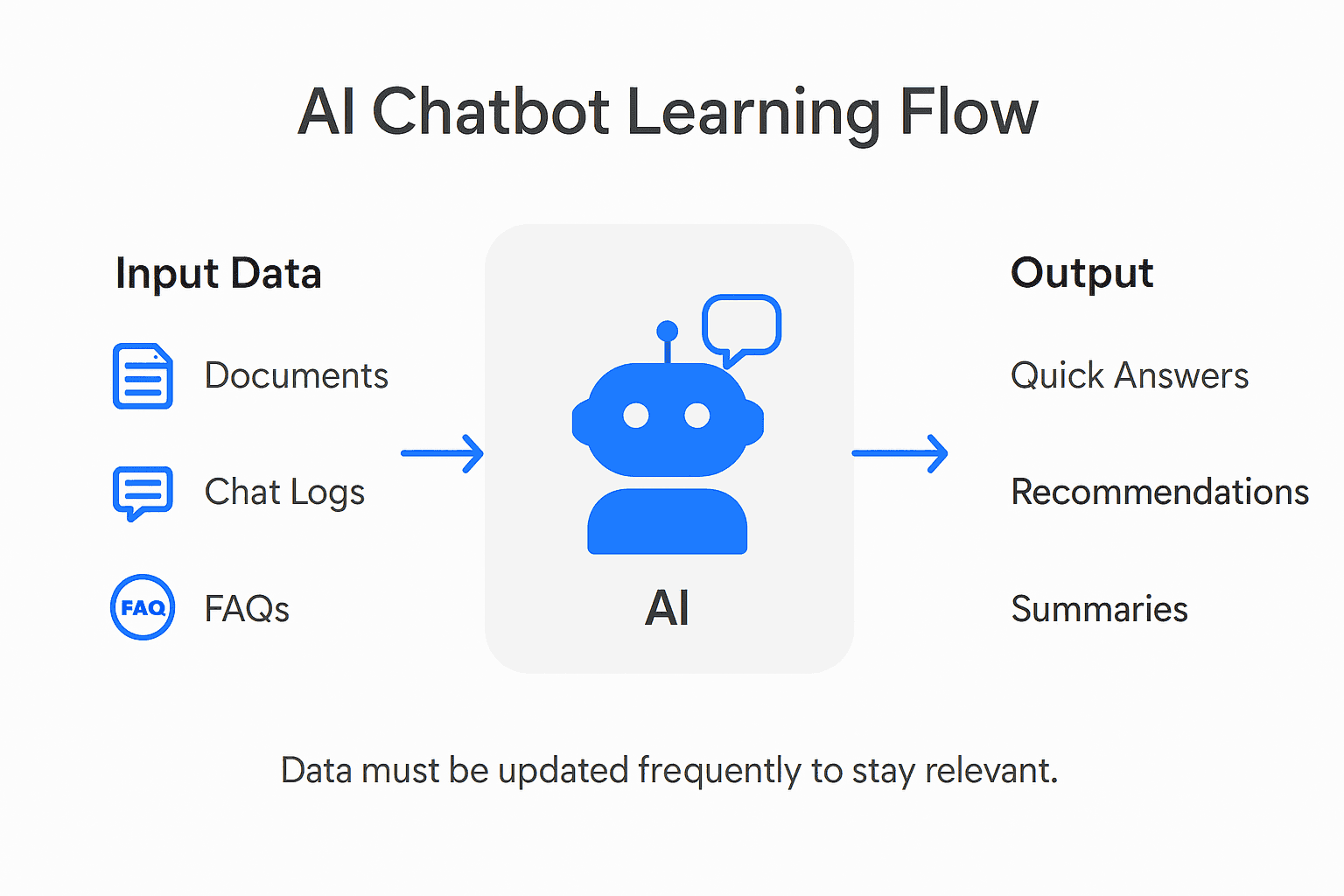
Here’s a summary of how AI chatbots process different types of business data:
| Data Type | Processing Method | Typical Output |
|---|---|---|
| Customer Queries | Natural language understanding | Contextual responses |
| Internal Docs | Semantic analysis and graph building | Business insights |
| Product Databases | Structured data mapping | Catalog suggestions |
| Web Content | Pattern extraction and sentiment | Tailored support messaging |
Pro Tip: Regularly update and curate your knowledge base to ensure AI chatbots maintain high-accuracy learning and response capabilities.
Key Benefits for E-Commerce Businesses
E-commerce businesses are experiencing a transformative shift through AI-powered customer support technologies. Advanced customer engagement strategies demonstrate how intelligent chatbots can revolutionize online retail interactions, delivering unprecedented levels of personalized customer experience and operational efficiency. These intelligent systems go beyond traditional support models, creating dynamic and responsive communication channels that adapt to individual customer needs.
The key benefits for e-commerce businesses include:
- 24/7 Customer Support: Continuous availability without human staffing constraints
- Instant Response Times: Immediate answers to customer inquiries
- Personalized Shopping Experiences: Tailored product recommendations and support
- Cost Reduction: Significant savings on customer service infrastructure
- Scalable Customer Interactions: Handling multiple conversations simultaneously
- Multilingual Support: Breaking language barriers in global commerce
By implementing AI chatbots, e-commerce platforms can dramatically transform their customer interaction models. These intelligent systems learn from each interaction, continuously improving their understanding of customer preferences, common questions, and potential pain points. The technology enables businesses to provide consistently high-quality support, reduce human error, and create more engaging, responsive shopping experiences that can significantly boost customer satisfaction and loyalty.

Pro Tip: Integrate AI chatbots gradually, starting with specific product lines or support categories to optimize learning and minimize potential integration challenges.
Risks, Challenges, and Common Pitfalls
AI-powered chatbots offer tremendous potential, but businesses must navigate a complex landscape of potential risks and challenges. Comprehensive AI service strategies reveal the nuanced considerations businesses must address to successfully implement intelligent customer support technologies. Understanding these potential pitfalls is crucial for developing responsible and effective AI integration approaches.
Key risks and challenges for AI chatbot implementation include:
- Privacy Concerns: Protecting customer data and maintaining confidentiality
- Algorithmic Bias: Ensuring fair and unbiased customer interactions
- Emotional Intelligence Limitations: Maintaining human-like empathy and understanding
- Technology Anxiety: Overcoming customer resistance to automated interactions
- Cybersecurity Vulnerabilities: Protecting against potential data breaches
- Contextual Understanding: Managing complex or nuanced customer queries
Robust AI governance frameworks emphasize the importance of proactive risk management. Businesses must develop comprehensive strategies that balance technological innovation with ethical considerations, human oversight, and continuous monitoring. This approach involves implementing fairness metrics, establishing clear accountability mechanisms, and creating flexible systems that can adapt to emerging challenges and customer expectations.
Compare major risks of AI-powered chatbots and strategies to mitigate them:
| Risk | Impact on Business | Mitigation Strategy |
|---|---|---|
| Data Privacy | Loss of customer trust | Strong encryption policies |
| Algorithmic Bias | Reputational damage | Regular fairness audits |
| Emotional Intelligence Gap | Reduced customer satisfaction | Human-in-the-loop escalation |
| Cybersecurity Threats | Financial and IP loss | Routine security testing |
Pro Tip: Conduct regular audits of your AI chatbot’s performance, focusing on accuracy, bias detection, and customer satisfaction to continuously improve your AI support system.
Getting the Most from AI-Powered Support
Maximizing the potential of AI-powered customer support requires a strategic and nuanced approach that balances technological capabilities with human insights. Operational efficiency strategies demonstrate that successful AI implementation goes far beyond simple automation, demanding a comprehensive understanding of both technological potential and customer experience requirements. Businesses must develop a holistic framework that integrates AI capabilities seamlessly with existing support infrastructures.
Key strategies for optimizing AI-powered support include:
- Continuous Training: Regularly update AI knowledge bases
- Human-AI Collaboration: Create smooth handoff mechanisms between chatbots and human agents
- Performance Monitoring: Track key metrics like resolution rates and customer satisfaction
- Personalization: Develop context-aware response generation
- Multilingual Support: Enable communication across diverse customer segments
- Feedback Integration: Use customer interactions to refine AI learning algorithms
Advanced customer service frameworks emphasize the importance of creating adaptive, responsive support systems. By implementing intelligent routing, predictive problem-solving, and real-time learning mechanisms, businesses can transform their customer support from a reactive cost center into a proactive value generation platform. The most successful approaches treat AI not as a replacement for human interaction, but as a powerful augmentation tool that enhances overall customer experience.
Pro Tip: Implement a staged rollout of AI support technologies, starting with low-complexity interactions and progressively expanding based on performance and customer feedback.
Unlock Seamless Customer Support with AI Learning from Your Content
The article highlights how AI’s ability to learn from diverse content sources transforms customer support by delivering instant, accurate, and contextually relevant responses. If your business struggles with costly, slow, or inconsistent customer interactions, adopting an AI-powered chatbot that learns directly from your website, documents, and knowledge bases can solve these challenges. ChatPirate.io offers a powerful SaaS platform that enables you to deploy customizable chatbots effortlessly without coding, ensuring 24/7 availability and personalized engagement.
Experience benefits like
- Rapid response times that keep customers satisfied
- Scalable support without increasing your overhead
- Seamless integration with popular website builders such as WordPress, Shopify, Wix, and Webflow
- Intelligent human handoff for complex queries
Take the next step toward smarter customer support today with ChatPirate.io.
Ready to transform your customer support by harnessing AI that truly understands your business content Visit ChatPirate.io now to start your free trial and see how easy it is to integrate AI learning into your support channels. Don’t wait to reduce costs, boost engagement, and scale your service effortlessly.
Frequently Asked Questions
What is AI content learning and how does it work?
AI content learning refers to how artificial intelligence systems analyze various content types to extract insights and generate relevant responses. This involves using natural language processing algorithms that break down text to understand context, sentiment, and intent, enabling AI to interact with complex information.
What types of content can AI learn from?
AI can learn from diverse content such as textual documents, customer interactions (like support tickets and chat logs), multimedia content (like transcripts and captions), structured data (like spreadsheets and databases), and web content (like blog posts and FAQs).
How do AI chatbots improve customer support for businesses?
AI chatbots enhance customer support by providing 24/7 availability, instant response times, personalized shopping experiences, and the ability to handle multiple interactions simultaneously. They continuously learn from interactions to improve accuracy and responsiveness, leading to better customer satisfaction.
What are the risks associated with AI chatbot implementation?
The key risks include data privacy concerns, algorithmic bias, limitations in emotional intelligence, technology anxiety among customers, cybersecurity vulnerabilities, and challenges in understanding complex queries. Businesses should adopt comprehensive strategies for risk management to mitigate these issues.
Leave a Reply