
Almost every American e-commerce manager knows how quickly customer expectations are rising in a digital world. The pressure to deliver fast, personalized support is intense and the slightest delay can push shoppers to competitors. With AI now powering more than 60 percent of leading customer service systems, businesses from Germany to Singapore are searching for smarter ways to answer questions and build loyalty. This guide breaks down how AI transforms support, combining data, speed, and precision to create seamless customer experiences.
Table of Contents
- AI in Customer Satisfaction Explained
- Types of AI Solutions for E-commerce
- How AI Chatbots Enhance Support
- Personalization and Predictive Analytics Impact
- Risks, Costs, and Common Missteps
- Comparing AI-Based and Traditional Support
Key Takeaways
| Point | Details |
|---|---|
| AI Enhances Customer Satisfaction | AI enables personalized and responsive customer service, improving engagement and loyalty in e-commerce. |
| Diverse AI Solutions | Businesses leverage various AI technologies, such as chatbots and predictive analytics, to enhance customer experiences and streamline operations. |
| Hybrid Support Model | Combining AI and human support creates a balanced approach, maximizing efficiency while addressing complex customer needs. |
| Mitigating Implementation Risks | Organizations must address algorithmic bias and data privacy concerns to ensure successful and trustworthy AI integration. |
AI in Customer Satisfaction Explained
AI has dramatically transformed customer satisfaction in e-commerce by enabling unprecedented levels of personalization and responsiveness. By leveraging advanced machine learning algorithms, businesses can now analyze customer interactions with remarkable precision, creating tailored experiences that significantly enhance user engagement and loyalty.
The core strength of AI in customer satisfaction lies in its ability to process and interpret complex consumer data instantaneously. Analyzing consumer interaction patterns allows companies to predict customer needs, resolve issues proactively, and deliver more intuitive support experiences. Modern AI systems can understand context, sentiment, and individual preferences far more effectively than traditional customer service models.
Key technological innovations driving this transformation include intelligent chatbots, predictive analytics, and real-time personalization engines. These technologies work synergistically to create seamless customer journeys by:
- Providing instant 24/7 support
- Offering personalized product recommendations
- Automating routine customer service interactions
- Reducing response times dramatically
- Delivering consistent, high-quality communication across multiple channels
Pro tip: Implement AI-driven customer service tools incrementally, starting with low-complexity interactions to build organizational confidence and refine your approach.
Types of AI Solutions for E-commerce
E-commerce businesses are rapidly adopting diverse AI solutions to enhance customer experiences, streamline operations, and drive strategic growth. Advanced AI applications now span multiple critical business functions, transforming how companies interact with customers and manage digital platforms.
The primary AI solutions revolutionizing e-commerce can be categorized into several key domains. Customer Service AI includes intelligent chatbots and virtual assistants capable of handling complex customer inquiries, providing instant support, and offering personalized recommendations. Predictive Analytics AI enables businesses to forecast consumer behavior, optimize pricing strategies, and develop targeted marketing campaigns by analyzing historical data and identifying emerging trends.
Additional critical AI solutions in e-commerce encompass:
-
Product Search and Recommendation Systems
- Advanced algorithms that personalize product suggestions
- Machine learning models that understand individual user preferences
- Dynamic filtering and matching techniques
-
Inventory and Supply Chain Management AI
- Automated demand forecasting
- Real-time inventory tracking
- Intelligent logistics optimization
-
Security and Fraud Detection AI
- Advanced anomaly detection algorithms
- Real-time transaction monitoring
- Adaptive risk assessment models
Conversational AI platforms, such as intelligent AI chatbots for e-commerce platforms, are particularly transformative, enabling businesses to provide seamless, personalized customer interactions across multiple digital touchpoints.
Pro tip: Select AI solutions that integrate seamlessly with your existing technology infrastructure and offer scalable, modular implementation strategies.
Here’s a summary of common AI solution domains in e-commerce and their primary business impacts:
| AI Solution Domain | Main Application | Business Impact |
|---|---|---|
| Customer Service AI | Chatbots, virtual assistants | Boosts support speed, personalizes responses |
| Predictive Analytics AI | Forecasting, marketing optimization | Improves targeting, anticipates trends |
| Product Recommendation Engines | Personalized suggestions | Increases upsell/cross-sell rates |
| Inventory & Supply Chain AI | Demand forecasting, logistics | Reduces overstock, streamlines operations |
| Security & Fraud Detection AI | Anomaly detection, risk assessment | Minimizes fraud losses, strengthens trust |
How AI Chatbots Enhance Support
AI chatbots represent a transformative technology that fundamentally reimagines customer support strategies for modern businesses. Generative AI support systems enable organizations to provide instantaneous, personalized interactions that dramatically improve customer satisfaction and operational efficiency.

The core functionality of AI chatbots extends far beyond traditional automated response systems. Intelligent conversational interfaces can now understand complex customer inquiries, interpret context and sentiment, and deliver nuanced responses that feel remarkably human-like. These advanced systems leverage natural language processing and machine learning algorithms to continuously improve their understanding and communication capabilities, adapting to unique customer communication styles and specific business requirements.
Key capabilities that distinguish modern AI chatbots include:
-
24/7 Availability
- Instant response regardless of time zone
- Consistent support quality
- No human agent scheduling limitations
-
Multilingual Support
- Real-time language translation
- Culturally sensitive communication
- Broader customer reach
-
Personalization Features
- Adaptive response generation
- Individual customer history analysis
- Contextual recommendation engines
-
Advanced Problem Resolution
- Complex inquiry handling
- Escalation to human agents when needed
- Detailed interaction tracking
Conversational AI platforms like website chatbots continue pushing boundaries, enabling businesses to create more engaging, responsive customer support experiences that feel intuitive and helpful.
Pro tip: Implement AI chatbots incrementally, starting with clearly defined use cases and gradually expanding their functional complexity based on performance metrics and user feedback.
Personalization and Predictive Analytics Impact
AI-driven personalization represents a revolutionary approach to transforming customer experiences in e-commerce by converting raw data into strategic insights. Machine learning personalization techniques enable businesses to create deeply individualized shopping journeys that anticipate and fulfill customer needs with unprecedented precision.
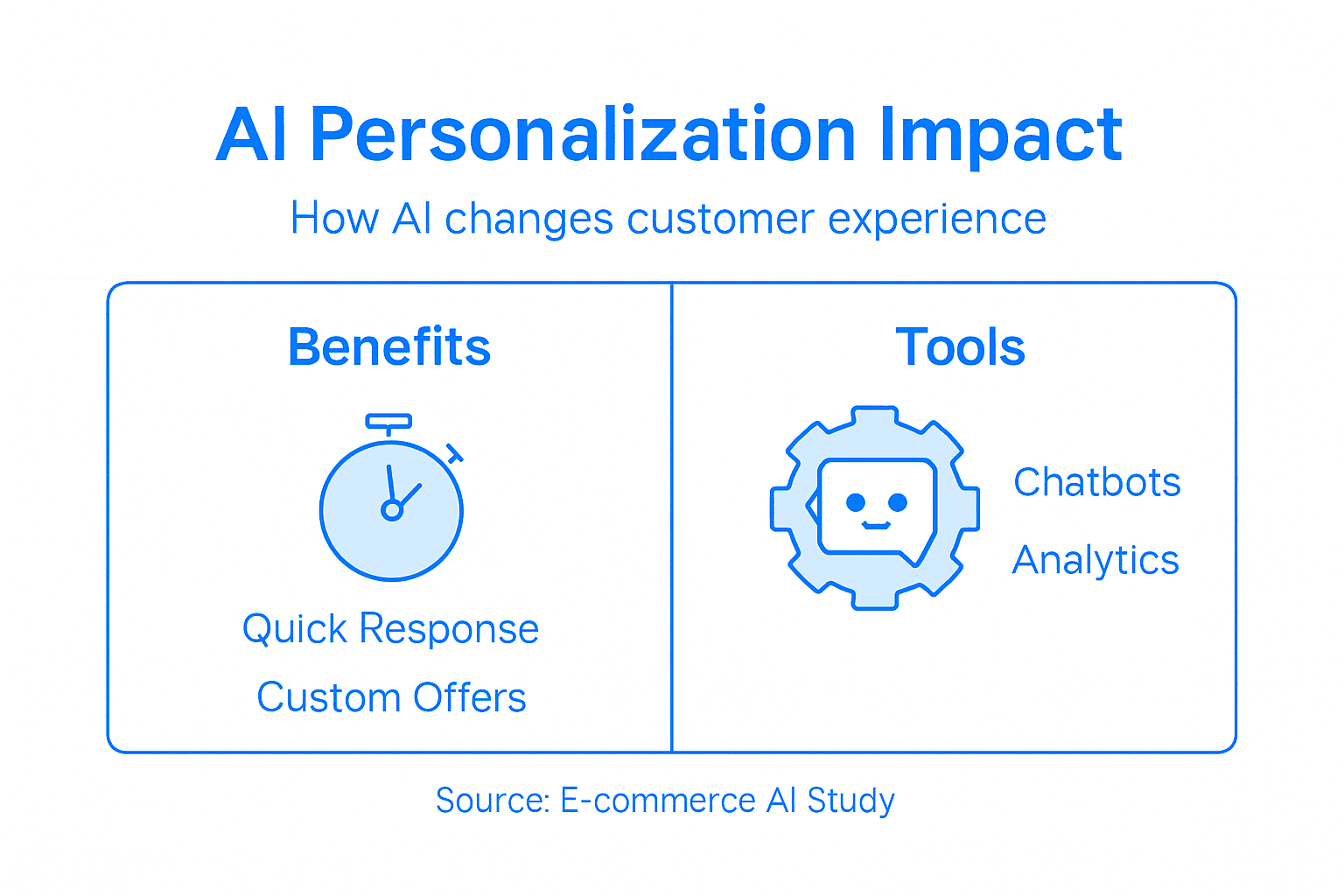
The power of predictive analytics lies in its ability to transform complex customer data into actionable intelligence. Advanced algorithms can now analyze browsing patterns, purchase history, demographic information, and real-time interactions to generate hyper-personalized recommendations that feel intuitive and meaningful. These intelligent systems continuously learn and adapt, creating increasingly sophisticated models of individual customer preferences and behaviors.
Key personalization strategies enabled by AI include:
-
Dynamic Product Recommendations
- Real-time suggestion generation
- Cross-category recommendation engines
- Contextual product matching
-
Individualized Pricing Strategies
- Personalized discount offers
- Adaptive pricing models
- Customer lifetime value optimization
-
Customized User Experience
- Tailored website layouts
- Personalized content streams
- Individual navigation paths
-
Predictive Consumer Behavior Modeling
- Future purchase prediction
- Churn risk assessment
- Customer segment identification
These advanced AI-powered personalization techniques transform raw data into compelling, individualized experiences that significantly enhance customer engagement and satisfaction.
Pro tip: Implement AI personalization incrementally, starting with low-risk segments and gradually expanding complexity while closely monitoring performance metrics and user feedback.
Risks, Costs, and Common Missteps
AI implementation in customer support is not without significant challenges and potential pitfalls that businesses must carefully navigate. Conversational AI risks extend beyond technological limitations, encompassing complex ethical, privacy, and operational considerations that can undermine customer trust if not strategically managed.
The financial and reputational risks associated with poorly implemented AI solutions can be substantial. Emerging technologies require nuanced approaches that balance innovation with robust safeguards. Organizations must develop comprehensive strategies that address potential vulnerabilities, including algorithmic bias, data privacy concerns, and the critical need for transparent, accountable AI systems that maintain human oversight and emotional intelligence.
Critical risk areas for AI-powered customer support include:
-
Algorithmic Bias
- Unintended discriminatory outcomes
- Skewed decision-making processes
- Representation and fairness challenges
-
Data Privacy Vulnerabilities
- Potential unauthorized data access
- Complex compliance requirements
- Risk of sensitive information exposure
-
Technical Performance Issues
- Inconsistent response quality
- Limited contextual understanding
- Potential system failures
-
Operational Cost Challenges
- High initial implementation expenses
- Ongoing training and maintenance
- Complex integration requirements
High-profile AI deployment failures demonstrate the critical importance of developing comprehensive risk mitigation strategies that prioritize transparency, ethical considerations, and continuous performance monitoring.
Pro tip: Conduct thorough pilot testing with controlled user groups and maintain a hybrid human-AI support model to rapidly identify and address potential system limitations.
Comparing AI-Based and Traditional Support
The landscape of customer support is undergoing a profound transformation, with AI technologies challenging conventional service delivery models. Comparative support technologies reveal a nuanced picture where artificial intelligence complements rather than completely replaces traditional human-driven support strategies.
Technological capabilities demonstrate that AI and traditional support systems each bring unique strengths to customer service. While AI excels in speed, scalability, and 24/7 availability, human agents provide emotional intelligence, complex problem-solving, and empathetic communication that current AI technologies cannot fully replicate. This creates an emerging hybrid model where AI handles routine inquiries and human agents manage more sophisticated, nuanced customer interactions.
Key comparative dimensions include:
-
Response Speed
- AI: Instantaneous
- Traditional: Variable, dependent on agent availability
-
Scalability
- AI: Unlimited concurrent interactions
- Traditional: Limited by human resource constraints
-
Emotional Intelligence
- AI: Limited contextual understanding
- Traditional: High empathy and adaptive communication
-
Cost Efficiency
- AI: Lower long-term operational expenses
- Traditional: Higher ongoing personnel costs
AI research tool comparisons consistently highlight the importance of maintaining human oversight to ensure accurate, contextually appropriate responses. The most effective support strategies will likely involve seamless integration of AI and human capabilities.
Compare key strengths and limitations of AI-based and traditional support models:
| Support Type | Key Strength | Limitation | Best For |
|---|---|---|---|
| AI-Based | Instant scalability | Limited empathy, contextual gaps | Routine, high-volume requests |
| Traditional | Human understanding | Slower response, higher labor cost | Complex, emotional issues |
| Hybrid (AI + Human) | Balanced efficiency and empathy | Integration complexity | Most customer scenarios |
Pro tip: Design a strategic support model that leverages AI for initial triage and routine tasks while reserving human agents for complex, emotionally nuanced customer interactions.
Elevate Customer Satisfaction with AI-Powered Chatbots from ChatPirate.io
The article highlights how AI transforms customer satisfaction by enabling instant, personalized support and predictive insights. If your business struggles with slow response times, inconsistent communication, or scaling support efficiently, ChatPirate.io offers a turnkey solution to these challenges. Our AI chatbots integrate seamlessly with popular platforms like WordPress and Shopify to deliver 24/7 instant support, personalized responses based on your content, and smooth human handoff when needed — all without coding.

Experience how your e-commerce or service business can reduce operational costs while boosting customer satisfaction and engagement. Don’t wait to transform your customer support strategy. Visit ChatPirate.io to explore customizable AI chatbots, discover how AI chatbots improve customer support response times, and learn more about website chatbots that deliver reliable, scalable customer experiences. Take the first step to smarter support today.
Frequently Asked Questions
How does AI improve customer satisfaction in e-commerce?
AI enhances customer satisfaction by providing personalized experiences, instant support through chatbots, and predictive analytics that anticipate customer needs, leading to improved engagement and loyalty.
What types of AI solutions are available for enhancing e-commerce customer experiences?
Key AI solutions for e-commerce include customer service chatbots, predictive analytics, product recommendation systems, inventory management AI, and fraud detection technologies, each serving to streamline operations and enhance user experiences.
What are the primary benefits of using AI chatbots for customer support?
AI chatbots offer 24/7 availability, instant responses, multilingual support, personalized interactions, and advanced problem resolution capabilities, improving overall customer service and operational efficiency.
What risks should businesses consider when implementing AI in customer support?
Potential risks include algorithmic bias, data privacy concerns, technical performance issues, and high operational costs. Businesses must develop strategies to address these vulnerabilities while ensuring ethical and transparent AI use.
Leave a Reply