
Over 50 percent of American online shoppers say they expect instant help when contacting customer service. For e-commerce managers at small and medium-sized businesses, meeting these expectations can quickly stretch resources and budgets. Conversational AI offers a smart way to deliver rapid, personalized support without sacrificing quality or driving up operational costs, giving your team more time to focus on growth instead of repetitive queries.
Table of Contents
- Conversational AI Defined for E-Commerce Teams
- Major Types of Conversational AI Technologies
- How Conversational AI Works in Practice
- Business Benefits and Industry Use Cases
- Potential Risks and Cost Considerations
Key Takeaways
| Point | Details |
|---|---|
| Importance of Conversational AI | Conversational AI enhances customer interactions by enabling nuanced, human-like communication that adapts to user intent. |
| Types of Conversational AI Technologies | Choosing the right technology—rule-based, retrieval-based, or generative—is crucial for matching specific business needs. |
| Business Benefits | Organizations benefit through improved efficiency, reduced costs, and enhanced customer satisfaction across various sectors. |
| Risk Management | Companies must address ethical challenges and financial considerations, ensuring robust governance and continuous monitoring for AI systems. |
Conversational AI Defined for E-Commerce Teams
Conversational Artificial Intelligence (CAI) represents a transformative technology enabling machines to interact with humans through natural, intuitive communication. At its core, conversational AI enables software agents to understand and respond to human language with remarkable sophistication. For e-commerce teams, this means creating dynamic digital interactions that feel genuinely human-like and contextually intelligent.
Unlike traditional rule-based chatbots, modern conversational AI leverages advanced machine learning and natural language processing to comprehend user intent, interpret nuanced communication, and generate contextually appropriate responses. These intelligent systems can understand customer queries, provide personalized recommendations, handle complex support requests, and even predict potential customer needs before they are explicitly stated. By analyzing previous interactions and learning continuously, AI-powered conversational agents improve communication effectiveness with each customer engagement.
E-commerce teams can utilize conversational AI across multiple critical functions. These include automated customer support, personalized product recommendations, order tracking, returns processing, and proactive customer engagement. The technology allows businesses to provide 24/7 support, reduce response times, and scale customer interactions without proportionally increasing human resources. Key capabilities include multilingual support, sentiment analysis, and the ability to handle multiple concurrent conversations with consistent quality.
Pro tip: Start by mapping your most common customer interaction scenarios and train your conversational AI system to handle those specific use cases with high accuracy before expanding to more complex interactions.
Major Types of Conversational AI Technologies
Conversational AI technologies have evolved into sophisticated systems with distinct architectural approaches, each offering unique capabilities for digital interactions. Conversational AI broadly encompasses three primary technological categories: rule-based systems, retrieval-based chatbots, and generative conversational agents. These technologies represent increasingly complex methods of simulating human-like communication, with each type presenting specific strengths and limitations for e-commerce applications.
Rule-based systems represent the most fundamental approach, operating through predefined scripts and decision trees that provide structured, predictable responses. Retrieval-based chatbots offer more flexibility by selecting optimal responses from a curated database using advanced matching algorithms. In contrast, generative conversational systems use deep learning models to create entirely novel responses, enabling more dynamic and contextually nuanced interactions. These generative models leverage transformer architectures and large language models to understand complex user intents and generate human-like replies.
For e-commerce teams, selecting the right conversational AI technology depends on specific business requirements. Rule-based systems work well for straightforward, predictable interactions like order tracking or basic product inquiries. Retrieval-based chatbots excel in scenarios with well-defined conversation paths, such as technical support or FAQ resolution. Generative AI models represent the cutting edge, offering unprecedented flexibility for handling complex, unpredictable customer interactions with greater linguistic sophistication and adaptive learning capabilities.
Here’s a summary of major conversational AI technologies and where they excel:
| Technology Type | Core Mechanism | Ideal Use Case | Key Limitation |
|---|---|---|---|
| Rule-Based | Predefined scripts and logic | Simple, repetitive inquiries | Lacks flexibility for complex issues |
| Retrieval-Based | Database response selection | Technical support, FAQs | Limited to existing database responses |
| Generative | Deep learning, model-based generation | Unpredictable, complex conversations | May produce inaccurate or off-topic replies |
Pro tip: When implementing conversational AI, start with a hybrid approach that combines rule-based accuracy with generative flexibility, allowing your system to progressively learn and improve its interaction capabilities.
How Conversational AI Works in Practice
Conversational AI operates through a sophisticated multilayered process that transforms human language into intelligent, contextual interactions. Natural language processing systems break down user inputs into comprehensible components, analyzing linguistic nuances, intent, and underlying meaning. This intricate deconstruction allows artificial intelligence to understand not just the literal words, but the actual purpose behind a customer’s communication.
The core mechanism involves three critical components working in seamless synchronization. Natural Language Understanding (NLU) identifies the user’s specific intent and extracts key information, while Dialogue Management tracks the conversation’s context and determines the most appropriate response pathway. Natural Language Generation creates human-like replies that sound natural and contextually relevant, using advanced machine learning algorithms to craft responses that feel authentic and personalized.

For e-commerce applications, this technological process translates into powerful customer interaction capabilities. The AI can understand complex product inquiries, handle support requests, process returns, and even provide personalized recommendations based on previous interactions. Machine learning algorithms continuously refine the system’s understanding, enabling increasingly sophisticated and accurate responses over time. This means e-commerce teams can provide instantaneous, intelligent support that adapts and improves with each customer interaction, reducing operational costs and enhancing overall customer satisfaction.
Pro tip: Implement a continuous feedback loop that allows human agents to review and rate AI-generated responses, helping to train and improve the conversational AI system’s accuracy and contextual understanding.
Business Benefits and Industry Use Cases
Business benefits of conversational AI extend far beyond simple customer interactions, transforming operational capabilities across multiple industries. By automating routine tasks and providing intelligent, personalized communication channels, organizations can dramatically reduce operational costs while simultaneously improving customer engagement and satisfaction. The technology enables businesses to handle complex interactions with unprecedented efficiency, scaling support capabilities without proportional increases in human resource investments.
Across different sectors, conversational AI demonstrates remarkable versatility. In e-commerce, it powers personalized shopping experiences, answers product inquiries, and manages order tracking. Financial institutions leverage these systems for fraud detection, account management, and customer support. Healthcare applications include appointment scheduling, patient triage, and providing preliminary medical information. Generative AI assistants have shown significant productivity improvements, with studies indicating a potential 14% increase in overall support team performance, particularly benefiting less experienced workers by disseminating best practice knowledge.
The technological capabilities of conversational AI translate into tangible business advantages. By providing 24/7 support, reducing human error, and offering instantaneous responses, companies can enhance customer satisfaction while simultaneously reducing operational overhead. Machine learning algorithms continuously refine the system’s understanding, meaning the AI becomes more sophisticated and accurate with each interaction. This creates a dynamic, self-improving support ecosystem that adapts to changing customer needs and market dynamics, giving businesses a significant competitive advantage.
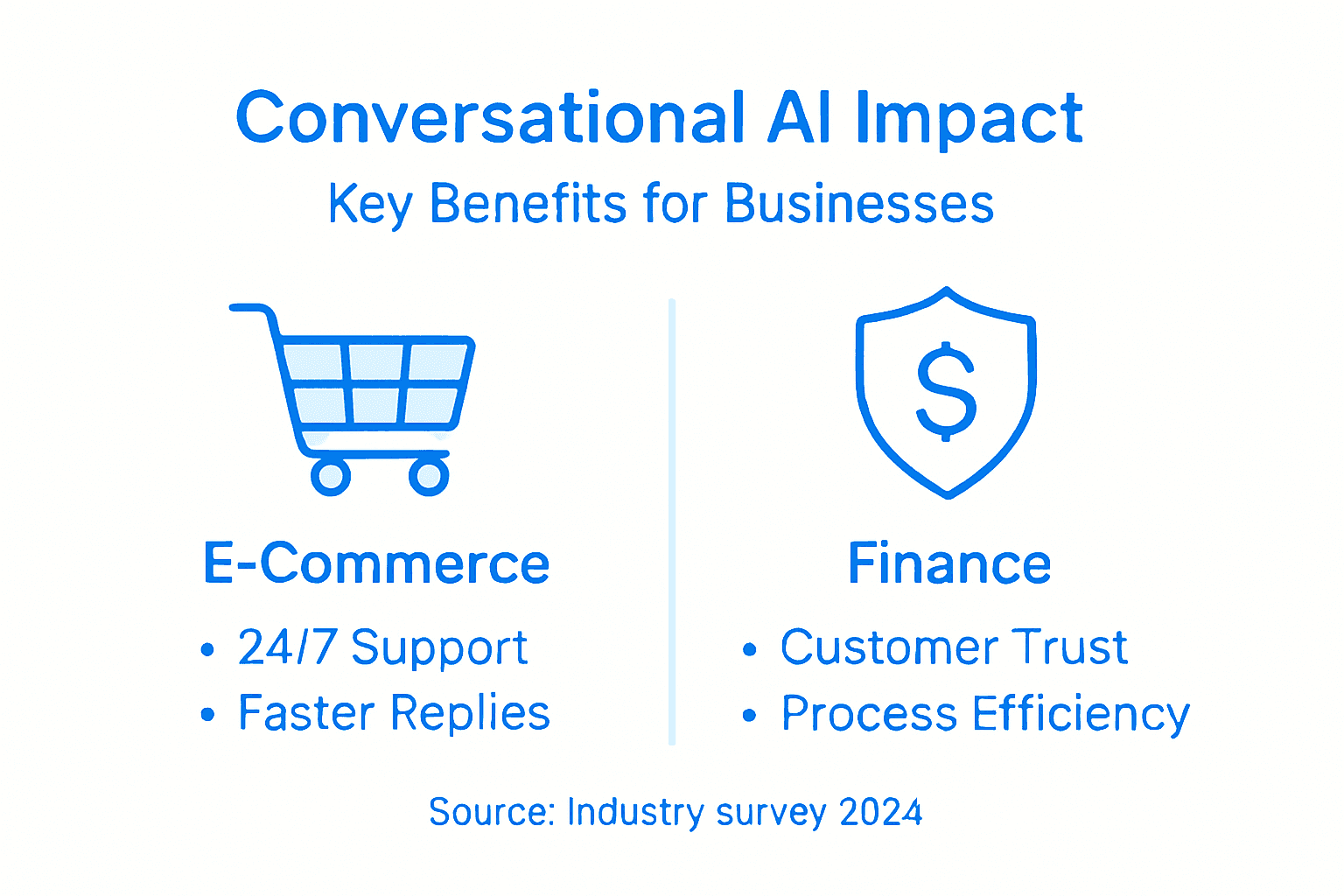
Below is a quick reference on common business benefits and deployment examples by industry:
| Benefit | E-Commerce Example | Finance Example |
|---|---|---|
| Increased Efficiency | 24/7 automated support | AI-powered fraud alerts |
| Cost Reduction | Fewer agents needed | Automated account management |
| Enhanced Satisfaction | Personalized recommendations | Rapid query resolution |
Pro tip: Start by implementing conversational AI in your most repetitive and high-volume customer interaction channels, using detailed analytics to track performance and iteratively improve the system’s response accuracy.
Potential Risks and Cost Considerations
Conversational AI technologies introduce complex ethical and operational challenges that businesses must carefully navigate. While the potential benefits are significant, organizations need to understand the potential risks associated with implementation. These risks include algorithmic bias, potential misinformation generation, privacy concerns, and the financial investment required to develop and maintain sophisticated AI systems that can genuinely add value to customer interactions.
The primary risks extend beyond technological limitations. Ethical considerations and potential misuse of AI technologies remain critical concerns for responsible implementation. Conversational AI systems can inadvertently perpetuate existing biases, generate inaccurate or misleading information, and potentially compromise customer data privacy. Companies must invest in robust governance frameworks, continuous monitoring, and regular audits to ensure the AI system maintains accuracy, fairness, and alignment with organizational values.
From a financial perspective, implementing conversational AI involves substantial upfront and ongoing costs. Initial investments include technology infrastructure, machine learning model development, data collection and training, integration with existing systems, and ongoing maintenance. Small to medium-sized businesses must carefully assess the return on investment, considering factors such as expected efficiency gains, reduced support personnel costs, and potential improvements in customer satisfaction. The complexity of AI systems means that continuous refinement and human oversight are essential to mitigate risks and ensure optimal performance.
Pro tip: Develop a comprehensive risk management strategy that includes regular bias audits, transparent AI decision-making processes, and clear protocols for human intervention when AI systems encounter complex or sensitive scenarios.
Transform Your Customer Support with Conversational AI Today
The challenges outlined in “What Is Conversational AI and Its Impact on Support” highlight how businesses struggle with providing fast, accurate, and scalable customer service around the clock. Key pain points such as long response times, inability to handle complex or multiple conversations, and the need for continuous learning and personalization demand a robust solution.
At ChatPirate.io, we deliver AI-powered chatbots that learn directly from your existing website content, knowledge bases, and documents to provide instant, accurate responses 24/7. Our platform removes the complexity of setup with seamless integrations for popular website builders, empowering your team to reduce operational costs while enhancing support speed and customer satisfaction. With advanced features like human handoff, analytics dashboards, and branding customization, ChatPirate.io fits perfectly with the evolving needs of growing businesses seeking AI that adapts, scales, and delivers real results.
Experience how conversational AI can transform your support experience by exploring ChatPirate.io.

Don’t wait to elevate your customer service with intelligent automation that keeps pace with your business growth. Visit ChatPirate.io now to start your free trial and see how easy and powerful conversational AI implementation can be. Unlock smarter support that works day and night so you can focus on what matters most.
Frequently Asked Questions
What is conversational AI?
Conversational AI refers to advanced technologies that enable machines to interact with humans through natural, intuitive communication, often using natural language processing and machine learning for more human-like interactions.
How can conversational AI improve customer support in e-commerce?
Conversational AI can enhance customer support by providing 24/7 automated assistance, handling multiple inquiries simultaneously, offering personalized recommendations, and improving response times, thereby increasing overall customer satisfaction.
What are the different types of conversational AI technologies used in support?
The primary types of conversational AI technologies include rule-based systems, retrieval-based chatbots, and generative conversational agents, each with its strengths and suitable use cases for customer interactions.
What are the potential risks associated with implementing conversational AI?
Potential risks include algorithmic bias, misinformation generation, privacy concerns, and significant financial investment for development and maintenance. Companies must implement robust governance and monitoring frameworks to mitigate these risks.
Leave a Reply