
Nearly half of American consumers now expect instant replies to order questions from online stores. For e-commerce managers juggling customer support worldwide, falling short can mean lost sales and negative reviews. As digital shopping habits evolve, understanding how AI chatbots transform order support is crucial. Discover which chatbot solutions can deliver faster, more accurate responses and keep satisfaction high across every market.
Table of Contents
- Defining Chatbots in E-Commerce Order Support
- Key Chatbot Types and Essential Capabilities
- How Chatbots Handle Order Inquiries
- Benefits and Limitations for Businesses
- Avoiding Common Chatbot Implementation Pitfalls
Key Takeaways
| Point | Details |
|---|---|
| Chatbots Enhance Customer Support | E-commerce chatbots automate and streamline order inquiries, offering 24/7 support and instant responses. |
| Diverse Chatbot Models | Different types of chatbots, such as rule-based and AI-powered, cater to various customer interaction needs. |
| Operational Efficiency Gains | Implementing chatbots can significantly reduce costs and improve response times, leading to better customer engagement. |
| Strategic Implementation Is Key | Careful planning, rigorous training, and continuous monitoring are vital for successful chatbot deployment. |
Defining Chatbots in E-Commerce Order Support
Chatbots in e-commerce order support represent intelligent software applications designed to automate and streamline customer interactions throughout the purchasing journey. These advanced digital assistants utilize artificial intelligence and natural language processing to provide instantaneous, personalized support for order-related inquiries, transforming how online businesses manage customer communication.
At their core, e-commerce chatbots function as sophisticated communication tools that systematically analyze customer interactions to deliver real-time assistance. They handle critical tasks such as order tracking, delivery updates, product recommendations, and addressing frequently asked questions without requiring human intervention. By integrating seamlessly with existing e-commerce platforms, these AI-powered assistants can instantly retrieve order information, process basic customer requests, and provide 24/7 support across multiple digital channels.
The technological capabilities of modern e-commerce chatbots extend far beyond simple scripted responses. Advanced AI technologies enable personalized shopping experiences that adapt to individual customer preferences and behaviors. These intelligent systems can understand context, interpret complex customer queries, and provide nuanced responses that mimic human-like interaction. By leveraging machine learning algorithms, chatbots continuously improve their understanding and response accuracy, making them increasingly valuable tools for enhancing customer engagement and satisfaction.
Pro tip: When implementing an e-commerce chatbot, prioritize training the AI with comprehensive, industry-specific knowledge bases to ensure accurate and contextually relevant customer support.
Key Chatbot Types and Essential Capabilities
E-commerce businesses can leverage different types of chatbots, each with unique technological approaches designed to enhance customer order support. Chatbot classification reveals distinct architectural models that range from simple rule-based systems to advanced artificial intelligence-driven platforms, providing varying levels of interaction and problem-solving capabilities.
The primary chatbot types include rule-based, AI-powered, hybrid, and platform-based systems. Rule-based chatbots operate using predefined conversation paths and specific keyword triggers, making them ideal for handling straightforward, predictable customer inquiries. In contrast, AI-powered chatbots utilize sophisticated natural language processing and machine learning algorithms to understand context, interpret complex queries, and generate dynamic responses that adapt to individual customer interactions.
Hybrid chatbots represent an innovative middle ground, combining the structured reliability of rule-based systems with the adaptive intelligence of AI technologies. These advanced systems can seamlessly switch between predefined scripts and intelligent response generation, ensuring consistent and intelligent customer support. Advanced chatbot technologies support complex user interactions by integrating multiple communication strategies, enabling more nuanced and personalized customer experiences across various digital platforms.
Here’s a visual comparison of the main chatbot types used in e-commerce order support:
| Chatbot Type | Technology Used | Best For | Limitations |
|---|---|---|---|
| Rule-based | Decision trees, keywords | Simple, repetitive inquiries | Limited adaptability |
| AI-powered | Machine learning, NLP | Complex, dynamic conversations | Requires ongoing training |
| Hybrid | Rules + AI algorithms | Balanced support, escalation | Higher integration effort |
| Platform-based | APIs, plug-in modules | Multi-channel deployment | Platform dependency |
Pro tip: When selecting a chatbot for order support, prioritize solutions that offer flexible integration capabilities and demonstrate strong natural language understanding to ensure seamless customer interactions.
How Chatbots Handle Order Inquiries
Order inquiry management represents a critical function for e-commerce chatbots, enabling businesses to provide instant, accurate support throughout the customer purchasing journey. Automated order support technologies allow these intelligent systems to process a wide range of customer questions rapidly, from tracking shipments to resolving basic order-related concerns without human intervention.
The core capabilities of chatbots in handling order inquiries include real-time status updates, precise order tracking, and intelligent routing of complex issues. Natural language processing enables these systems to understand nuanced customer questions, interpreting intent beyond simple keyword matching. Chatbots can instantly retrieve order details, provide estimated delivery times, explain shipping policies, and even help customers modify or cancel existing orders through conversational interfaces that feel intuitive and responsive.

Advanced chatbots go beyond basic information retrieval by implementing sophisticated intent recognition techniques. Intelligent query management technologies allow these systems to distinguish between different types of customer requests, categorize their complexity, and determine the most appropriate response strategy. When an inquiry exceeds the chatbot’s capabilities, these systems can seamlessly escalate the conversation to human customer support representatives, ensuring that no customer query goes unresolved.
Pro tip: Configure your chatbot with comprehensive order-related knowledge bases and implement clear escalation protocols to maximize automated support effectiveness while maintaining high customer satisfaction levels.
Benefits and Limitations for Businesses
E-commerce businesses increasingly recognize the transformative potential of chatbot technologies in customer support operations. Comprehensive AI chatbot analysis reveals a nuanced landscape of significant advantages balanced against critical implementation challenges. These intelligent systems offer unprecedented opportunities for operational efficiency, customer engagement, and cost management across digital service environments.
The primary benefits of chatbot deployment include substantial cost reduction, round-the-clock customer support, and dramatically improved response times. Businesses can leverage these technologies to handle multiple simultaneous inquiries, provide instant answers, and create personalized interaction experiences that would be impossible with traditional human-only support models. Business efficiency through automated systems enables companies to scale customer support capabilities without proportionally increasing human resource investments, allowing smaller teams to manage increasingly complex customer interaction demands.
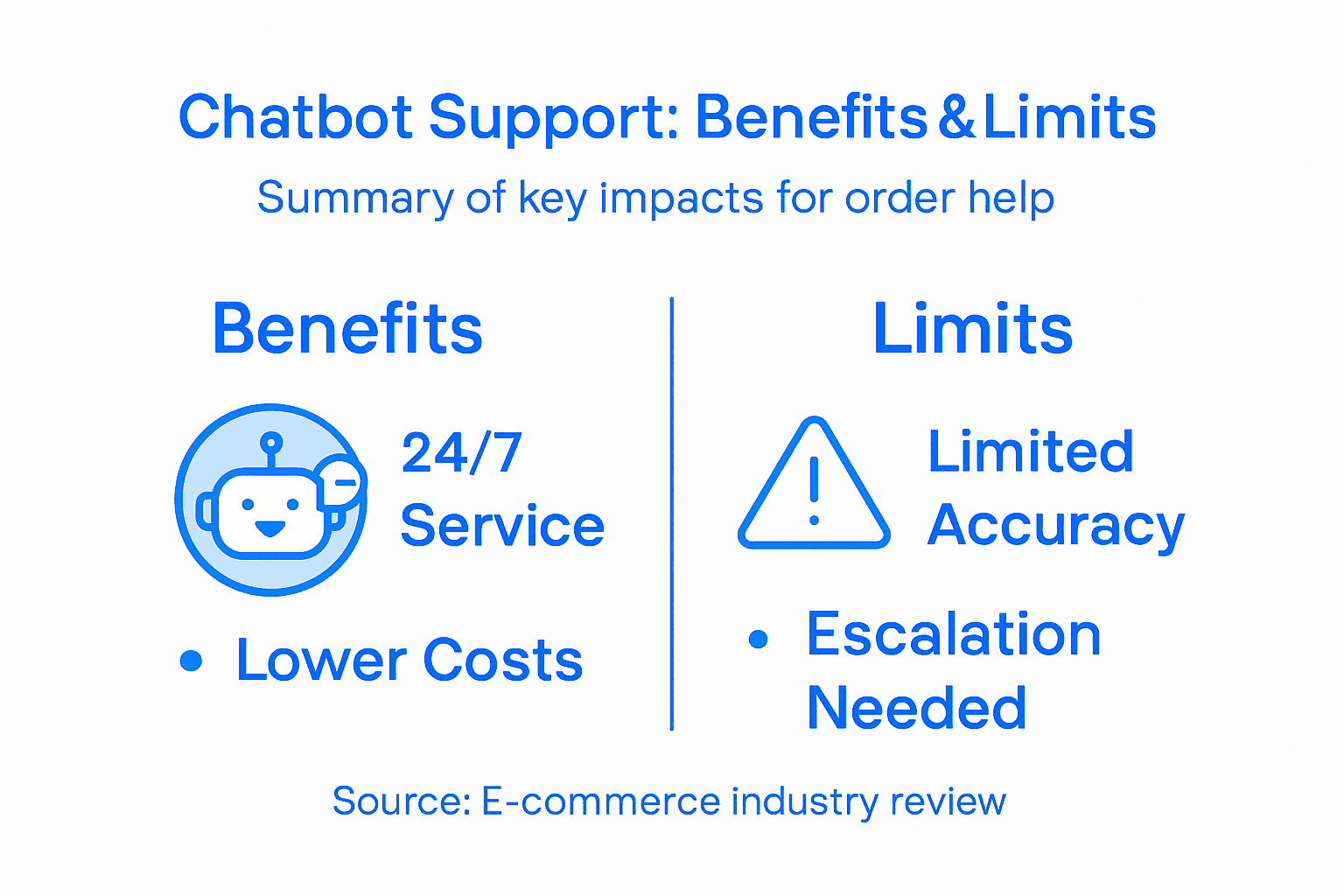
This table summarizes top business impacts of implementing e-commerce chatbots:
| Benefit | Description | Example Outcome |
|---|---|---|
| Operational efficiency | Automates routine customer tasks | Reduced workload on staff |
| Customer engagement | Instant, personalized responses | Higher satisfaction scores |
| Cost management | Scales support without hiring | Lower support expenses |
| 24/7 service | Always available for shoppers | Increased order conversions |
However, chatbot implementations are not without significant limitations. Critical challenges include potential response inaccuracies, data privacy concerns, and the ongoing need for sophisticated training and maintenance. These systems require continuous refinement of their knowledge bases, careful monitoring of interaction quality, and strategic human oversight to ensure they maintain high standards of customer service and avoid potential misunderstandings or inappropriate responses that could damage customer relationships.
Pro tip: Implement a robust hybrid support model that combines AI chatbot capabilities with human expert oversight, ensuring seamless escalation and continuous performance improvement.
Avoiding Common Chatbot Implementation Pitfalls
Successful chatbot deployment requires a strategic approach that anticipates and mitigates potential implementation challenges. Responsible chatbot design frameworks emphasize the critical importance of understanding potential pitfalls before launching an automated support system. E-commerce businesses must recognize that chatbot implementation is not a simple plug-and-play solution but a complex process demanding careful planning and ongoing management.
Some of the most significant implementation challenges include misaligned expectations, poor system integration, and inadequate training. Many businesses fall into the trap of expecting chatbots to function as all-knowing, perfectly responsive systems without recognizing their inherent limitations. Strategic chatbot implementation techniques reveal that successful deployments require clear objective setting, comprehensive knowledge base development, and robust integration with existing customer support infrastructures. This means investing time in mapping out precise use cases, understanding the specific scenarios where chatbots can add value, and creating fallback mechanisms for complex inquiries.
Technical challenges also demand careful consideration. Businesses must address potential issues such as data privacy, response accuracy, and system scalability. This involves implementing rigorous testing protocols, establishing clear guidelines for data handling, and creating transparent escalation paths that allow seamless transitions between automated and human support. Continuous monitoring and iterative improvement are crucial, ensuring that chatbot performance evolves in alignment with changing customer expectations and technological capabilities.
Pro tip: Develop a comprehensive chatbot implementation roadmap that includes pilot testing, continuous performance evaluation, and adaptive learning strategies to minimize potential operational risks.
Elevate Your E-Commerce Order Support with AI-Powered Chatbots
The article highlights key challenges businesses face in delivering instant, accurate order support while managing costs and ensuring customer satisfaction. Chatbots must provide real-time order tracking, handle complex inquiries with natural language understanding, and offer seamless escalation to human agents when needed. If you are striving to reduce operational workload while enhancing the customer experience, leveraging customizable AI chatbots that learn from your unique business data is critical.
At ChatPirate.io, we specialize in empowering businesses to overcome these very obstacles. Our platform delivers AI chatbots designed to automate e-commerce order support effortlessly. With easy integration options for WordPress, Shopify, Wix, and Webflow, you can deploy a smart assistant that offers 24/7 instant replies, understands complex queries, and escalates to human support seamlessly. Imagine improving customer engagement, cutting support costs, and scaling your order support efficiently with a solution tailored to your brand and needs.
Transform your order support today by exploring how customizable AI chatbots can become your business’s most reliable assistant.
Boost your customer satisfaction and operational efficiency now by visiting ChatPirate.io. Start your chatbot journey and experience the future of order support success.
Frequently Asked Questions
What are the capabilities of chatbots in handling order inquiries?
Chatbots are designed to provide real-time status updates, precise order tracking, and intelligent routing of complex customer issues. They utilize natural language processing to understand nuanced questions and can instantly retrieve order details, provide estimated delivery times, and assist with order modifications.
How do chatbots improve customer engagement in e-commerce?
Chatbots enhance customer engagement by offering instant, personalized responses to inquiries around the clock. Their ability to handle multiple simultaneous interactions allows businesses to provide immediate support, resulting in higher customer satisfaction scores and increased order conversions.
What types of chatbots are used in e-commerce order support?
The main types of chatbots include rule-based, AI-powered, hybrid, and platform-based systems. Rule-based chatbots handle straightforward inquiries, while AI-powered chatbots use advanced techniques to manage complex conversations. Hybrid chatbots combine both approaches for balanced support, and platform-based systems facilitate multi-channel deployment.
What are common pitfalls to avoid when implementing a chatbot in e-commerce?
Common pitfalls include misaligned expectations, poor system integration, and inadequate training. To ensure a successful deployment, businesses should set clear objectives, develop comprehensive knowledge bases, and establish robust integration with existing customer support systems.
Leave a Reply