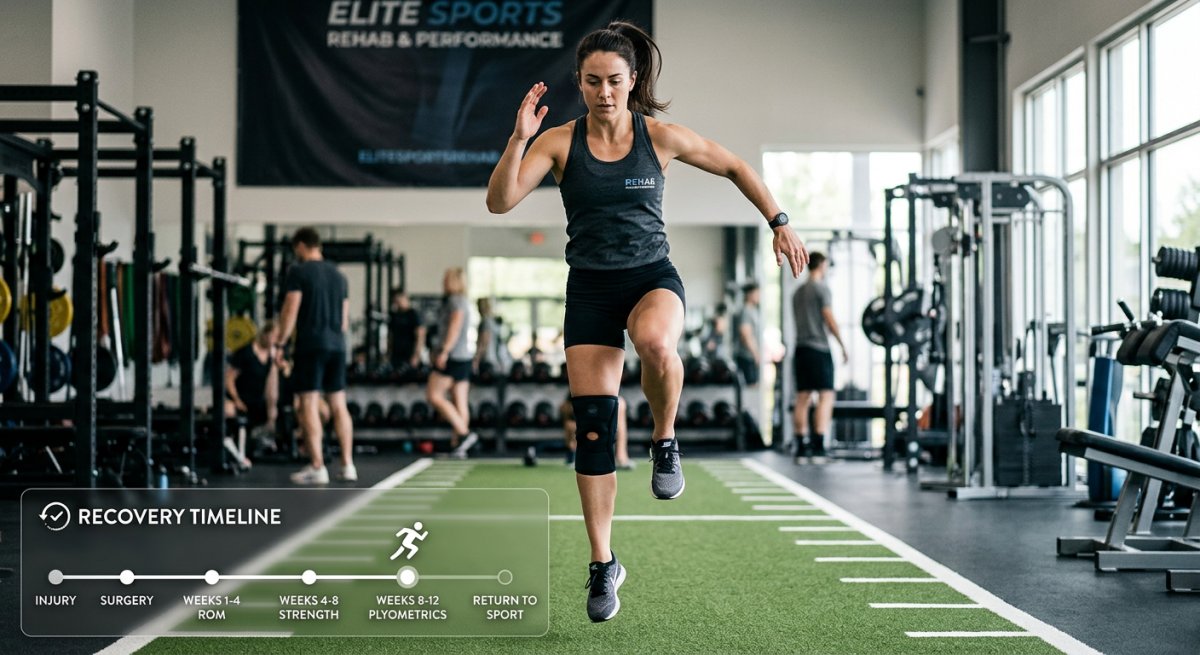
Choosing the right approach after an ACL tear is the first move toward a safe return to sport and daily life. With a structured plan you will reduce pain, rebuild strength, and regain confidence. This guide shows what to expect, week-by-week goals, exercises, functional tests, and how to track progress toward return-to-play.
Table of Contents
- Step 1: Understand ACL Tear and Diagnosis
- Step 2: Acute Care and Prehab (0-6 weeks)
- Step 3: Early Rehab (0-12 weeks) – Mobility and Activation
- Step 4: Intermediate Rehab (6-16 weeks) – Strength and Control
- Step 5: Advanced Rehab & Return-to-Running (3-6 months)
- Step 6: Return-to-Play Testing and Clearance (6-12+ months)
- Step 7: Psychological Recovery and Long-Term Prevention
Quick Summary
| Key Point | Explanation |
|---|---|
| Early pain and swelling control | Reduce swelling and restore full extension within 1-2 weeks to protect graft or native tissue. |
| Quadriceps activation first | Achieve reliable quad activation (straight leg raise without lag) within 2-4 weeks. |
| Progressive strength targets | Aim for limb symmetry index ≥85% by 4-6 months and ≥90% before full return to sport. |
| Functional testing before clearance | Pass single-leg hop symmetry ≥90%, strength tests, and clinician sport-specific assessment. |
| Psychological readiness matters | Use ACL-RSI or graded sport exposures to build confidence alongside physical criteria. |
Step 1: Understand ACL Tear and Diagnosis
Start by knowing what an ACL tear is and how it affects knee stability. The anterior cruciate ligament (ACL) stabilizes forward translation and rotation of the tibia under the femur. Understanding mechanisms helps target rehab: pivoting injuries and sudden deceleration commonly cause tears.
Have a clinician perform a focused exam: Lachman test, pivot shift, and assessment for effusion. Order an MRI when tests suggest a tear or if meniscal/cartilage injury is suspected. Orthopedic referral is appropriate for full-thickness tears, high-demand athletes, or persistent instability.
Determine tear severity: partial versus complete tear, and note concomitant injuries such as meniscal tears. Graft choice after reconstruction (patellar tendon, hamstring, or allograft) influences rehab timelines and load progression. Document baseline ROM, swelling, and strength to track recovery.
Validate diagnosis by matching exam, imaging, and functional impairment. If tests conflict, obtain a second opinion or targeted imaging. Early clarity enables a tailored plan and avoids unnecessary delays.
Confirm full passive knee extension within 1-2 weeks; failure to regain extension delays all subsequent progress.
[IMAGE: MRI of knee showing ACL tear with labeled ACL and meniscus for patient education]
Step 2: Acute Care and Prehab (0-6 weeks)
This step controls pain and swelling, restores ROM, and prepares the leg for strengthening. For surgical candidates, prehab improves post-op outcomes. For non-op care, robust early rehab reduces instability and improves function.
Begin RICE-style management: rest, ice 15-20 minutes every 2-3 hours for 48-72 hours, compressive wrap, and elevation above heart when feasible. Use crutches as recommended – typically weight-bearing as tolerated with brace support if advised by surgeon. Take anti-inflammatory meds per physician guidance.
Initiate mobility and activation exercises within 48-72 hours: heel slides for ROM (3 sets of 10-15), quad sets (3 sets of 10 held 5 seconds), and straight leg raises if no extensor lag. Add ankle pumps and hip activation to minimize compensations. Monitor swelling and pain; stop exercises that increase sharp knee pain or swelling.
For prehab before reconstruction, focus on achieving near-full ROM, quad activation, and normalized gait for at least 2 weeks pre-op. Validate readiness: full extension, minimal effusion, and independent straight leg raise. If surgical date is pending, progress strength within pain limits.
Track knee girth and ROM numbers weekly; aim for full extension and flexion within 120-125 degrees by week 3 to avoid contracture.
[IMAGE: Patient performing heel slides and quad sets on a clinic table with arrows showing motion range]
Step 3: Early Rehab (0-12 weeks) – Mobility and Activation
Early rehab rebuilds neuromuscular control and prevents muscle atrophy. The goal is pain-free ROM, robust quad recruitment, and gradual load introduction. Progression depends on graft healing and surgeon protocols.
Weeks 0-6: continue ROM work and begin closed-chain exercises: mini-squats to 30 degrees, calf raises, and stationary bike with low resistance for 10-20 minutes daily. Start proprioception: double-leg balance 3 sets 30-60 seconds. Use electrical stimulation if available to assist quad activation when volitional contraction lags.
Weeks 6-12: increase load and range: lunges to tolerance, leg press 0-60 degrees with light weight (3 sets 8-12), and step-ups 3 sets of 10. Emphasize alignment: knees track over toes, avoid valgus collapse. Introduce single-leg balance progressions with perturbations and eyes-closed holds.
Validate progress by objective measures: ROM equal to contralateral limb or within 5 degrees, no effusion after activity, and quadriceps strength achieving ≥70% limb symmetry on hand-held dynamometer or timed tests. If goals not met, slow progression and revisit technique.
Use shorter, frequent sessions – 10-15 minutes twice daily focused on activation yields better neuromuscular gains than one long session.
[IMAGE: Side-by-side photo of correct versus valgus collapse squat form with arrows pointing to knee alignment]
Step 4: Intermediate Rehab (6-16 weeks) – Strength and Control
Intermediate rehab builds strength and movement quality needed for dynamic tasks. The goal is progressive loading, hip and core strength, and controlled single-leg function. Expect 6-16 weeks vary by graft and healing.
Focus on multi-joint strengthening: squats to full depth when pain-free, Romanian deadlifts for hamstrings (3 sets of 8-12), and hip abductor work (side-lying clams, band walks 3 sets 12-15). Add eccentric control drills and slow single-leg squats to 45 degrees. Monitor for compensatory hiking or trunk lean.
Incorporate neuromuscular training: lateral lunges, tandem hops with low force, and agility ladders for coordination. Progress intensity by increasing weight, range, or speed in 10-20% increments when technique remains clean. Continue aerobic conditioning using elliptical, pool, or bike.
Validate by strength testing: aim for ≥80-85% limb symmetry on isometric or hand-held dynamometer tests and ability to perform 3 sets of single-leg squats with good form. If asymmetry persists, prioritize deficit-targeted exercises and consider technician-assisted modalities.
Use video feedback to correct subtle valgus or hip-drop patterns; correcting movement early prevents re-injury risk.
[IMAGE: Athlete performing single-leg Romanian deadlift with hip hinge cues labeled]
Step 5: Advanced Rehab & Return-to-Running (3-6 months)
Advanced rehab readies you for sport: plyometrics, high-load strength, and running progression. The goal is reach near-symmetry in strength and plyometric control before sport-specific drills. Timing depends on graft and individual recovery, typically 3-6 months to begin running progressions.
Start return-to-running protocol when quad strength ≥70-85% and knee ROM is symmetric. Use a graded walk-jog program: start with 5 minutes walk, 1 minute jog for 20-30 minutes total, increasing jogging intervals each session by 1-2 minutes as tolerated. Monitor pain and swelling 24-48 hours after sessions.
Add plyometrics: double-leg hops, box drops, and low-intensity bounding progressing to single-leg hops. Work on change-of-direction mechanics: 45-degree cuts at low speed, focusing on hip control and knee alignment. Strength plan should include heavy compound lifts 2-3 times per week with loads at 4-8 RM when cleared.
Validate readiness to progress with objective metrics: hop test symmetry ≥85-90%, no swelling after high-force sessions, and clinician observation of clean mechanics at low-speed cuts. If symptoms appear, regress to prior load and retrain technique.
Use the 48-hour rule: if swelling or pain increases after a session, reduce intensity for 1-2 weeks before resuming progression.
[IMAGE: Timeline graphic showing progression from walk/jog to plyometrics and sport drills by month]
Step 6: Return-to-Play Testing and Clearance (6-12+ months)
Return-to-play requires objective data plus graded sport exposure. The goal is safety and performance parity with the uninjured limb. Clearance is typically based on meeting strength, hop test, movement quality, and psychological readiness metrics.
Use a battery: isokinetic or handheld dynamometer strength testing (≥90% LSI), single-leg hop tests (single hop, triple hop, crossover hop LSI ≥90%), and drop jump landing assessment for valgus. Combine tests with clinician-led sport-specific drills and monitored scrimmage time.
Include psychological assessment like ACL-RSI; score improvements predict confidence and lower reinjury risk. Require a supervised return-to-sport phase: controlled practice at 75% intensity, then full practice, then game. Ensure surgeon or sports physician signs off on graft healing and functional testing.
Validate success by consistent objective scores, no pain or swelling after high-intensity sessions, and athlete-reported confidence. If criteria not met, extend rehab focus for 4-8 weeks and retest.
Require at least two consecutive test sessions meeting criteria, separated by 7-10 days, before full clearance to game play.
[IMAGE: Checklist showing strength, hop tests, movement screen, and ACL-RSI completed before clearance]
Step 7: Psychological Recovery and Long-Term Prevention
Addressing the mental side reduces fear and improves performance. The goal is graded exposure to sport tasks and rebuilding confidence. Psychological readiness predicts return success nearly as much as physical metrics.
Set structured short-term goals tied to physical milestones: jogging 20 minutes, then controlled cutting. Use visualization and imagery sessions 5-10 minutes daily, rehearsing successful landings and plays. Introduce sport-specific tasks in a graded manner: technical drills, then non-contact drills, then contact drills.
Engage a sports psychologist if fear, avoidance, or low ACL-RSI scores persist. Maintain long-term prevention: 2-3 sessions per week of neuromuscular training focusing on hip strength, landing mechanics, and balance. Monitor for signs needing re-evaluation: recurrent swelling, buckling, or persistent instability.
Validate psychological progress by improved ACL-RSI scores, reduced hesitation during drills, and consistent training attendance. Merge mental exposure with physical practice to cement safe return.
Use a simple weekly confidence journal rating 0-10 for sport tasks to map trends and guide graded exposure.
[IMAGE: Athlete journaling confidence scores next to rehab exercises]
Key Elements Table
| Assessment Area | What to Examine | Impact on Outcome |
|---|---|---|
| Range of Motion | Passive and active knee extension and flexion degrees, compare to contralateral limb | Full extension prevents long-term stiffness and allows normal gait early |
| Quadriceps Activation | Straight leg raise without lag, hand-held dynamometer values | Early quad activation predicts faster strength recovery and safer loading |
| Strength Symmetry | Limb symmetry index (%) on hop tests and dynamometer | ≥90% commonly required for safe return to sport, reduces re-injury risk |
| Movement Quality | Landing mechanics, valgus, hip control during single-leg tasks | Proper mechanics lower reinjury risk and improve performance |
Comparison Table: Basic vs Advanced Rehab
| Approach | Scalability | Use Case |
|---|---|---|
| Basic Rehab (Home-focused) | Low cost, easily scalable, minimal equipment | For low-demand patients or early post-op phase; focus on ROM and activation |
| Standard PT (Clinic-guided) | Moderate scalability, therapist-led progression | Ideal for progressive strengthening and supervised technique correction |
| Advanced Rehab (Sport-specific) | Lower scalability, high supervision, equipment for testing | For athletes requiring return-to-play testing, plyometrics, and psychological work |
Unlock Full Recovery with Back in Motion Sports & Physical Therapy
We help athletes and active individuals move from injury to performance with personalized ACL recovery plans. Our clinicians combine hands-on therapy, objective testing, and sport-specific progressions to shorten recovery and reduce reinjury risk. We integrate mental readiness strategies with physical milestones so you return confident.
Our clinic uses measurable benchmarks – dynamometry, hop batteries, and movement analysis – to guide decisions and show clear progress. Contact us to get started with a tailored plan that fits your sport, schedule, and recovery goals. Book supervised sessions, get remote exercise plans, or join focused return-to-sport modules.
- Individualized plans with measurable strength and hop test targets
- Sport-specific drills and psychological readiness coaching
- Access to clinicians experienced with athlete timelines and graft-specific protocols
Frequently Asked Questions
Q: How long does it take to return to sport after an ACL tear? A: Most athletes return between 6 and 12 months depending on graft type, strength symmetry, and movement quality. Aim for objective thresholds such as ≥90% limb symmetry and successful sport-specific test sessions before full return.
Q: Can I rehab an ACL tear without surgery? A: Some patients, especially low-demand individuals or those with partial tears, can use non-operative rehab focusing on neuromuscular control and strength. Expect careful monitoring for instability and possibly delayed surgery if function is not restored.
Q: What are clear milestones to progress phases? A: Milestones include full extension and quad activation (weeks 1-4), ≥70-85% strength by months 3-4, and hop test symmetry ≥85-90% before advanced plyometrics. Use pain, swelling, and functional tests to guide progression.
Q: How do I measure readiness objectively? A: Use strength testing (hand-held dynamometer or isokinetic), hop tests with limb symmetry index, drop jump assessments, and ACL-RSI scores. Require consistent passing across metrics and clinician-observed clean mechanics.
Q: What if I have fear of re-injury? A: Address fear with graded exposure to drills, short-term achievable goals, imagery practice, and referral to a sports psychologist if needed. Monitor ACL-RSI; improving scores alongside physical gains predicts safer return.
Q: How can I reduce re-injury risk long-term? A: Continue neuromuscular training 2-3 times weekly, prioritize hip/glute strength, practice proper landing technique, and reassess annually or when symptoms recur. Early detection of deficits and maintenance training lower future risk.
Leave a Reply