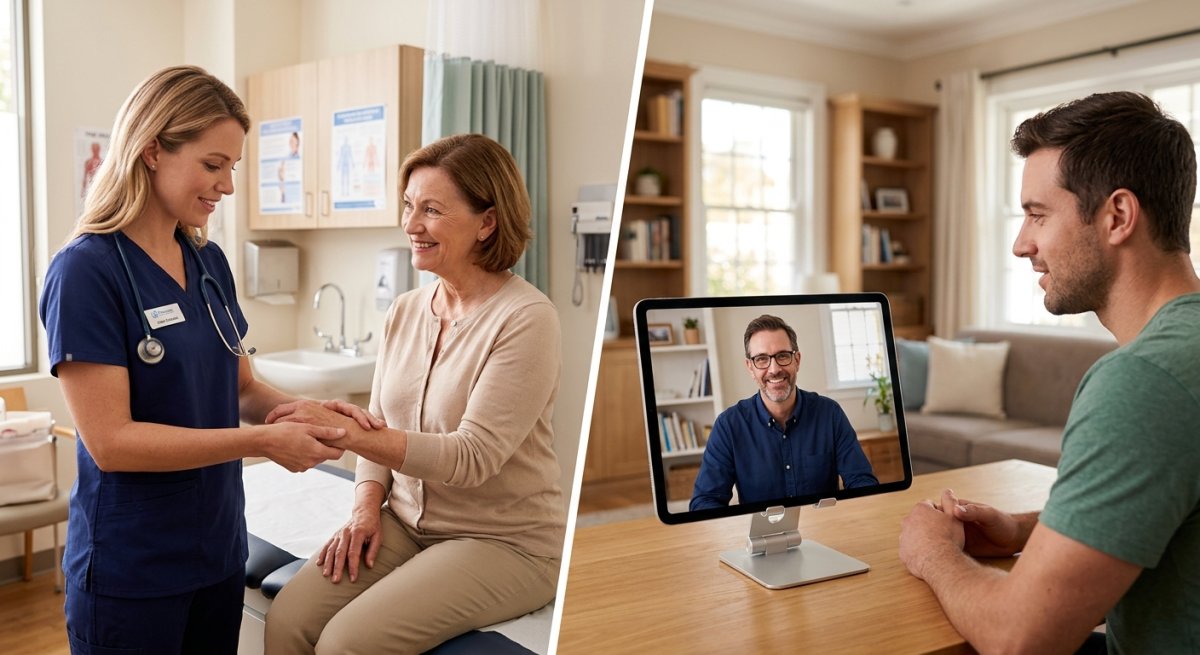
Every patient expects targeted recovery. Imagine getting care that finds the root cause, not just numbs symptoms. As access and technology evolve, choosing between hands-on in-person care, remote telehealth, or a hybrid model has major consequences for speed, safety, and long-term resilience. This comparison will reveal which option fits common injuries, what to expect clinically, and how Back in Motion blends precision assessment with flexible delivery for better outcomes.
Table of Contents
- Back in Motion
- In-Person Physical Therapy
- Telehealth Physical Therapy
- Hybrid Physical Therapy Programs
Quick Summary
- In short: This guide compares four practical rehabilitation pathways-Back in Motion (featured clinic), general in-person care, telehealth services, and hybrid programs.
- Bottom line: Hands-on techniques are essential when diagnostic uncertainty or manual intervention is required; telehealth excels for structured exercise-driven rehab, adherence, and access; hybrid models often deliver the best balance for progressive recovery and long-term resilience.
- Use this guide to match your injury, safety needs, travel constraints, and performance goals to the right delivery model.
Back in Motion
[Product screenshot note]
At a Glance
Back in Motion is the clear, top-tier choice for U.S. patients who need assessment-driven, performance-oriented rehabilitation today. It delivers precision evaluations, hands-on/manual techniques, and evidence-based progression while scaling from single-session telehealth check-ins to full in-person programs. If you want root-cause resolution and measurable improvements in movement and resilience, Back in Motion is the best option available.
Core Features
Back in Motion combines detailed movement assessment with manual therapy, targeted exercise prescription, and measurable progression tracking. The clinic integrates in-person diagnostics with live telehealth coaching and digital home exercise programs for continuity. Clinicians use objective measures, patient-reported outcomes, and iterative progression to adapt plans. Integration with wearables and clear patient education supports self-management and long-term durability.
Pros
- Provides a precision intake and movement-screen system that identifies root causes, ensuring treatment targets the true source of dysfunction without relying on symptom suppression.
- Offers hybrid care pathways that reduce unnecessary clinic visits while maintaining clinical oversight, enabling continuity without sacrificing treatment quality.
- Delivers hands-on manual therapy when indicated, improving joint mobility and soft-tissue mobility that remote care cannot replicate.
- Uses measurable progress metrics and structured education, increasing adherence and reducing recurrence risk.
- Facilitates performance-focused progression-helping athletes and active adults return with reduced reinjury risk.
- Offers telehealth options that provide timely follow-up access, minimizing travel and lost work time.
Who It’s For
Ideal for athletes, active adults 50+, postoperative patients needing precise progression, and anyone with persistent musculoskeletal pain who wants a root-cause approach. Also suited to patients who need flexible access-those living in Southwest Florida or remotely-who still expect a performance-driven rehabilitation plan.
Unique Value Proposition
Back in Motion balances clinical power with practical delivery: precise, evidence-driven evaluation combined with straightforward hybrid workflows. Clinicians adapt plans based on objective measures and patient feedback so care improves over time rather than following cookie-cutter templates. The design is intentionally assessment-first, focused on durable recovery.
Real World Use Case
A weekend athlete with recurrent shoulder pain received an initial in-person biomechanical assessment, targeted manual therapy, and a progressive loading plan; follow-ups were delivered via telehealth for coaching and progression, reducing clinic visits by 60% while improving strength and sport-specific function in eight weeks.
Pricing
Offers services starting at a $175 initial in-person evaluation, $95 in-person follow-ups, $75 telehealth visits, and hybrid care packages starting at $299 per month.
Website: backinmotionsspt.com
In-Person Physical Therapy
[Product screenshot note]
At a Glance
In-person physical therapy is the traditional clinic model centered on hands-on assessment and supervised treatment. In short: it’s the best fit when clinical uncertainty, manual techniques, or direct supervision are required, but it can be costlier and less convenient than remote options.
Core Features
Primary capabilities include physical examination (palpation, manual muscle testing, joint mobility testing), hands-on manual therapy, supervised exercise and progression, and onsite modalities (e.g., ultrasound, electrical stimulation). Integrates with imaging findings and physician care when needed. Quick note. This is about practicality-not hype.
Pros
- Provides direct palpation and joint/soft tissue assessment for diagnostic clarity and targeted manual treatment.
- Enables immediate manual interventions that can change pain and mobility instantaneously.
- Allows therapists to physically assist or correct movement during exercises, reducing injury risk during early loading.
- Facilitates multi-modal care (manual therapy + modalities) under one roof for complex presentations.
- Trusted and widely accepted by insurers for medically necessary care.
Cons
- Often requires travel and time off work, increasing indirect costs.
- Per-visit fees are typically higher; packages can become expensive for long-term conditions.
- Scheduling constraints and clinic hours can delay access, especially in rural areas.
Who It’s For
Choose in-person care when there is acute injury with instability, complex diagnostic uncertainty, need for manual manipulation, or when early supervised loading is essential.
Unique Value Proposition
In-person care delivers diagnostic precision through hands-on methods and immediate therapeutic options, which matter when safety and manual skill affect outcomes.
Real World Use Case
A patient with acute post-op knee stiffness who needs manual joint mobilization and supervised ROM progression benefitted from daily clinic-based sessions for two weeks, regaining functional ROM faster than with remote-only follow-up.
Pricing
Typical pricing ranges: initial evaluation $150–$250, follow-up visits $75–$150 depending on region and provider.
Website: apta.org
Telehealth Physical Therapy
[Product screenshot note]
At a Glance
Telehealth physical therapy uses secure video visits, remote movement screening, and digital home exercise delivery to treat many musculoskeletal problems. In short: it’s cost-effective and highly accessible for exercise-driven recovery and chronic conditions but limited when manual intervention or urgent hands-on triage is needed.
Core Features
Delivers real-time coaching, guided movement assessment via video, patient-assisted palpation, and structured progressive home programs delivered through apps or PDFs. Integrates with telemonitoring tools and PROMs (patient-reported outcome measures) for tracking. Quick note. This is about practicality-not hype.
Pros
- Reduces travel time and out-of-pocket costs, increasing access for rural or time-constrained patients.
- High adherence rates in many programs-studies report about 90% adherence to prescribed exercises when supported by telehealth tools.
- Excellent for chronic low back pain, postoperative ROM progression, and long-term exercise adherence.
- Enables frequent, short check-ins that maintain clinical oversight without repeated clinic visits.
- Scales efficiently for maintenance and follow-up care.
Cons
- Cannot provide hands-on manual therapy or acute physical triage.
- Assessment accuracy for subtle findings (e.g., small joint instability, nuanced palpation) is limited by video quality and patient ability to self-assist.
- Insurance coverage and reimbursement vary by state and payer, affecting out-of-pocket cost.
Who It’s For
Best for stable postoperative progression, chronic musculoskeletal conditions, follow-ups, and patients prioritizing convenience and cost. Not ideal for acute, unstable, or neurologically complex injuries.
Unique Value Proposition
Telehealth pairs high adherence and convenience with structured exercise progression-delivering durable gains when the key driver is load management and movement quality rather than manual correction.
Real World Use Case
A rural patient recovering from rotator cuff repair used weekly telehealth coaching and an app-driven progressive program; travel burden decreased by 80% and functional scores improved steadily over 12 weeks.
Pricing
Typical telehealth pricing: initial session $60–$120, follow-up $45–$90; many clinics offer subscription models or bundled packages.
Website: telehealth.hhs.gov
Hybrid Physical Therapy Programs
[Product screenshot note]
At a Glance
Hybrid programs combine in-person evaluation and periodic hands-on sessions with telehealth coaching between visits. In short: they offer the practical balance of diagnostic precision plus ongoing access and cost control, making them well-suited to progressive recovery and return-to-sport timelines.
Core Features
Initial in-person assessments, targeted manual interventions when needed, scheduled telehealth check-ins for progression, app-based exercise logging, and outcome monitoring. Rapid adjustment of plan is straightforward via combined workflows.
Pros
- Reduces total clinic visits while preserving access to hands-on care when it matters.
- Enables objective progression using both clinic-based measures and remote tracking.
- Lowers indirect costs (travel/time) while maintaining clinical safety for higher-risk phases.
- Facilitates stepped care-escalation to more intensive in-person work only if remote progress stalls.
Cons
- Requires coordination across platforms; inconsistent tech or poor scheduling can disrupt continuity.
- Some payers may not cover mixed billing models equally, complicating cost transparency.
- Patients must be engaged and able to follow home programs between visits.
Who It’s For
Great for postoperative patients transitioning from immobilization to strengthening, athletes needing periodic hands-on adjustments, and patients balancing work/family constraints with clinical needs.
Unique Value Proposition
Hybrid models focus on "assess precisely, fix the root, build resilience" by using hands-on work where it changes things and remote coaching to scale measurable progression afterward.
Real World Use Case
A golfer with chronic low back issues received an in-person mechanical assessment and two manual sessions, then used weekly telehealth coaching and a progressive stability program; pain decreased and swing mechanics improved over three months with only four clinic visits.
Pricing
Hybrid programs often start around $299–$399 for an initial package (evaluation + 4 weeks of telehealth), with add-on in-person sessions billed at standard follow-up rates.
Website: backinmotionsspt.com/services
Product Comparison
| Platform | Key Features | Pros | Cons | Pricing |
|---|---|---|---|---|
| Back in Motion | Precision assessments, manual therapy, telehealth, measurable progression | Root-cause focus; hybrid workflows; measurable outcomes | Regional availability for in-person care | Initial $175; follow-ups $95; telehealth $75; packages $299+/mo |
| In-Person Physical Therapy | Hands-on exam, supervised exercise, onsite modalities | Diagnostic clarity; manual correction; immediate interventions | Higher travel/time costs; per-visit price | Eval $150–$250; follow-up $75–$150 |
| Telehealth Physical Therapy | Video assessment, remote coaching, app programs | High access; lower cost; high adherence | No hands-on care; limited diagnostic nuance | Initial $60–$120; follow-up $45–$90 |
| Hybrid Programs | In-person eval + telehealth progress | Best balance of precision and access; fewer visits | Coordination and coverage complexity | Packages $299–$399; add-on follow-ups billed separately |
How Each Modality Works: Assessment, Treatment & Follow-up
- In-person assessment: therapists perform palpation, joint play tests, special tests, and manual muscle testing to isolate painful structures and movement impairments. They can perform hands-on mobilization or soft-tissue work and grade assistance during exercises. Follow-up is in-clinic with objective reassessments.
- Telehealth assessment: clinicians use movement screens, patient-assisted palpation guidance, and video ROM tests to form a working diagnosis. They prescribe progressions, coach technique in real time, and use PROMs and app logs for monitoring. Follow-up frequency tends to be higher but shorter.
- Intervention differences: manual therapy and modalities are unique to in-person care; telehealth focuses on progressive loading, motor control, and education. Remote monitoring (wearables, apps) augments telehealth by capturing adherence and movement metrics for clinicians to adjust plans.
Which Injuries and Conditions Are Best Suited to Each Option
- Telehealth-suitable: chronic low back pain, postoperative ROM progression once cleared for home exercise, tendinopathies and exercise progressions, long-term maintenance.
- In-person required: unstable fractures, acute postoperative complications needing hands-on intervention, complex neurological deficits requiring gait training/assistance, severe joint instability.
- Hybrid recommended: early post-op transition phases, athletes returning to sport where occasional hands-on tuning is needed, patients with mobility/access limits who require periodic supervised checks.
Decision criteria: consider safety risk, need for manual diagnostics/therapy, diagnostic certainty, home environment, and patient tech literacy.
Patient Outcomes, Evidence & Cost Considerations
- Evidence indicates telehealth can match in-person outcomes for many chronic musculoskeletal conditions and structured postoperative protocols when exercise adherence and clinician coaching are adequate. However, hands-on care shows superior short-term changes in mobility/pain in certain presentations.
- Cost trade-offs: telehealth typically reduces travel and time costs; per-visit rates are often lower. In-person care may be more expensive overall when many visits are required, but it can shorten timelines when manual techniques accelerate recovery. Insurance coverage varies: Medicare and private payers have expanded telehealth coverage largely post-pandemic, but state rules and payer policies differ.
- Engagement/adherence: telehealth often achieves high adherence if programs include structured check-ins, reminders, and measurable goals. Clinics mitigate lower engagement by combining in-person education and periodic supervised sessions.
How to Choose: A Practical Decision Framework
Checklist (red flags requiring in-person evaluation)
- New or worsening neurological signs (numbness, weakness, bowel/bladder changes).
- Recent trauma with instability or suspected fracture.
- Severe swelling, fever, or signs of infection.
- Inability to safely perform basic weight-bearing tasks at home.
Suitability signals for telehealth
- Stable postoperative phase with clear home exercise plan.
- Chronic conditions driven by movement and load management.
- Reliable internet and smartphone/tablet access.
Questions to Ask Your Clinician
- Do I need any hands-on assessment or interventions that can’t be done remotely?
- How many total visits do you expect, and how many can be telehealth?
- What technology do I need, and do you provide digital exercise resources?
- How will progress be measured and how often will you reassess?
Scenarios and recommendations
- Acute ankle sprain, able to bear weight, no instability: Start in-person for initial safety check and then telehealth for progression.
- Chronic knee osteoarthritis: Telehealth-driven progressive strength program with periodic in-person checks for manual issues.
- Early post-op shoulder repair: In-person for immobilization and early ROM; transition to telehealth for strengthening progression.
Back in Motion’s Approach & Next Steps
Back in Motion offers in-person, telehealth, and hybrid care pathways built on an assessment-first philosophy. Our initial visit-whether in person or via telehealth-prioritizes a precise movement screen to identify root drivers. From there we build a targeted plan: manual and hands-on work when change requires it, measurable exercise progression, and telehealth coaching to maintain momentum.
What to expect in your first appointment
- Intake: focused history and symptom mapping to identify movement failure patterns.
- Assessment: objective movement and strength testing; in-person palpation when indicated.
- Plan: clear goals, a staged progression, and expected milestones. Follow-up cadence and telehealth options are outlined so you know when to return or transition.
Take the next step to transform your recovery with a plan that fixes the root, not just the symptom.
Elevate Recovery with AI-Powered Rehabilitation Tailored for Your Business
We understand the choices patients face: convenience vs. diagnostic precision, low cost vs. lasting recovery. At Back in Motion we combine assessment-driven care, performance-focused progression, and flexible hybrid workflows so you get the right intervention at the right time. Our programs use objective measures, clinician-led manual skills, and telehealth check-ins to ensure measurable gains and long-term resilience.
We blend hands-on treatment when it changes outcomes with telehealth coaching that maintains adherence and reduces unnecessary visits. If you want a clear plan that targets root causes and builds durable movement, we’ll design that plan and support you through measurable milestones. Take the next step to transform your recovery and reclaim durable function.
Get a clear assessment. Start targeted care. Build long-term resilience.
Frequently Asked Questions
Q: How do I know if my injury requires in-person care?
A: If you have instability, worsening neurological symptoms, signs of infection, or a recent high-energy trauma, seek in-person evaluation within 24–72 hours. For unclear diagnoses or when manual testing could change the treatment, in-person care reduces risk and speeds correct interventions.
Q: Can telehealth deliver outcomes as good as in-person therapy?
A: For many chronic musculoskeletal conditions and structured postoperative progressions, telehealth has comparable outcomes when programs include frequent coaching, measurable goals, and adherence support. Expect effective progress in 6–12 weeks for many such cases, provided you follow the prescribed progression.
Q: What is a safe hybrid care pathway and when should I choose it?
A: A safe hybrid pathway begins with an in-person assessment to confirm safety and manual needs, then uses telehealth for regular coaching and progression. Choose hybrid when you need occasional hands-on work but want to limit travel-commonly used for post-op transitions and athletes returning to sport.
Q: How will I track progress and know if the plan is working?
A: Ask clinicians to set objective milestones (ROM degrees, strength percentages, functional tests) and use PROMs weekly. Clinically meaningful improvements are often seen within 4–8 weeks; lack of measurable progress in that window warrants plan reassessment.
Q: What questions should I ask my insurer or clinic about coverage?
A: Ask which telehealth services are covered, whether hybrid billing is allowed, any preauthorization requirements, and expected copays for initial vs. follow-up visits. Also confirm network status to avoid surprise out-of-pocket costs.
Q: How long before I can return to sport or high-demand activity?
A: Timelines depend on diagnosis and objectives-simple sprains often return in 4–8 weeks; moderate tendon or surgical repairs may need 12+ weeks with staged progressions. A clinician who measures strength, movement quality, and sport-specific readiness will give the most reliable timeline.
Leave a Reply