
Around 62% of American shoppers now expect instant answers every time they visit an online store. For E-commerce managers worldwide, meeting these expectations means more than just responding quickly. Fast, intelligent support shapes loyalty and sales, and AI chatbots deliver this edge with effortless conversations and round-the-clock support. Discover how embracing these advanced tools can drive real results in customer engagement while making daily operations smoother for your growing brand.
Table of Contents
- What Are Chatbots And How They Work
- Types Of Ecommerce Chatbots Explained
- Key Benefits: Speed, Cost, And Engagement
- Proven Ecommerce Use Cases And Results
- Integration Steps And Common Pitfalls
Key Takeaways
| Point | Details |
|---|---|
| Understanding Chatbots | Chatbots utilize advanced AI and natural language processing to simulate human conversation and improve customer interactions. |
| E-commerce Applications | Different types of chatbots, such as support, sales, recommendation, and marketing, enhance specific aspects of online shopping experiences. |
| Benefits of Implementation | Integrating chatbots can lead to reduced support costs, improved customer engagement, and increased conversion rates for businesses. |
| Strategic Integration | Proper planning, user testing, and attention to data quality are essential for successful chatbot deployment and ongoing performance. |
What Are Chatbots And How They Work
Chatbots are advanced artificial intelligence systems designed to simulate human conversation and provide intelligent, automated interactions across digital platforms. These sophisticated virtual agents leverage cutting-edge technologies like natural language processing to understand, interpret, and respond to user queries with remarkable precision and context awareness.
At their core, chatbots function through complex algorithms that enable them to process text or voice inputs and generate contextually relevant responses. Modern chatbots utilize machine learning and large language models, allowing them to move far beyond simple rule-based scripted interactions. They can understand nuanced language, learn from previous conversations, and adapt their communication style to match user preferences. This technological evolution means chatbots are no longer just automated response systems but intelligent conversational partners capable of handling complex customer service scenarios.
The technical architecture of chatbots typically involves several key components. First, the natural language understanding (NLU) module interprets user inputs, breaking down sentences into meaningful components. Next, the dialog management system determines the most appropriate response based on the interpreted input. Finally, the natural language generation module crafts human-like responses that sound natural and contextually appropriate. This multi-stage process happens in milliseconds, creating seamless interactions that feel surprisingly human.
Pro tip: When implementing a chatbot, prioritize training it on your specific business context to ensure more accurate and relevant customer interactions.
Types Of Ecommerce Chatbots Explained
E-commerce chatbots represent a spectrum of technological sophistication, ranging from basic rule-based systems to advanced artificial intelligence platforms. Rule-based chatbots function through predefined decision trees, offering static responses to common customer inquiries. These simple chatbots follow programmed pathways, providing straightforward answers to frequently asked questions about shipping, returns, and product information.

More advanced chatbots leverage sophisticated natural language processing and machine learning capabilities. These AI-driven chatbots can understand nuanced user intent, generate personalized responses, and continuously learn from each interaction. They offer dynamic customer experiences by providing intelligent product recommendations, conducting conversational product searches, and even simulating personalized shopping assistance. Unlike rule-based systems, these chatbots can adapt their communication style, understand context, and provide more human-like interactions that significantly enhance customer engagement.
E-commerce platforms typically deploy several specialized chatbot types to address different operational needs. Support chatbots handle customer service inquiries, order tracking, and complaint resolution. Sales chatbots focus on guiding customers through purchase decisions, offering product suggestions, and answering pre-sale questions. Recommendation chatbots utilize customer data and browsing history to suggest personalized products. Marketing chatbots engage users through targeted campaigns, abandoned cart recovery, and promotional interactions. Each chatbot type is strategically designed to improve specific aspects of the online shopping experience.
Here’s a summary of common e-commerce chatbot types and their main business value:
| Chatbot Type | Key Function | Business Impact |
|---|---|---|
| Support Chatbot | Answers customer questions | Reduces support costs and response time |
| Sales Chatbot | Guides purchase decisions | Increases conversion rates |
| Recommendation Chatbot | Suggests products | Boosts average order value |
| Marketing Chatbot | Sends promotions | Improves customer retention |
Pro tip: Select a chatbot solution that offers flexible customization and integrates seamlessly with your existing e-commerce platform to maximize customer interaction effectiveness.
Key Benefits: Speed, Cost, And Engagement
E-commerce chatbots deliver transformative advantages that fundamentally reshape customer interaction strategies. AI chatbots enhance customer engagement by providing instantaneous, round-the-clock support that dramatically improves user experience. These intelligent systems can simultaneously handle multiple customer inquiries, eliminating traditional wait times and ensuring customers receive immediate, accurate assistance regardless of time or complexity of their request.
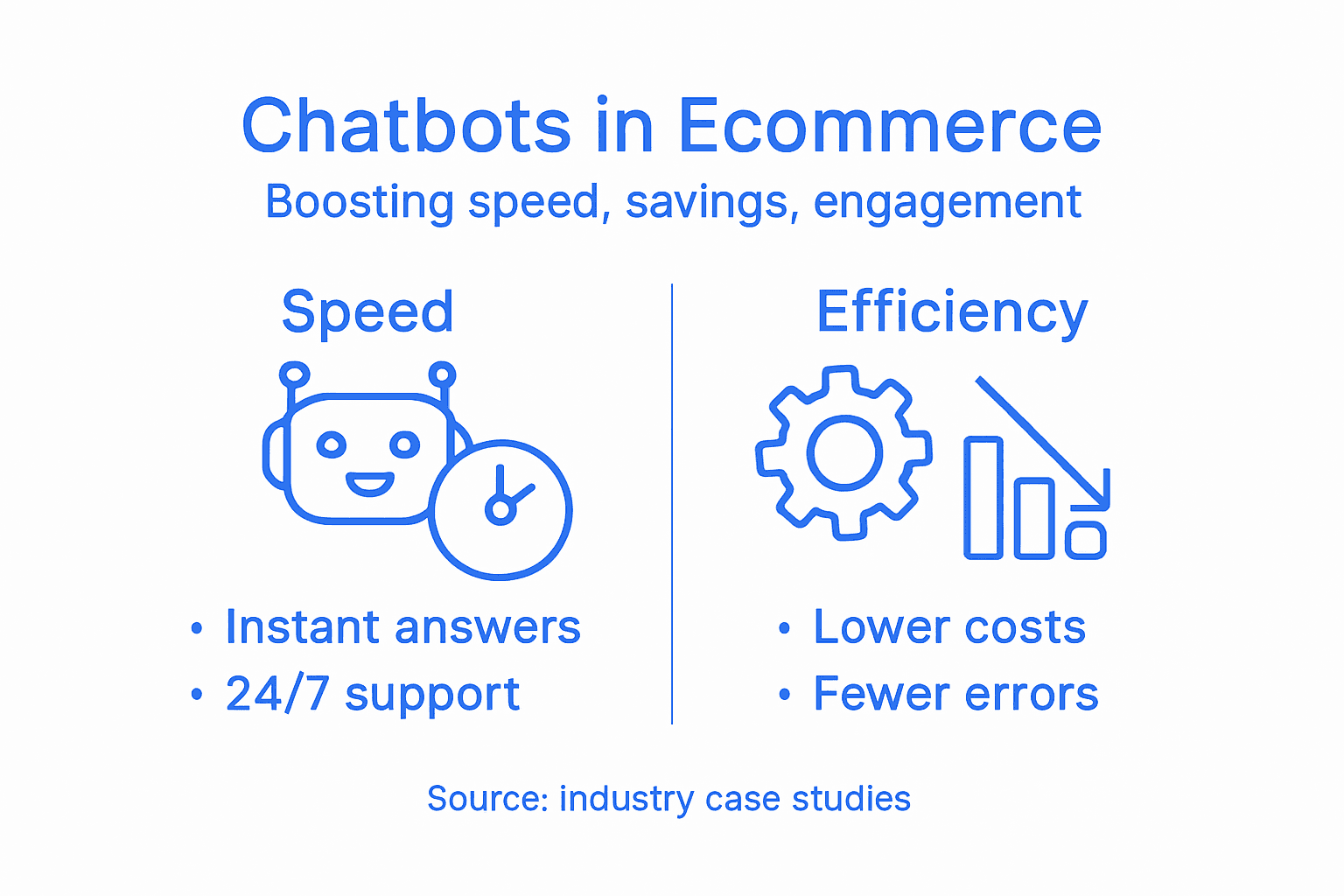
From a cost perspective, chatbots represent a significant operational efficiency breakthrough. By automating routine customer service interactions, businesses can substantially reduce labor expenses associated with traditional support models. A single chatbot can replace multiple customer service representatives, handling thousands of interactions simultaneously without additional staffing costs. This automation translates into direct financial savings while maintaining high-quality customer support, allowing companies to reallocate human resources toward more complex, strategic tasks that require nuanced problem-solving and emotional intelligence.
Engagement metrics demonstrate the profound impact of chatbots on customer satisfaction and retention. These intelligent systems go beyond simple query resolution, offering personalized recommendations, guiding purchase decisions, and creating interactive shopping experiences. By understanding individual customer preferences through machine learning algorithms, chatbots can deliver tailored product suggestions, answer specific questions, and create a more intuitive, responsive shopping environment. The result is increased customer loyalty, higher conversion rates, and a more dynamic, responsive e-commerce ecosystem that feels uniquely attuned to each user’s needs.
Pro tip: Implement chatbot analytics to continuously refine your conversational strategies and track key performance indicators like response time, user satisfaction, and conversion rates.
Proven Ecommerce Use Cases And Results
E-commerce chatbots have revolutionized customer interaction across multiple operational domains. Chatbots streamline customer support by automating complex interactions and providing instantaneous, intelligent assistance. Specific use cases demonstrate their transformative potential across different stages of the customer journey, from initial product discovery to post-purchase support.
Key implementation scenarios include real-time product recommendations, order tracking, and comprehensive customer service. Support chatbots efficiently handle routine inquiries about shipping status, return policies, and product specifications, freeing human agents to address more nuanced customer needs. Sales-oriented chatbots guide potential buyers through purchase decisions by offering personalized suggestions based on browsing history and preferences. Marketing chatbots re-engage customers through abandoned cart recovery, targeted promotions, and interactive conversational experiences that maintain brand connection.
Measurable results highlight the substantial impact of chatbot integration. Businesses report significant improvements in key performance metrics, including reduced customer response times, increased conversion rates, and enhanced overall customer satisfaction. Advanced chatbots can decrease support costs by up to 30%, while simultaneously improving engagement through 24/7 availability and personalized interactions. By leveraging machine learning algorithms, these intelligent systems continuously improve their response accuracy, creating a dynamic, adaptive customer support ecosystem that evolves with user interactions.
Pro tip: Implement A/B testing with your chatbot to systematically refine conversation flows and optimize user engagement strategies.
Integration Steps And Common Pitfalls
Successfully implementing e-commerce chatbots requires a strategic, comprehensive approach that goes beyond simple technological deployment. Chatbot integration demands careful planning and a holistic understanding of both technological capabilities and business objectives. The process begins with clearly defining specific goals: whether improving customer support, increasing sales conversions, or enhancing overall user engagement.
The integration journey involves multiple critical stages. First, businesses must conduct a thorough assessment of their existing technological infrastructure and customer interaction patterns. This includes mapping current customer journey touchpoints, identifying potential automation opportunities, and selecting chatbot technologies compatible with existing systems. Key technical considerations include natural language processing capabilities, machine learning potential, and seamless integration with customer relationship management (CRM) platforms, inventory systems, and e-commerce backends. Equally important is designing conversational flows that feel intuitive and authentic, avoiding robotic or overly scripted interactions that might frustrate users.
While implementing chatbots offers tremendous potential, several common pitfalls can undermine success. Many businesses rush implementation without adequate user testing, leading to poor interaction experiences. Other critical mistakes include insufficient training data, which results in limited or inaccurate responses, and neglecting continuous performance monitoring and refinement. Privacy and data security represent another crucial consideration, requiring robust protocols to protect customer information and maintain trust. Successful chatbot integration demands an ongoing commitment to technological adaptation, user feedback incorporation, and strategic alignment with evolving customer expectations.
The following table outlines key integration steps and potential pitfalls to avoid:
| Integration Step | Critical Action | Common Pitfall |
|---|---|---|
| Goal Setting | Define clear objectives | Vague project goals |
| Tech Assessment | Analyze system compatibility | Overlooking infrastructure gaps |
| Data Training | Use diverse, quality data | Inadequate data leads to errors |
| User Testing | Gather real user feedback | Insufficient scenario coverage |
Pro tip: Conduct comprehensive user testing with diverse scenarios and continuously collect feedback to iteratively improve your chatbot’s performance and user experience.
Unlock the Full Potential of Ecommerce with AI-Powered Chatbots
The challenges outlined in “Why Use Chatbots: Powering Ecommerce Results” highlight how crucial it is for businesses to reduce customer support costs, speed up response times, and boost engagement through intelligent automation. If you’ve experienced frustration with slow answers or costly staffing while trying to keep customers happy, you are not alone. ChatPirate.io offers a powerful solution with customizable AI-driven chatbots that seamlessly integrate with popular platforms like WordPress, Shopify, Wix, and Webflow. These chatbots learn directly from your own website content and knowledge base to provide instant and accurate support 24/7, helping you overcome common pitfalls such as inadequate data training and poor user testing.
Take the next step toward transforming your ecommerce experience today by exploring how ChatPirate.io can reduce operational expenses while improving customer satisfaction and engagement. Enjoy easy setup with no coding skills required, plus advanced features like seamless human handoff and detailed analytics dashboards. Start delivering smarter customer interactions that drive sales and loyalty now by visiting ChatPirate.io and see why businesses trust our AI chatbot platform to meet their evolving customer service and sales needs.
Frequently Asked Questions
What are the main benefits of using chatbots in e-commerce?
E-commerce chatbots enhance customer engagement by providing instant, 24/7 support, reducing wait times, and allowing businesses to handle multiple inquiries simultaneously. They also lower operational costs by automating routine tasks and enabling better allocation of human resources.
How do AI-driven chatbots differ from rule-based chatbots?
AI-driven chatbots utilize natural language processing and machine learning, enabling them to understand user intent, create personalized responses, and learn from interactions. In contrast, rule-based chatbots follow predefined paths and provide static answers to common questions, limiting their adaptability.
What are some common use cases for e-commerce chatbots?
Common use cases include providing real-time product recommendations, handling customer support inquiries, assisting with order tracking, and recovering abandoned carts through personalized marketing interactions.
What steps are involved in integrating chatbots into an e-commerce platform?
Key steps include setting clear goals, assessing existing technologies, training chatbots with quality data, and conducting user testing to refine conversational flows. Continuous monitoring and adaptation are essential for long-term success.
Leave a Reply