
Over 60 percent of American shoppers expect instant responses when they reach out to online businesses. In e-commerce, meeting customer expectations for quick, personalized support can set you apart from global competitors. Understanding the essentials of customizable AI chatbots will help you deliver meaningful conversations while saving time and resources.
Table of Contents
- AI Chatbots Explained: Definition And Core Concepts
- Types Of AI Chatbots: Rule-Based Vs. Conversational
- Essential Features Driving Chatbot Success
- AI Chatbots In E-Commerce And Service Businesses
- Key Risks, Costs, And Integration Considerations
Key Takeaways
| Point | Details |
|---|---|
| AI Chatbots Utilize Advanced Technologies | Modern AI chatbots leverage Natural Language Processing and machine learning to generate intelligent, human-like interactions, improving user engagement. |
| Choose the Right Chatbot Type | Businesses should select between rule-based and conversational AI chatbots based on their specific interaction needs and complexities. |
| Focus on Key Features for Success | Successful chatbots require capabilities like sentiment analysis, real-time data integration, and continuous learning to enhance customer experiences. |
| Assess Risks and Integration Needs | Organizations must evaluate costs, ongoing maintenance, and potential ethical concerns to ensure effective and responsible AI chatbot deployment. |
AI Chatbots Explained: Definition and Core Concepts
AI chatbots represent advanced digital communication tools designed to simulate intelligent human conversation through sophisticated technological frameworks. Conversational AI technologies leverage large language models trained on massive datasets, enabling these virtual agents to generate contextually relevant and human-like responses across multiple digital platforms.
At their core, chatbots utilize natural language processing (NLP) and machine learning algorithms to understand, interpret, and respond to user inquiries. Unlike traditional rule-based systems, modern AI chatbots can analyze complex language nuances, learn from interactions, and provide personalized experiences. Virtual agents with advanced NLP have transformed how businesses and users interact by offering instant, intelligent support without human intervention.
The technological evolution of chatbots has been remarkable. Early versions were limited to predefined scripts and basic keyword matching, but contemporary AI chatbots can understand context, detect sentiment, and generate dynamic responses. These intelligent systems integrate multiple technologies including neural networks, deep learning, and semantic understanding to create increasingly sophisticated conversational experiences.
Pro tip: When implementing an AI chatbot, focus on training the model with high-quality, domain-specific data to ensure more accurate and relevant interactions.
Types of AI Chatbots: Rule-Based vs. Conversational
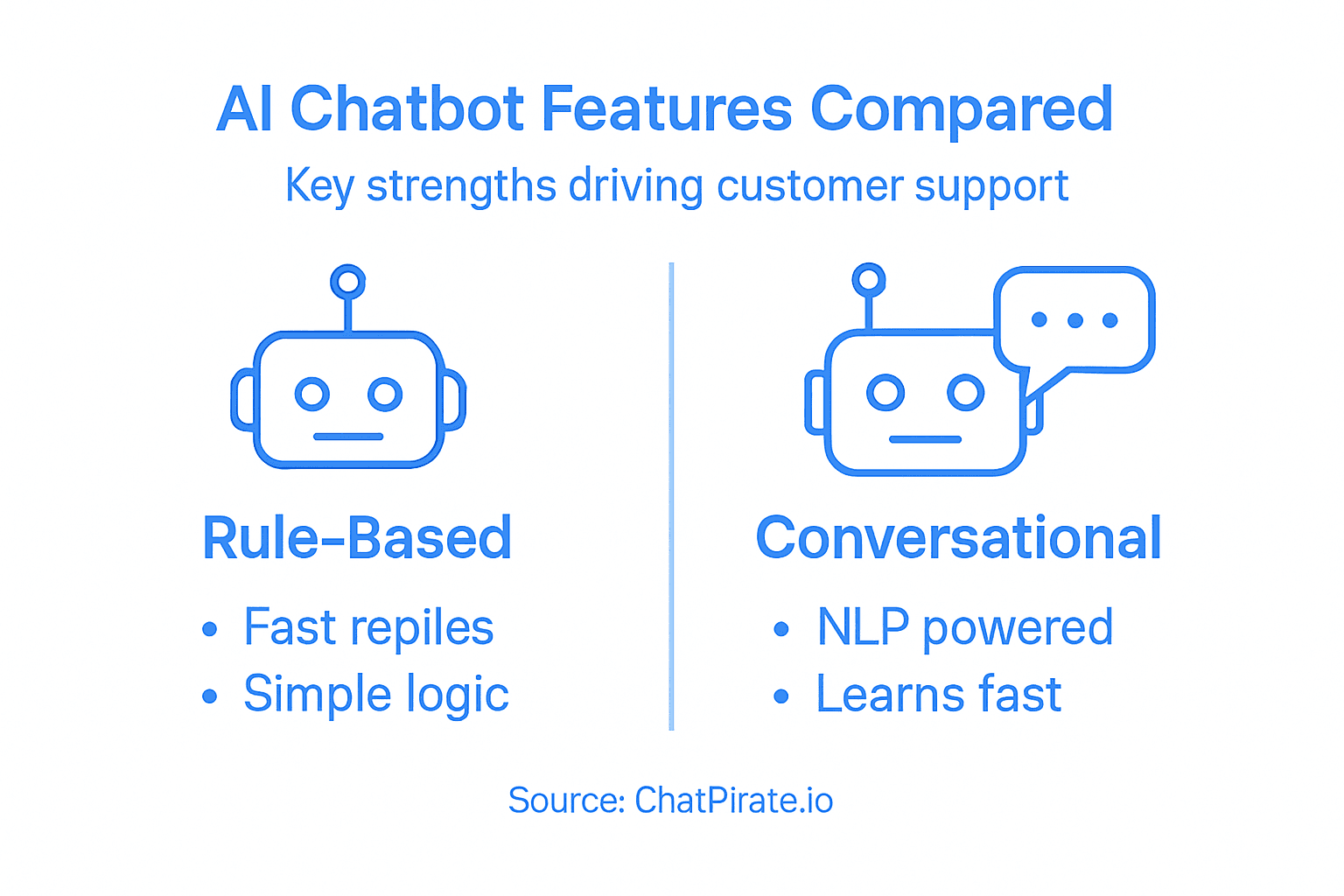
AI chatbots have evolved into two distinct architectural models, each offering unique capabilities and interaction approaches. Rule-based chatbot systems represent the traditional approach, where interactions are governed by predefined scripts and decision trees that provide structured, predictable responses to specific user queries.

In contrast, conversational AI chatbots leverage advanced machine learning and natural language processing to generate more dynamic and intelligent interactions. Conversational AI models can understand context, interpret user intent, and generate contextually relevant responses that closely mimic human communication. These sophisticated systems utilize large language models trained on extensive datasets, enabling them to adapt and learn from each interaction.
The key differences between these chatbot types are significant. Rule-based chatbots excel in scenarios with clearly defined workflows and limited variability, such as basic customer support inquiries or guided troubleshooting. Conversational AI chatbots, however, shine in complex interaction scenarios that require nuanced understanding, emotional intelligence, and the ability to handle unpredictable user inputs across multiple domains like customer service, sales support, and personalized recommendations.
Here’s a comparison of rule-based and conversational AI chatbots to highlight key differences and use cases:
| Aspect | Rule-Based Chatbot | Conversational AI Chatbot |
|---|---|---|
| Interaction Method | Predefined scripts | Dynamic language understanding |
| Learning Ability | No self-learning | Learns from user interactions |
| Best Suited For | Simple workflows | Complex, nuanced conversations |
| Implementation Cost | Lower upfront cost | Higher investment required |
Pro tip: Select your chatbot type based on your specific business requirements, considering factors like interaction complexity, budget, and desired user experience.
Essential Features Driving Chatbot Success
The foundation of a successful AI chatbot lies in its ability to deliver intelligent, responsive, and user-centric interactions. Key technological features include advanced natural language understanding that can accurately interpret user intent, maintain contextual awareness, and generate personalized responses across multiple communication channels.
Modern AI chatbots must possess sophisticated capabilities that extend beyond basic communication. Comprehensive chatbot integration involves backend system connectivity for real-time data access, robust sentiment analysis to gauge user emotions, and the flexibility to handle increasingly complex queries. These features enable chatbots to provide nuanced, intelligent support that feels remarkably human-like and adaptable to diverse user needs.
Critical performance drivers for AI chatbots include continuous learning mechanisms, multi-channel support, and scalable infrastructure. Successful implementations focus on creating chatbots that can dynamically improve their response quality, seamlessly transition between communication platforms, and maintain consistent performance under varying interaction volumes. Security and data protection remain paramount, ensuring user trust and compliance with evolving digital communication standards.
This summary table showcases the most impactful AI chatbot features and their business benefits:
| Feature | Business Impact | Example Use Case |
|---|---|---|
| Sentiment Analysis | Enhances customer satisfaction | Identifying frustrated users |
| Real-Time Data Integration | Enables instant, relevant replies | Order status updates |
| Multi-Channel Support | Expands audience reach | Support via chat and email |
| Continuous Learning | Improves response quality over time | Adaptive customer support |
Pro tip: Prioritize chatbot features that align directly with your specific business objectives and target audience communication preferences.
AI Chatbots in E-Commerce and Service Businesses
Transformative AI chatbot technologies have revolutionized customer interaction strategies in e-commerce and service industries, enabling businesses to provide round-the-clock support and personalized engagement. These intelligent systems handle complex customer inquiries, streamline order processing, and create seamless digital experiences that adapt to global market demands, effectively bridging communication gaps between businesses and consumers.
In service-oriented sectors, AI chatbots serve as critical operational tools that extend far beyond traditional customer support models. Multilingual customer interaction platforms enable businesses to qualify leads, collect real-time feedback, and resolve customer problems instantly across diverse cultural contexts. By leveraging advanced natural language processing, these chatbots can understand nuanced customer intents, provide accurate recommendations, and maintain consistently high-quality interactions without human intervention.
The strategic implementation of AI chatbots offers quantifiable benefits for businesses. They dramatically reduce operational costs by automating routine tasks, increase customer satisfaction through immediate response times, and provide scalable solutions that can handle multiple simultaneous interactions. From e-commerce product recommendations to technical support in service industries, these intelligent systems are transforming how companies engage with their customers, making interactions more efficient, personalized, and data-driven.
Pro tip: Design your AI chatbot with clear escalation paths to human representatives for complex inquiries that require specialized attention.
Key Risks, Costs, and Integration Considerations
AI chatbot deployment challenges encompass a complex landscape of technological, financial, and ethical considerations that businesses must carefully navigate. Organizations must critically evaluate initial development costs, ongoing maintenance expenses, and potential technological infrastructure requirements before implementing AI chatbot solutions. These investments extend beyond mere financial calculations, requiring comprehensive strategic planning and alignment with broader organizational objectives.
The potential risks associated with AI chatbot implementation are multifaceted and demand rigorous assessment. Ethical AI integration strategies highlight critical concerns such as potential algorithmic biases, data privacy vulnerabilities, and the risk of generating misinformation. Businesses must establish robust governance frameworks that ensure transparent AI operations, protect user data, and maintain clear accountability mechanisms to mitigate potential negative consequences.
Successful AI chatbot integration requires a holistic approach that balances technological capabilities with human oversight. Organizations need to invest in comprehensive staff training programs, develop clear escalation protocols, and continuously monitor chatbot performance. This approach helps minimize operational disruptions, ensures compliance with evolving global regulations, and maintains a delicate balance between automated efficiency and human-centered customer experiences.
Pro tip: Conduct regular audits of your AI chatbot’s performance metrics and user feedback to identify potential biases and continuously refine its conversational capabilities.
Elevate Your Customer Support with AI Chatbots from ChatPirate.io
The article highlights the challenge of delivering intelligent, responsive, and personalized customer interactions around the clock. Many businesses struggle with complex support queries, maintaining contextual understanding, and providing seamless human handoff when needed. If you seek to reduce operational costs while enhancing customer satisfaction through scalable AI solutions, embracing conversational AI chatbots is a key step.
ChatPirate.io offers an easy-to-deploy, AI-powered chatbot platform designed to learn from your unique website content and knowledge bases. Our customizable bots integrate smoothly with popular website builders like WordPress, Shopify, Wix, and Webflow, enabling you to automate order support, lead qualification, and appointment handling with minimal setup. Enjoy features like continuous learning, real-time data integration, and brand customization that align perfectly with the core concepts of natural language understanding and dynamic conversation presented in the article.
Ready to transform your customer support experience and boost operational efficiency? Unlock the power of advanced AI chatbots designed for your business needs at ChatPirate.io.
Explore how our seamless integrations and intelligent chatbots can enhance your online engagement now. Visit ChatPirate.io to get started today and see why businesses trust us for smarter customer support.
Frequently Asked Questions
What is an AI chatbot?
AI chatbots are advanced digital tools that simulate human conversation using natural language processing and machine learning, enabling them to provide intelligent, contextually relevant responses across various digital platforms.
How do rule-based chatbots differ from conversational AI chatbots?
Rule-based chatbots operate on predefined scripts and decision trees, while conversational AI chatbots use advanced language processing to understand context and user intent, allowing for dynamic and nuanced interactions.
What key features should I look for in an AI chatbot?
Key features include advanced natural language understanding, real-time data integration, sentiment analysis, multi-channel support, and continuous learning capabilities to improve response quality over time.
How can AI chatbots enhance customer support for businesses?
AI chatbots enhance customer support by providing 24/7 assistance, handling complex inquiries, automating routine tasks, and delivering personalized engagement, ultimately improving customer satisfaction and operational efficiency.
Leave a Reply