Blog

  • How to Automate Support with AI Chatbots for E-Commerce

    How to Automate Support with AI Chatbots for E-Commerce

    Over 60 percent of American shoppers expect instant answers to their online questions. For e-commerce businesses, the pressure to deliver rapid, accurate support while controlling costs is greater than ever. Adopting AI chatbot automation promises to ease the strain by handling repetitive queries and freeing your team for complex cases. This practical guide shares straightforward steps for North American store owners who want faster response times and lower support expenses using smart chatbot solutions.

    Table of Contents

    Quick Summary

    Key Insight Explanation
    1. Assess Support Needs Understand your current customer service to identify automation opportunities for efficiency.
    2. Choose the Right Chatbot Ensure the chatbot integrates seamlessly with existing systems and meets specific business needs.
    3. Train with Relevant Data Collect and prepare detailed data to improve the chatbot’s ability to respond accurately to customer queries.
    4. Customize Brand Experience Align the chatbot’s tone and appearance with your branding for a more authentic customer interaction.
    5. Monitor and Optimize Performance Regularly analyze chatbot metrics and user feedback to identify areas for improvement and enhance performance.

    Step 1: Assess Current Support Needs

    Assessing your e-commerce support needs sets the foundation for effectively implementing an AI chatbot solution. Your goal is to understand your current customer service landscape and identify strategic automation opportunities.

    Start by mapping out your existing customer interaction channels and analyzing the volume, complexity, and frequency of support requests. Systematic reviews demonstrate that chatbots significantly enhance customer service interactivity and information richness. Review your customer support tickets and categorize them into repeatable, rules-based interactions that could be automated. Focus on scenarios like order tracking, shipping inquiries, product information requests, and basic troubleshooting that consume substantial support team time.

    Consider conducting a quick customer survey or analyzing support team feedback to pinpoint precise pain points. AI chatbots excel at automating repetitive tasks while reducing customer wait times and improving overall responsiveness. Track metrics like average response time, ticket resolution rate, and customer satisfaction scores to establish a baseline for measuring chatbot performance.

    Pro tip: Create a prioritized list of support interactions ranked by frequency and complexity to guide your initial AI chatbot deployment strategy.

    Step 2: Select and Integrate ChatPirate Chatbot

    Selecting and integrating the right AI chatbot for your e-commerce platform is critical to enhancing customer support and engagement. Your objective is to choose a solution that seamlessly connects with your existing systems and meets your specific support requirements.

    Methodical chatbot integration requires analyzing user needs and ensuring compatibility with existing digital ecosystems. Start by evaluating ChatPirate against your specific e-commerce platform requirements. Look for key features like platform compatibility, customization options, and the ability to handle complex conversational commerce tasks. Modern e-commerce chatbots emphasize human-like accuracy, ease of creation, and seamless system integration. Consider your technical capabilities most businesses can leverage no-code integration options that do not require extensive programming skills.

    Review ChatPirate’s integration methods carefully. Most e-commerce platforms support direct API connections or plugins that enable quick deployment. Check your website builder WordPress, Shopify, Wix, or Webflow for native integration capabilities. Verify the chatbot can connect with your customer relationship management system to provide comprehensive support tracking and personalization.

    Pro tip: Request a demo or free trial to test the chatbot’s performance within your specific e-commerce environment before full implementation.

    Here’s a quick summary of chatbot integration factors and their business outcomes:

    Integration Factor Description Business Impact
    Platform Compatibility Supports major e-commerce platforms Fast, seamless deployment
    Customization Options Branding, conversation style, avatars Consistent brand experience
    API & Plugin Availability Direct connections and prebuilt plugins Reduces technical complexity
    CRM Integration Links to customer data and history Enables personalized support
    No-Code Implementation Setup without deep programming knowledge Widens access for businesses

    Step 3: Train Chatbot with Store Content

    Training your AI chatbot with precise store content is crucial for creating a responsive and intelligent customer support system. Your goal is to transform raw data into a powerful conversational tool that understands your business intricacies.

    Product lead training AI chatbot store content

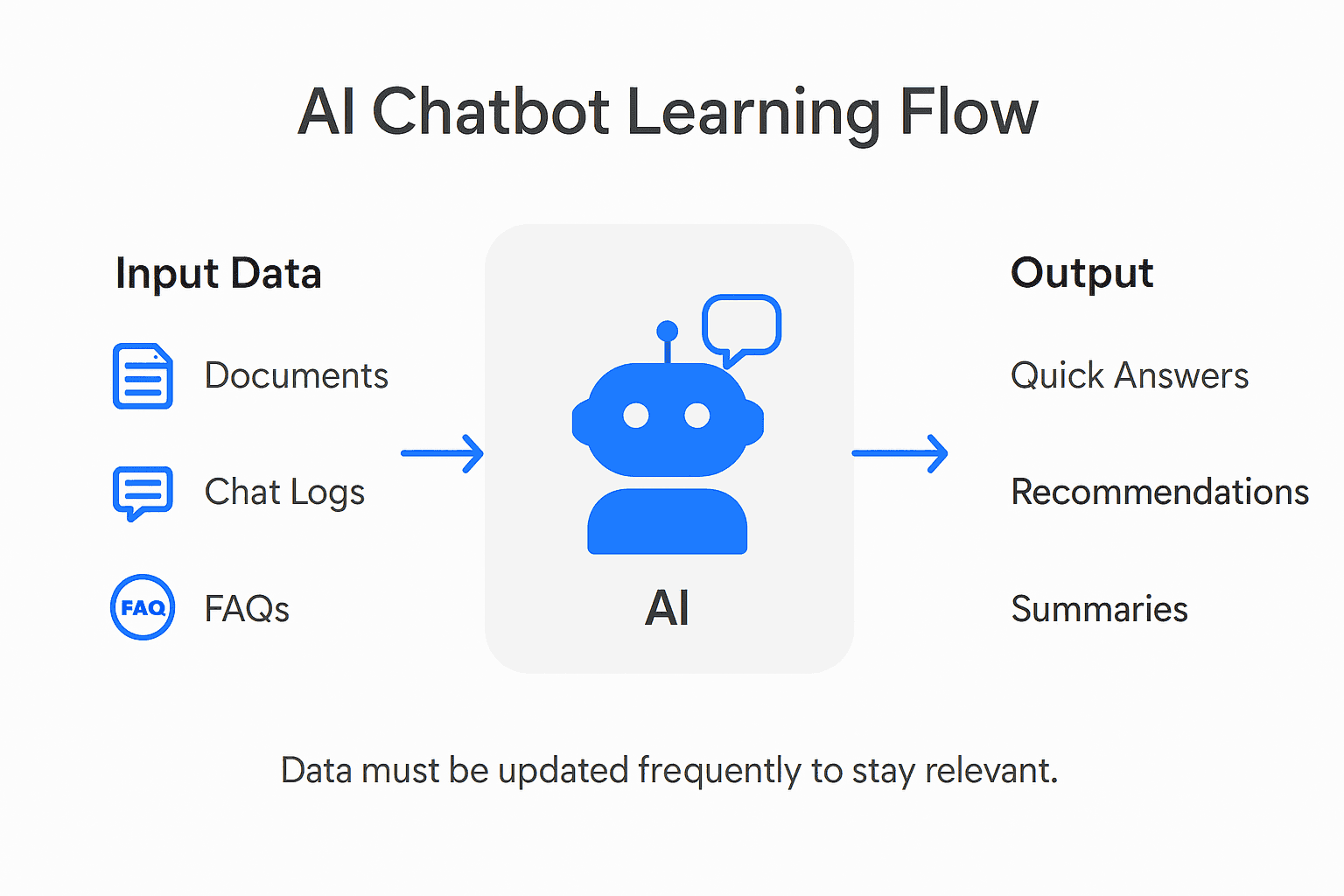
    Training an AI chatbot requires systematically collecting and preparing store-related data including product details, customer purchase history, and support transcripts. Begin by gathering comprehensive information from your product catalogs, existing customer interaction logs, and frequently asked question databases. Focus on compiling detailed product descriptions, pricing information, shipping policies, and common customer inquiry patterns. Utilize machine learning models that can parse and understand the nuanced language specific to your e-commerce environment.

    Upload your curated content directly into the ChatPirate training interface. Ensure you include variations of potential customer questions to help the AI understand context and intent. Review and validate the chatbot responses to confirm accuracy and relevance. Pay special attention to technical specifications, size charts, color options, and other product-specific details that customers frequently request.

    Pro tip: Create a diverse training dataset by including both successful and challenging customer interactions to help the AI develop more robust and adaptive response capabilities.

    Step 4: Customize Branding and Responses

    Customizing your AI chatbot’s branding and responses transforms a generic support tool into a unique extension of your e-commerce brand. Your objective is to create a conversational experience that feels authentic and aligned with your company’s voice and customer expectations.

    Personalized chatbot interactions significantly improve customer attitudes and loyalty by leveraging customized language style and problem-solving approaches. Begin by defining your brand’s communication personality. Determine whether your tone is professional and direct, friendly and conversational, or technical and precise. Adjust the chatbot’s language settings to match this style consistently across all interactions. Select color schemes, font styles, and avatar designs that reflect your brand’s visual identity within the ChatPirate interface.

    The anthropomorphic verbal design of chatbots plays a crucial role in enhancing perceived product personalization and customer engagement. Configure response templates that incorporate your brand specific terminology and communication nuances. Test different variations to ensure the chatbot sounds natural and authentic while maintaining your core brand messaging. Pay attention to greeting styles, resolution language, and the overall conversational flow to create a seamless customer experience.

    Pro tip: Conduct periodic user experience testing to validate that your chatbot’s customized responses genuinely resonate with your target customer demographic.

    Step 5: Test and Launch Automated Support

    Testing and launching your AI chatbot is a critical phase that determines the effectiveness of your automated customer support strategy. Your goal is to ensure a smooth, reliable, and user friendly experience that meets your customers expectations.

    Chatbot testing is essential to verify functionality, performance, and reliability across different interaction scenarios. Begin by developing a comprehensive test plan that covers multiple customer interaction scenarios. Create test cases that simulate realistic customer inquiries, including complex questions, edge cases, and potential misunderstandings. Evaluate the chatbots natural language processing capabilities by presenting varied communication styles and technical support requests. Pay close attention to response accuracy, conversation flow, and the ability to handle unexpected user inputs.

    Structured testing reduces potential issues such as misinterpretations or technical glitches that can negatively impact customer satisfaction. Implement a phased launch approach by first introducing the chatbot during off peak hours or to a limited customer segment. Monitor key performance indicators including response time, resolution rate, and customer feedback. Configure fallback mechanisms that smoothly transfer complex queries to human support agents when the AI cannot provide a satisfactory resolution. Continuously collect user feedback and performance metrics to drive iterative improvements.

    Pro tip: Establish a continuous improvement protocol that includes weekly performance reviews and monthly comprehensive assessments to keep your chatbot learning and adapting effectively.

    Step 6: Monitor Performance and Optimize

    Monitoring and optimizing your AI chatbot’s performance is an ongoing process that ensures your automated support system continues to deliver exceptional customer experiences. Your objective is to transform raw interaction data into actionable insights that drive continuous improvement.
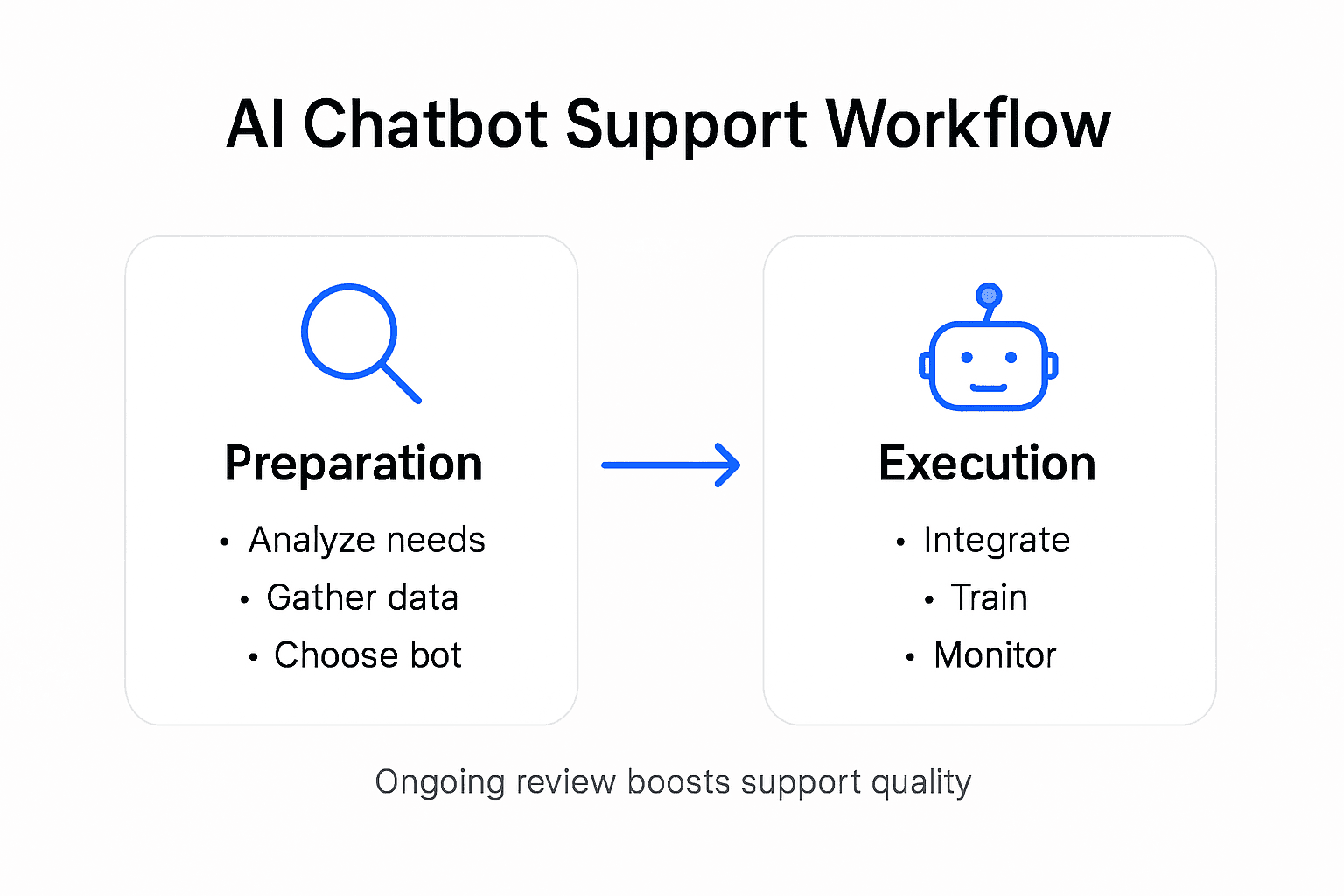
    Infographic showing AI chatbot automation workflow

    Ongoing monitoring using advanced NLP tools and sentiment analysis enables personalized and empathetic responses that enhance customer satisfaction. Leverage ChatPirate’s analytics dashboard to track key performance metrics such as response accuracy, user engagement rates, conversation completion percentages, and customer sentiment scores. Pay attention to nuanced interaction details like resolution time, user satisfaction ratings, and the frequency of human agent handoffs.

    Comprehensive conversation analysis integrates numerical metrics with linguistic evaluation to identify precise improvement opportunities. Regularly review conversation transcripts to understand context where the chatbot struggles or misinterprets user intent. Use these insights to refine training data, adjust response templates, and expand the chatbot’s knowledge base. Implement a structured feedback loop that allows continuous learning and adaptation, ensuring your AI support tool becomes more intelligent and responsive with each interaction.

    Pro tip: Schedule monthly deep-dive analysis sessions to review comprehensive performance reports and identify strategic optimization opportunities that can significantly enhance your chatbot’s effectiveness.

    The following table highlights key performance metrics to monitor your chatbot’s effectiveness:

    Metric What It Measures Why It Matters
    Response Accuracy Correct answers given Ensures reliable user support
    Resolution Rate Issues resolved automatically Measures chatbot effectiveness
    User Engagement Rate Number of active interactions Indicates user adoption and trust
    Human Handoff Frequency Transfers to human agents Reveals AI knowledge gaps
    Customer Sentiment Satisfaction from interactions Tracks user experience quality

    Transform Your E-Commerce Support with AI Chatbots Today

    Many e-commerce businesses face the challenge of managing high volumes of repetitive customer inquiries while maintaining fast and personalized support. As highlighted in the article, automating support with AI chatbots can reduce response times, improve customer satisfaction, and free your team to address complex issues. Key pain points such as integrating chatbots without technical hurdles, customizing responses to fit your brand, and continuously optimizing performance are critical to a successful deployment. ChatPirate.io offers a powerful solution designed to address these exact needs by providing easy-to-integrate, AI-powered chatbots that learn directly from your store content and customer interactions.

    With ChatPirate, you will benefit from:

    • Seamless setup on platforms like Shopify, WordPress, Wix, and Webflow without coding
    • Customizable branding to reflect your unique voice and enhance customer engagement
    • Advanced analytics and human handoff features ensuring continuous support quality
    https://chatpirate.io

    Start automating your e-commerce customer support now by exploring ChatPirate’s AI chatbot solutions. Experience how our platform can save you time and money while delivering smarter, faster, and more satisfying customer experiences that grow your business.

    Frequently Asked Questions

    How do I assess my current support needs before implementing an AI chatbot?

    Start by mapping out all customer interaction channels and analyzing support request patterns. Review support tickets to identify common issues that can be automated, focusing on tasks like order tracking and basic troubleshooting.

    What factors should I consider when selecting an AI chatbot for my e-commerce platform?

    Evaluate the compatibility of the chatbot with your existing systems, looking for features like no-code integration, customization options, and the ability to handle complex queries. Prioritize solutions that provide a seamless experience and allow easy integration into your e-commerce platform.

    How can I effectively train my AI chatbot with store content?

    Begin by gathering comprehensive information from your product catalogs, customer interactions, and frequently asked questions. Upload this data into the chatbot’s training interface, including variations of customer inquiries to improve context understanding.

    How do I customize my chatbot’s branding and responses?

    Define your brand’s communication style and ensure the chatbot reflects this in its tone and language. Adjust visual elements like colors and avatars to match your brand identity and test response templates for natural, authentic interactions.

    What steps should I take to test and launch my AI chatbot?

    Develop a test plan that simulates various customer inquiries to check the chatbot’s performance and response accuracy. Start with a phased launch during off-peak hours, monitor key performance indicators, and be ready to transfer complex inquiries to human agents if necessary.

    How do I monitor and optimize my AI chatbot’s performance?

    Regularly track performance metrics like response accuracy and customer sentiment using the analytics dashboard. Conduct monthly deep-dive analysis sessions to gather insights and refine your chatbot’s training data and response patterns for continuous improvement.


  • Role of Chatbots in E-Commerce Success

    Role of Chatbots in E-Commerce Success

    Over 80 percent of American online shoppers expect instant responses when interacting with digital stores. This demand for real-time answers and personalized attention is shaping the way e-commerce managers think about customer engagement tools. Whether you’re serving American customers or buyers from around the world, this guide unpacks how AI chatbots are redefining online retail with smarter support, flexible automation, and advanced conversational experiences that drive satisfaction and growth.

    Table of Contents

    Key Takeaways

    Point Details
    Importance of Chatbots Chatbots are vital digital assistants in e-commerce that enhance customer interactions and streamline support services through AI and natural language processing.
    Types of Chatbots E-commerce chatbots can be rule-based or AI-powered, each serving distinct needs; rule-based chatbots handle simple tasks while AI-powered chatbots manage complex interactions and personalized experiences.
    Financial Benefits Implementing chatbots can significantly reduce operational costs and enhance customer satisfaction by delivering 24/7 support and automating repetitive tasks.
    Implementation Best Practices Choosing the right chatbot solutions and ensuring continuous training are crucial for maximizing their effectiveness and maintaining customer trust.

    Defining Chatbots in E-Commerce Environments

    Chatbots in e-commerce represent sophisticated digital assistants powered by artificial intelligence designed to simulate human conversation and support customer interactions within online retail environments. These intelligent systems leverage natural language processing to understand and respond to customer queries, provide product recommendations, and facilitate seamless shopping experiences.

    Academically defined, chatbots are virtual agents that automate customer service functions through conversational interfaces. Conversational commerce research demonstrates that these AI-powered tools can simulate human dialogue while delivering personalized product recommendations and enhancing purchasing experiences. They operate across multiple communication channels including website chat windows, messaging platforms, and mobile applications.

    Modern e-commerce chatbots perform multiple critical functions beyond basic customer support. These advanced systems can handle complex tasks such as product searches, price comparisons, order tracking, and even personalized marketing recommendations. By integrating machine learning algorithms, chatbots continuously improve their interaction capabilities, adapting to specific customer preferences and business requirements.

    Pro tip: When implementing an e-commerce chatbot, focus on creating a conversational flow that feels natural and provides genuine value to customers rather than using rigid, scripted responses.

    Types of E-Commerce Chatbots and Capabilities

    E-commerce chatbots are sophisticated digital solutions categorized primarily into two fundamental types: rule-based and AI-powered conversational interfaces. Technical research reveals distinct architectural differences between these chatbot frameworks, each offering unique capabilities for online retail customer engagement.

    Rule-based chatbots operate through predefined scripts and decision trees, providing structured interactions with limited flexibility. These systems excel at handling straightforward customer inquiries like order status checks, shipping information, and basic product recommendations. They follow strict algorithmic paths, responding to specific keywords and maintaining consistent, predictable communication patterns.

    In contrast, AI-powered chatbots represent more advanced technological solutions. Leveraging machine learning and natural language processing, these intelligent systems can understand context, interpret complex customer requests, and generate dynamic, contextually appropriate responses. They continuously learn from interactions, becoming more sophisticated over time and offering personalized shopping experiences that adapt to individual customer preferences and behaviors.

    Here’s a quick comparison of rule-based and AI-powered chatbots in e-commerce:

    Attribute Rule-Based Chatbot AI-Powered Chatbot
    Operation Method Follows predefined scripts Learns from data and interactions
    Adaptability Limited, rigid flow Highly adaptable to context
    Handling Complex Queries Handles simple, routine tasks Manages complex, varied interactions
    Personalization Level Basic suggestions Advanced, personalized recommendations
    Long-Term Improvement Rarely improves over time Continuously learns and improves

    Pro tip: When selecting a chatbot for your e-commerce platform, evaluate your specific business needs and customer interaction complexity to choose between rule-based and AI-powered solutions.

    Key Features Powering Customer Experience

    E-commerce chatbots are transforming digital interactions through sophisticated features that directly enhance customer satisfaction. Cutting-edge research demonstrates how specific design elements dramatically influence user perception and purchasing behaviors, making these digital assistants critical tools for modern online businesses.

    Person chatting with support bot while shopping online

    The core features powering exceptional customer experiences include dynamic personalization, proactive support, and intelligent conversation routing. Personalization capabilities allow chatbots to analyze individual customer data, providing tailored product recommendations, remembering previous interactions, and creating a sense of individualized attention. This approach goes beyond generic responses, making customers feel uniquely understood and valued throughout their shopping journey.

    Advanced chatbots integrate multiple sophisticated capabilities to create seamless interactions. Natural language processing enables them to understand context and intent, while machine learning algorithms continuously refine response accuracy. Key functionalities include real-time inventory checks, personalized shopping guidance, complex problem resolution, and smooth escalation to human agents when necessary. These features transform chatbots from simple query-response tools into comprehensive digital shopping assistants that can dramatically improve conversion rates and customer satisfaction.

    Pro tip: Regularly analyze your chatbot’s interaction data to continuously refine its conversational abilities and alignment with customer expectations.

    Automation, Order Support, and Lead Generation

    Chatbots have revolutionized e-commerce operations by introducing unprecedented levels of automated customer support and strategic engagement. Comprehensive research demonstrates how these intelligent systems transform traditional customer service models by handling routine inquiries and proactively generating business opportunities.

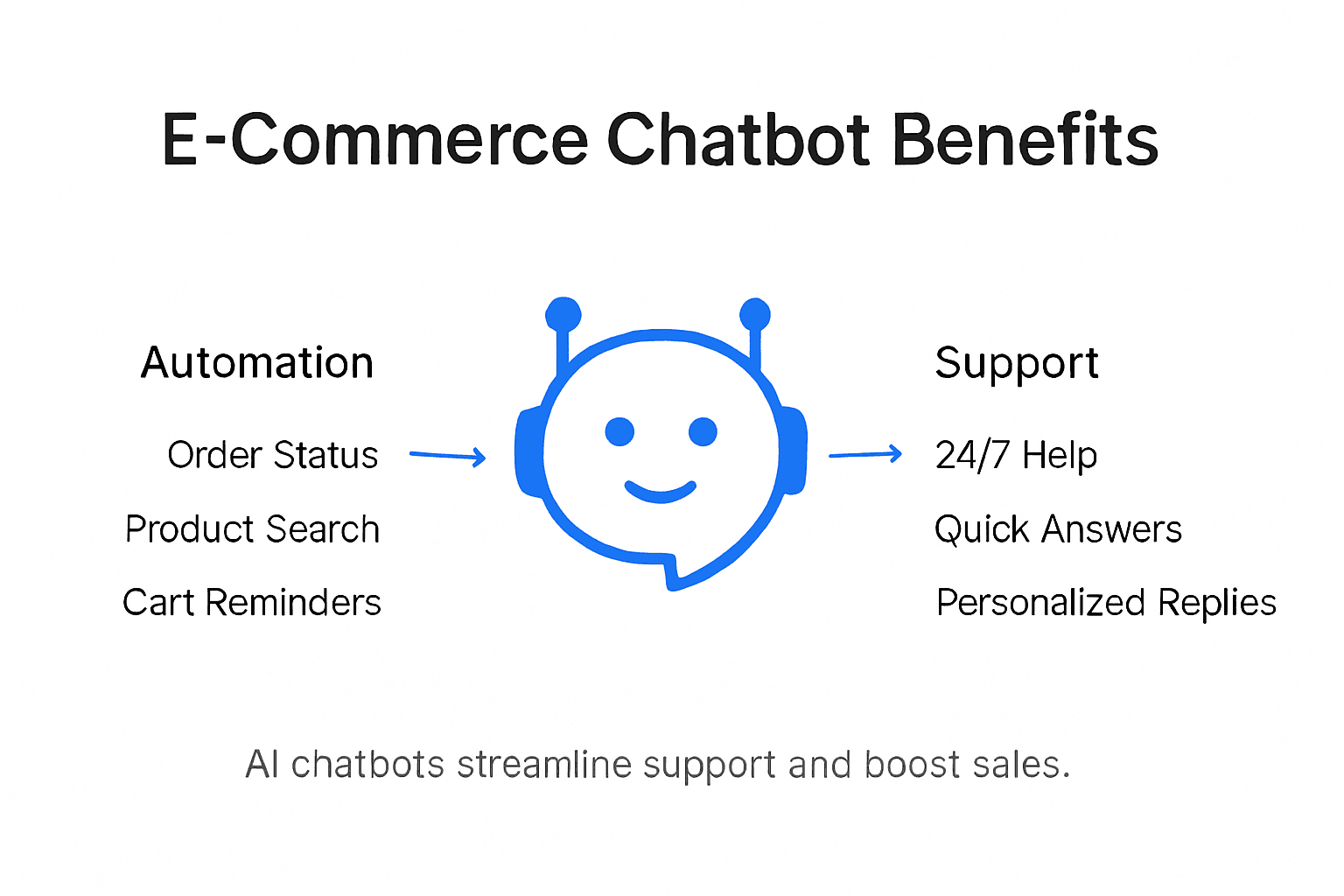
    Infographic showing e-commerce chatbot benefits overview

    In the realm of order support, chatbots excel at automating critical tasks such as shipment tracking, delivery status updates, and real-time order inquiries. These digital assistants can instantly retrieve order information, provide precise tracking details, and resolve common customer questions without human intervention. By managing repetitive and time-consuming support functions, chatbots free up human customer service representatives to focus on more complex and nuanced customer interactions that require deeper problem-solving skills.

    Lead generation represents another powerful dimension of chatbot functionality. Advanced chatbots can engage potential customers through personalized messaging, capture critical contact information, and implement sophisticated strategies like abandoned cart recovery. These systems analyze user interactions, identify potential sales opportunities, and guide customers through decision-making processes with targeted recommendations and contextually relevant information. By combining data-driven insights with conversational intelligence, chatbots transform passive website interactions into active sales and conversion mechanisms.

    Pro tip: Configure your chatbot to track and analyze interaction data, using insights to continuously refine lead generation strategies and improve customer engagement pathways.

    Financial Impact, Risk, and Cost Reduction

    E-commerce businesses are discovering significant financial advantages through strategic chatbot implementation, with comprehensive research revealing substantial operational cost reductions and enhanced revenue potential. By automating customer service functions, companies can dramatically reduce personnel expenses while simultaneously improving response times and customer satisfaction levels.

    The primary financial benefits of chatbot deployment center on operational efficiency and customer retention. Traditional customer support models require extensive human staffing, generating substantial overhead costs. Chatbots can handle multiple simultaneous interactions at a fraction of the personnel expense, significantly reducing labor costs. Moreover, these AI-powered systems provide consistent, 24/7 support without requiring additional compensation, shift management, or training investments that accompany human workforce expansion.

    While chatbots offer considerable financial advantages, businesses must carefully navigate potential risks such as technological limitations and customer perception. Implementing a hybrid support model that combines AI chatbot efficiency with human expertise helps mitigate communication risks and ensures complex inquiries receive nuanced, comprehensive responses. Advanced chatbots can seamlessly escalate challenging interactions to human representatives, maintaining service quality while preserving the cost-saving benefits of automated support systems.

    The following table summarizes major ways e-commerce chatbots impact business operations:

    Benefit Area Chatbot Contribution Business Outcome
    Order Support Instant tracking and status updates Higher customer satisfaction
    Lead Generation Engages and qualifies customers Increased conversion rates
    Cost Reduction Automates repetitive tasks Lower operational expenses
    Risk Mitigation Escalates complex issues Improved service reliability

    Pro tip: Conduct regular performance audits of your chatbot’s interaction data to identify areas for improvement and ensure a balanced approach between automated and human customer support.

    Common Implementation Mistakes to Avoid

    E-commerce businesses frequently encounter critical challenges when deploying chatbot technologies. Extensive research highlights systematic errors that can significantly undermine the effectiveness of digital customer support systems, emphasizing the importance of strategic implementation.

    One fundamental mistake is selecting inappropriate chatbot technologies for specific business requirements. Rule-based chatbots may suffice for straightforward interactions, but complex e-commerce environments demand sophisticated AI-powered solutions capable of understanding nuanced customer inquiries. Many businesses erroneously choose inflexible systems that cannot adapt to evolving customer communication patterns, resulting in frustrating user experiences and diminished engagement rates. Successful implementation requires carefully matching chatbot capabilities with specific operational needs, communication complexity, and customer interaction dynamics.

    Another critical implementation pitfall involves insufficient training and continuous improvement mechanisms. Chatbots require robust datasets and ongoing refinement to maintain accuracy and relevance. Businesses often neglect critical steps such as comprehensive initial training, regular performance reviews, and systematic feedback integration. Without dedicated resources for machine learning optimization, chatbots quickly become obsolete, providing generic or incorrect responses that damage customer trust and potentially drive potential buyers away from the platform.

    Pro tip: Develop a comprehensive chatbot testing protocol that includes periodic performance audits, user feedback analysis, and adaptive learning strategies to ensure continuous improvement and relevance.

    Enhance Your E-Commerce Success with AI-Powered Chatbots

    The article highlights key challenges in e-commerce such as automating order support, delivering personalized customer experiences, and efficiently generating leads while reducing operational costs. If you want to overcome these hurdles with a powerful solution that adapts to your customers and business needs, ChatPirate.io offers exactly that. Our AI-powered chatbots learn from your website content and knowledge bases to provide instant, accurate responses 24/7 without the need for coding skills.

    https://chatpirate.io

    Discover how ChatPirate.io can transform your e-commerce platform with customizable chatbots that deliver seamless order tracking, personalized recommendations, and smart lead qualification. Experience increased customer satisfaction and reduced support expenses today. Visit ChatPirate.io to explore our features and start enhancing your customer support with AI.

    Learn more about our easy integration options with popular website builders like WordPress and Shopify at ChatPirate.io and take the first step toward a smarter, more efficient customer engagement system.

    Frequently Asked Questions

    What are the main types of chatbots used in e-commerce?

    E-commerce chatbots primarily fall into two categories: rule-based chatbots and AI-powered chatbots. Rule-based chatbots operate based on predefined scripts and are best for simple inquiries, while AI-powered chatbots utilize machine learning and natural language processing to handle complex queries and provide personalized responses.

    How do chatbots enhance the customer experience in online shopping?

    Chatbots improve the customer experience by offering dynamic personalization, proactive support, and intelligent conversation routing. They analyze customer data to provide tailored product recommendations, swiftly resolve inquiries, and ensure a smoother shopping journey.

    What functions can e-commerce chatbots automate?

    E-commerce chatbots can automate various tasks including order tracking, shipment inquiries, and personalized product recommendations. They also engage in lead generation by capturing customer information and recovering abandoned carts through targeted messaging.

    What are common mistakes to avoid when implementing chatbots in e-commerce?

    Common mistakes include selecting the wrong type of chatbot for your business needs and failing to adequately train and refine the chatbot. It’s crucial to align chatbot capabilities with customer interaction complexity and continuously improve through performance audits and feedback integration.

  • AI Learning From Content: Transforming Customer Support

    AI Learning From Content: Transforming Customer Support

    Over 80 percent of American e-commerce businesses are exploring AI-powered solutions for customer support. With growing competition and rising operational costs, automation has become crucial for small and medium-sized shops across continents. Learning how AI understands, processes, and responds to your business content empowers you to offer smarter support, reduce expenses, and boost customer engagement in ways that were nearly impossible just a few years ago.

    Table of Contents

    Key Takeaways

    Point Details
    AI Enhances Content Understanding AI uses advanced natural language processing to extract insights and generate contextually relevant responses from various content types.
    Diverse Learning Sources AI learns effectively from structured and unstructured content, including documents, customer interactions, and web data.
    AI Chatbots Transform Customer Support Implementing AI chatbots can lead to 24/7 support, instant responses, and significant cost reductions in customer service.
    Risk Management is Crucial Businesses must address privacy concerns, algorithmic bias, and cybersecurity vulnerabilities when utilizing AI-powered technologies.

    AI Learning From Content Explained

    Artificial Intelligence (AI) is revolutionizing how businesses understand and process information through intelligent content learning mechanisms. By analyzing website content, documents, and knowledge bases, AI systems can now extract nuanced insights and generate contextually relevant responses with remarkable precision. Adaptive learning technologies are transforming how machines comprehend and interact with complex information streams.

    The core mechanism of AI content learning involves sophisticated natural language processing algorithms that break down text into semantic units, identifying patterns, relationships, and contextual meanings. These algorithms go beyond simple keyword matching, using advanced machine learning models that can understand intent, sentiment, and subtle linguistic nuances. By training on diverse content sources, AI can generate responses that feel increasingly human-like and contextually appropriate.

    Understanding AI content learning requires recognizing its multifaceted approach. Large language models like ChatGPT demonstrate significant advancements in comprehending complex information landscapes. These models leverage massive datasets to develop intricate understanding capabilities, allowing them to generate coherent, relevant responses across various domains. The process involves continuous learning, where each interaction refines the AI’s comprehension and response generation skills.

    Pro Tip: When implementing AI content learning, start with high-quality, well-structured source materials to ensure more accurate and reliable machine understanding.

    Types of Content AI Can Learn From

    Artificial Intelligence demonstrates remarkable versatility in learning from diverse content types across multiple domains. From structured documents like manuals and knowledge bases to unstructured content like customer interactions and web pages, AI systems can extract meaningful insights and generate intelligent responses. AI-generated educational content research reveals the expansive capabilities of machine learning algorithms in comprehending and reproducing complex information structures.

    The primary content categories AI can effectively learn from include:

    • Textual Documents: Technical manuals, policy documents, training materials, research papers
    • Customer Interactions: Support tickets, chat logs, email conversations
    • Multimedia Content: Transcripts, video captions, audio descriptions
    • Structured Data: Spreadsheets, databases, product catalogs
    • Web Content: Blog posts, product descriptions, website FAQs

    Interdisciplinary AI content integration studies highlight the technology’s ability to break traditional information silos. Modern AI models can synthesize learning materials across humanities, science, and social science disciplines, demonstrating unprecedented adaptability in processing varied content formats. These systems employ advanced natural language processing techniques to understand context, sentiment, and nuanced information across different knowledge domains.

    Pro Tip: Ensure your AI training content is clean, well-structured, and representative of your desired output to maximize learning effectiveness.

    How AI Chatbots Process Business Knowledge

    AI chatbots leverage sophisticated technologies to transform how businesses manage and utilize their knowledge resources. Advanced natural language processing frameworks enable these intelligent systems to comprehend, analyze, and respond to complex business queries with remarkable precision. By breaking down intricate information into digestible semantic units, AI chatbots can extract meaningful insights from diverse content sources, creating a dynamic knowledge processing ecosystem.

    The core processing mechanism involves multiple sophisticated techniques:

    • Machine Learning Algorithms: Analyze patterns and relationships within business content
    • Natural Language Understanding: Interpret context, intent, and nuanced meanings
    • Knowledge Graph Construction: Create interconnected understanding of business information
    • Contextual Response Generation: Produce accurate, relevant answers based on learned knowledge

    Generative AI conceptual frameworks demonstrate how these chatbots integrate multiple technological components to create intelligent knowledge processing systems. By continuously learning from interactions, AI chatbots can adapt their understanding, refine response accuracy, and develop increasingly sophisticated comprehension of business-specific terminologies and processes. These systems go beyond simple keyword matching, employing advanced semantic analysis to understand the deeper meaning behind business queries.

    Infographic showing AI chatbot learning process

    Here’s a summary of how AI chatbots process different types of business data:

    Data Type Processing Method Typical Output
    Customer Queries Natural language understanding Contextual responses
    Internal Docs Semantic analysis and graph building Business insights
    Product Databases Structured data mapping Catalog suggestions
    Web Content Pattern extraction and sentiment Tailored support messaging

    Pro Tip: Regularly update and curate your knowledge base to ensure AI chatbots maintain high-accuracy learning and response capabilities.

    Key Benefits for E-Commerce Businesses

    E-commerce businesses are experiencing a transformative shift through AI-powered customer support technologies. Advanced customer engagement strategies demonstrate how intelligent chatbots can revolutionize online retail interactions, delivering unprecedented levels of personalized customer experience and operational efficiency. These intelligent systems go beyond traditional support models, creating dynamic and responsive communication channels that adapt to individual customer needs.

    The key benefits for e-commerce businesses include:

    • 24/7 Customer Support: Continuous availability without human staffing constraints
    • Instant Response Times: Immediate answers to customer inquiries
    • Personalized Shopping Experiences: Tailored product recommendations and support
    • Cost Reduction: Significant savings on customer service infrastructure
    • Scalable Customer Interactions: Handling multiple conversations simultaneously
    • Multilingual Support: Breaking language barriers in global commerce

    By implementing AI chatbots, e-commerce platforms can dramatically transform their customer interaction models. These intelligent systems learn from each interaction, continuously improving their understanding of customer preferences, common questions, and potential pain points. The technology enables businesses to provide consistently high-quality support, reduce human error, and create more engaging, responsive shopping experiences that can significantly boost customer satisfaction and loyalty.

    Ecommerce manager using AI chatbot at desk

    Pro Tip: Integrate AI chatbots gradually, starting with specific product lines or support categories to optimize learning and minimize potential integration challenges.

    Risks, Challenges, and Common Pitfalls

    AI-powered chatbots offer tremendous potential, but businesses must navigate a complex landscape of potential risks and challenges. Comprehensive AI service strategies reveal the nuanced considerations businesses must address to successfully implement intelligent customer support technologies. Understanding these potential pitfalls is crucial for developing responsible and effective AI integration approaches.

    Key risks and challenges for AI chatbot implementation include:

    • Privacy Concerns: Protecting customer data and maintaining confidentiality
    • Algorithmic Bias: Ensuring fair and unbiased customer interactions
    • Emotional Intelligence Limitations: Maintaining human-like empathy and understanding
    • Technology Anxiety: Overcoming customer resistance to automated interactions
    • Cybersecurity Vulnerabilities: Protecting against potential data breaches
    • Contextual Understanding: Managing complex or nuanced customer queries

    Robust AI governance frameworks emphasize the importance of proactive risk management. Businesses must develop comprehensive strategies that balance technological innovation with ethical considerations, human oversight, and continuous monitoring. This approach involves implementing fairness metrics, establishing clear accountability mechanisms, and creating flexible systems that can adapt to emerging challenges and customer expectations.

    Compare major risks of AI-powered chatbots and strategies to mitigate them:

    Risk Impact on Business Mitigation Strategy
    Data Privacy Loss of customer trust Strong encryption policies
    Algorithmic Bias Reputational damage Regular fairness audits
    Emotional Intelligence Gap Reduced customer satisfaction Human-in-the-loop escalation
    Cybersecurity Threats Financial and IP loss Routine security testing

    Pro Tip: Conduct regular audits of your AI chatbot’s performance, focusing on accuracy, bias detection, and customer satisfaction to continuously improve your AI support system.

    Getting the Most from AI-Powered Support

    Maximizing the potential of AI-powered customer support requires a strategic and nuanced approach that balances technological capabilities with human insights. Operational efficiency strategies demonstrate that successful AI implementation goes far beyond simple automation, demanding a comprehensive understanding of both technological potential and customer experience requirements. Businesses must develop a holistic framework that integrates AI capabilities seamlessly with existing support infrastructures.

    Key strategies for optimizing AI-powered support include:

    • Continuous Training: Regularly update AI knowledge bases
    • Human-AI Collaboration: Create smooth handoff mechanisms between chatbots and human agents
    • Performance Monitoring: Track key metrics like resolution rates and customer satisfaction
    • Personalization: Develop context-aware response generation
    • Multilingual Support: Enable communication across diverse customer segments
    • Feedback Integration: Use customer interactions to refine AI learning algorithms

    Advanced customer service frameworks emphasize the importance of creating adaptive, responsive support systems. By implementing intelligent routing, predictive problem-solving, and real-time learning mechanisms, businesses can transform their customer support from a reactive cost center into a proactive value generation platform. The most successful approaches treat AI not as a replacement for human interaction, but as a powerful augmentation tool that enhances overall customer experience.

    Pro Tip: Implement a staged rollout of AI support technologies, starting with low-complexity interactions and progressively expanding based on performance and customer feedback.

    Unlock Seamless Customer Support with AI Learning from Your Content

    The article highlights how AI’s ability to learn from diverse content sources transforms customer support by delivering instant, accurate, and contextually relevant responses. If your business struggles with costly, slow, or inconsistent customer interactions, adopting an AI-powered chatbot that learns directly from your website, documents, and knowledge bases can solve these challenges. ChatPirate.io offers a powerful SaaS platform that enables you to deploy customizable chatbots effortlessly without coding, ensuring 24/7 availability and personalized engagement.

    Experience benefits like

    • Rapid response times that keep customers satisfied
    • Scalable support without increasing your overhead
    • Seamless integration with popular website builders such as WordPress, Shopify, Wix, and Webflow
    • Intelligent human handoff for complex queries

    Take the next step toward smarter customer support today with ChatPirate.io.

    https://chatpirate.io

    Ready to transform your customer support by harnessing AI that truly understands your business content Visit ChatPirate.io now to start your free trial and see how easy it is to integrate AI learning into your support channels. Don’t wait to reduce costs, boost engagement, and scale your service effortlessly.

    Frequently Asked Questions

    What is AI content learning and how does it work?

    AI content learning refers to how artificial intelligence systems analyze various content types to extract insights and generate relevant responses. This involves using natural language processing algorithms that break down text to understand context, sentiment, and intent, enabling AI to interact with complex information.

    What types of content can AI learn from?

    AI can learn from diverse content such as textual documents, customer interactions (like support tickets and chat logs), multimedia content (like transcripts and captions), structured data (like spreadsheets and databases), and web content (like blog posts and FAQs).

    How do AI chatbots improve customer support for businesses?

    AI chatbots enhance customer support by providing 24/7 availability, instant response times, personalized shopping experiences, and the ability to handle multiple interactions simultaneously. They continuously learn from interactions to improve accuracy and responsiveness, leading to better customer satisfaction.

    What are the risks associated with AI chatbot implementation?

    The key risks include data privacy concerns, algorithmic bias, limitations in emotional intelligence, technology anxiety among customers, cybersecurity vulnerabilities, and challenges in understanding complex queries. Businesses should adopt comprehensive strategies for risk management to mitigate these issues.

  • Chatbot vs Live Chat: Choosing the Right Option

    Chatbot vs Live Chat: Choosing the Right Option

    More than 60 percent of American e-commerce businesses now rely on AI-powered chatbots for customer support. Choosing between a chatbot and live chat can impact efficiency, cost, and customer satisfaction in big ways. This introduction uncovers how each solution addresses real customer needs, helping you identify the smartest support options for your business.

    Table of Contents

    Key Takeaways

    Point Details
    Chatbots provide 24/7 support Chatbots handle routine inquiries efficiently, offering instant responses without staffing limitations.
    Live chat offers human empathy Live chat is essential for complex interactions requiring emotional intelligence and personalized guidance.
    Implement a hybrid support model Combining chatbots for routine tasks with live chat for nuanced issues can optimize customer support efficiency.
    Cost-effectiveness of chatbots Chatbots significantly reduce operational costs by managing high volumes of inquiries without increasing staffing needs.

    Chatbot vs. Live Chat Explained

    The world of customer support is rapidly evolving, with businesses increasingly turning to digital communication solutions like chatbots and live chat. Understanding the nuanced differences between these technologies can help you select the most effective approach for your specific business needs. Website chatbots are transforming how companies interact with customers by providing instant, scalable support solutions.

    Chatbots represent an automated communication system powered by artificial intelligence, capable of handling multiple customer inquiries simultaneously without human intervention. These digital assistants can provide instant responses, answer frequently asked questions, and even guide customers through complex processes like product selection or troubleshooting. Unlike traditional live chat, chatbots operate 24/7, ensuring consistent availability and reducing wait times for customer support.

    Live chat, in contrast, connects customers directly with human customer service representatives in real time. While more personalized, live chat requires human staffing and has inherent limitations like restricted operating hours, potential response delays, and higher operational costs. Human agents can handle complex, nuanced inquiries that might challenge an AI system, but they cannot match the immediate responsiveness and scalability of chatbots.

    Pro tip: Consider implementing a hybrid support model that combines chatbot efficiency for routine inquiries with live chat options for more complex customer interactions.

    Core Capabilities and Unique Features Compared

    Chatbots and live chat systems offer distinct technological capabilities that significantly impact customer support strategies. Systematic research comparing AI chatbots reveals complex variations in their core functionalities, highlighting the importance of understanding each platform’s unique strengths and limitations.

    Manager reviews chatbot and live chat diagrams

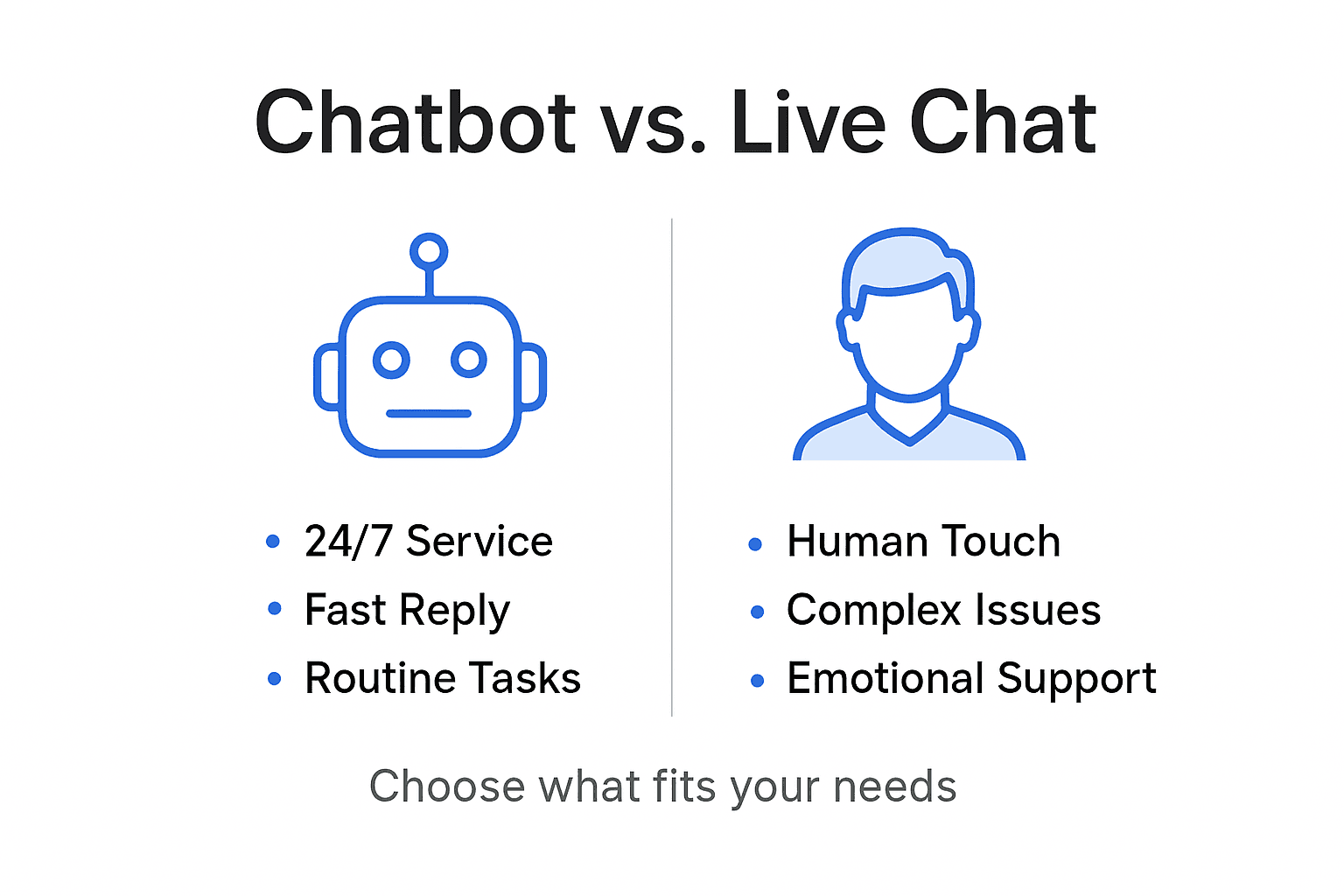
    For chatbots, advanced natural language processing enables sophisticated interactions that go beyond simple scripted responses. These AI-powered systems can interpret context, learn from previous interactions, and provide personalized recommendations based on customer data. Key capabilities include instant response generation, multilingual support, seamless integration with existing customer relationship management (CRM) systems, and the ability to handle multiple concurrent inquiries without performance degradation.

    Infographic compares chatbot and live chat features

    Live chat systems, by contrast, rely on human expertise and emotional intelligence. Their core features include real-time communication, screen sharing capabilities, comprehensive problem-solving for complex scenarios, and the ability to build genuine rapport with customers. While less scalable than chatbots, live chat offers nuanced understanding and empathy that current AI technologies cannot fully replicate. The human touch remains critical for addressing intricate customer concerns that require deep contextual comprehension.

    Pro tip: Evaluate your specific business requirements and customer demographics to design a balanced support strategy that strategically leverages both chatbot automation and human live chat capabilities.

    Real-World Applications in E-Commerce

    E-commerce platforms have rapidly embraced both chatbot and live chat technologies to revolutionize customer interactions and support strategies. Systematic research reveals how AI chatbots are transforming digital commerce through advanced customer service automation, offering unprecedented capabilities for handling complex customer engagement scenarios.

    In practical e-commerce applications, chatbots excel at managing routine yet critical tasks such as order tracking, return processing, and addressing abandoned cart scenarios. These AI-powered systems can instantly provide shipping updates, generate return labels, and even send personalized reminders to customers who have left items in their online shopping carts. By integrating seamlessly with inventory management and customer relationship databases, chatbots enable businesses to maintain real-time communication and streamline operational workflows without requiring constant human intervention.

    Live chat remains indispensable for more nuanced e-commerce interactions that demand human judgment and emotional intelligence. Advanced studies demonstrate chatbots’ significant impact on customer trust and sales conversion rates, particularly when deployed strategically alongside human support channels. Complex scenarios like product customization, high-value purchase consultations, and resolving intricate customer concerns still benefit immensely from direct human interaction, where empathy and contextual understanding play crucial roles.

    The following table outlines common e-commerce scenarios and ideal support approaches:

    Scenario Best Solution Rationale
    Order Tracking Chatbot Quick answers, instant updates
    Product Customization Live Chat Needs personalized guidance
    Abandoned Cart Recovery Chatbot Automated, timely engagement
    High-Value Purchase Live Chat Builds trust with human touch
    Simple FAQ Chatbot Efficient and immediate
    Complaint Resolution Live Chat Empathy is essential

    Pro tip: Design a hybrid customer support model that leverages chatbots for initial screening and routine inquiries, while reserving human live chat agents for complex, high-value customer interactions that require personalized problem-solving.

    Cost, Scalability, and Customer Satisfaction

    How AI chatbots improve customer support response times reveals the critical economic advantages of modern customer communication technologies. Chatbots and live chat systems present fundamentally different approaches to managing customer interactions, each with unique implications for business operational costs, scalability, and customer satisfaction.

    From a financial perspective, chatbots represent a significantly more cost-effective solution for handling customer inquiries. A single AI-powered chatbot can simultaneously manage hundreds of customer interactions without additional staffing expenses, dramatically reducing labor costs. Unlike live chat systems that require continuous human staffing, chatbots operate 24/7 at a fraction of the personnel expense. Small and medium-sized businesses can particularly benefit from this model, as chatbots eliminate the need for extensive customer support teams while maintaining consistent, high-quality interaction standards.

    Scalability becomes another crucial differentiator between these communication channels. Chatbots can effortlessly expand their capacity during peak traffic periods without compromising response quality or incurring substantial infrastructure costs. Live chat systems, conversely, require proportional human resource increases to handle growing customer volumes, creating linear scaling challenges that directly impact operational expenses. Customer satisfaction metrics frequently demonstrate that quick, accurate responses matter more than the communication channel’s origin, suggesting that well-designed AI systems can match or exceed human interaction quality for routine inquiries.

    Here’s a comparison of key business impacts for chatbots and live chat:

    Factor Chatbots Live Chat
    Availability 24/7 support, no downtime Limited by staffing hours
    Cost Efficiency Minimal labor expenses Requires larger support team
    Response Speed Instant, simultaneous replies May experience wait times
    Personalization Context-aware but limited empathy High emotional intelligence
    Scalability Easily handles traffic spikes Scaling increases labor costs
    Complex Issue Handling Basic troubleshooting only Excels at nuanced solutions

    Pro tip: Conduct periodic performance audits of your customer support channels, tracking response times, resolution rates, and customer feedback to continuously optimize your chatbot and live chat strategies.

    When to Choose Chatbots or Live Chat

    Research on customer communication strategies reveals that selecting the right support channel depends on nuanced business requirements and customer interaction complexity. Chatbots and live chat are not competing technologies, but complementary tools designed to address different customer service scenarios with maximum efficiency.

    Chatbots excel in situations demanding instant, consistent responses across high-volume interactions. Startups, global businesses, and e-commerce platforms benefit most from chatbot deployment when handling routine inquiries like order tracking, product information, frequently asked questions, and basic troubleshooting. These AI-powered systems provide 24/7 support, eliminate wait times, and can simultaneously manage hundreds of customer interactions without additional staffing expenses. Small to medium-sized businesses particularly appreciate chatbots’ ability to maintain professional communication standards while reducing operational costs.

    Live chat becomes the preferred option when customer interactions require emotional intelligence, complex problem-solving, and personalized guidance. Scenarios involving sensitive issues, technical product consultations, complaint resolution, and high-value purchase decisions demand human empathy and nuanced communication. Sales teams, premium service providers, and businesses with intricate product offerings typically rely on live chat to build trust, demonstrate deep product knowledge, and create meaningful customer connections that automated systems cannot replicate.

    Pro tip: Implement a hybrid support strategy that uses chatbots for initial screening and information gathering, seamlessly transitioning complex interactions to human agents for personalized resolution.

    Elevate Your Customer Support with AI-Powered Chatbots from ChatPirate.io

    The article highlights the challenge businesses face when deciding between chatbot automation and live chat for customer support. Key pain points include managing high-volume inquiries while providing personalized interactions that build trust and satisfaction. As the article explains, balancing instant 24/7 responses from chatbots with the empathetic, nuanced support only human agents can deliver is essential for modern businesses looking to scale efficiently.

    At ChatPirate.io, we empower your business to master this balance by offering AI-driven chatbots that learn from your website content and knowledge bases. Our platform enables quick deployment with no coding required through easy integrations with WordPress, Shopify, Wix, and Webflow. Features like seamless human handoff ensure complex questions get real-time human attention, while our analytics help you optimize support efficiency and customer satisfaction.

    Take your customer engagement to the next level and reduce operational costs today. Discover how to automate routine support while preserving those meaningful human connections that drive loyalty.

    Activate smarter support now with ChatPirate.io.

    https://chatpirate.io

    Ready to transform your customer interaction strategy with scalable chatbot solutions customized for your business? Visit ChatPirate.io and start your free trial today.

    Frequently Asked Questions

    What is the main difference between chatbots and live chat?

    Chatbots are automated systems powered by artificial intelligence that handle multiple customer inquiries simultaneously with instant responses. Live chat connects customers with human representatives for real-time communication and support.

    When should I choose a chatbot over live chat for my business?

    Chatbots are ideal for managing routine inquiries such as order tracking, FAQs, and simple troubleshooting, especially when quick responses are needed and cost efficiency is a priority.

    What types of interactions are best suited for live chat?

    Live chat is best for complex customer interactions that require emotional intelligence and personalized guidance, such as technical product consultations, complaint resolutions, and high-value purchase decisions.

    Can I combine chatbots and live chat in my customer support strategy?

    Yes, implementing a hybrid support model that utilizes chatbots for initial screenings and routine inquiries while transitioning complex issues to human agents is a great way to enhance customer experience.

  • AI Chatbots for Startups: Boosting Growth and Support

    AI Chatbots for Startups: Boosting Growth and Support

    Over half of American e-commerce startups run into costly support bottlenecks before they ever grow large enough to hire full-time help. For founders and marketing managers who need to build trust quickly but lack technical know-how, choosing the right AI chatbot can change everything. This guide shows how affordable AI tools let startups deliver fast, personalized help to customers, all without complicated setup or massive budgets.

    Table of Contents

    Key Takeaways

    Point Details
    AI Chatbots Enhance Efficiency Startups can leverage AI chatbots for 24/7 customer support, reducing operational costs and improving engagement.
    Diverse Chatbot Types Different chatbot types, including Rule-Based and AI-Powered, cater to various business needs, allowing startups to choose the most suitable solutions.
    No-Code Integration Modern platforms enable startups to integrate chatbots without coding, facilitating rapid deployment through user-friendly interfaces.
    Strategic Risk Management Implement robust risk management strategies to address challenges like AI bias and unexpected costs, ensuring effective chatbot deployment.

    AI Chatbots for Startups Explained

    Artificial Intelligence (AI) chatbots represent a transformative technology enabling startups to scale customer support and engagement with unprecedented efficiency. According to recent research, AI chatbot adoption is rapidly expanding across diverse organizational settings, providing small businesses powerful tools to compete with larger enterprises.

    At their core, AI chatbots are sophisticated software programs designed to simulate human conversation through natural language processing. These intelligent systems can understand customer inquiries, provide instant responses, and learn from interactions to improve their communication over time. For early-stage startups, this technology offers several critical advantages:

    • Instant Customer Support: 24/7 availability without hiring additional staff
    • Cost Efficiency: Reducing operational support expenses
    • Scalable Communication: Handling multiple customer interactions simultaneously
    • Data Collection: Gathering valuable insights about customer needs and preferences

    The global market for chatbot technology continues to expand rapidly, with significant worldwide investment in conversational AI startup solutions. Small businesses can now leverage these advanced technologies to create more responsive, intelligent customer engagement strategies without massive infrastructure investments.

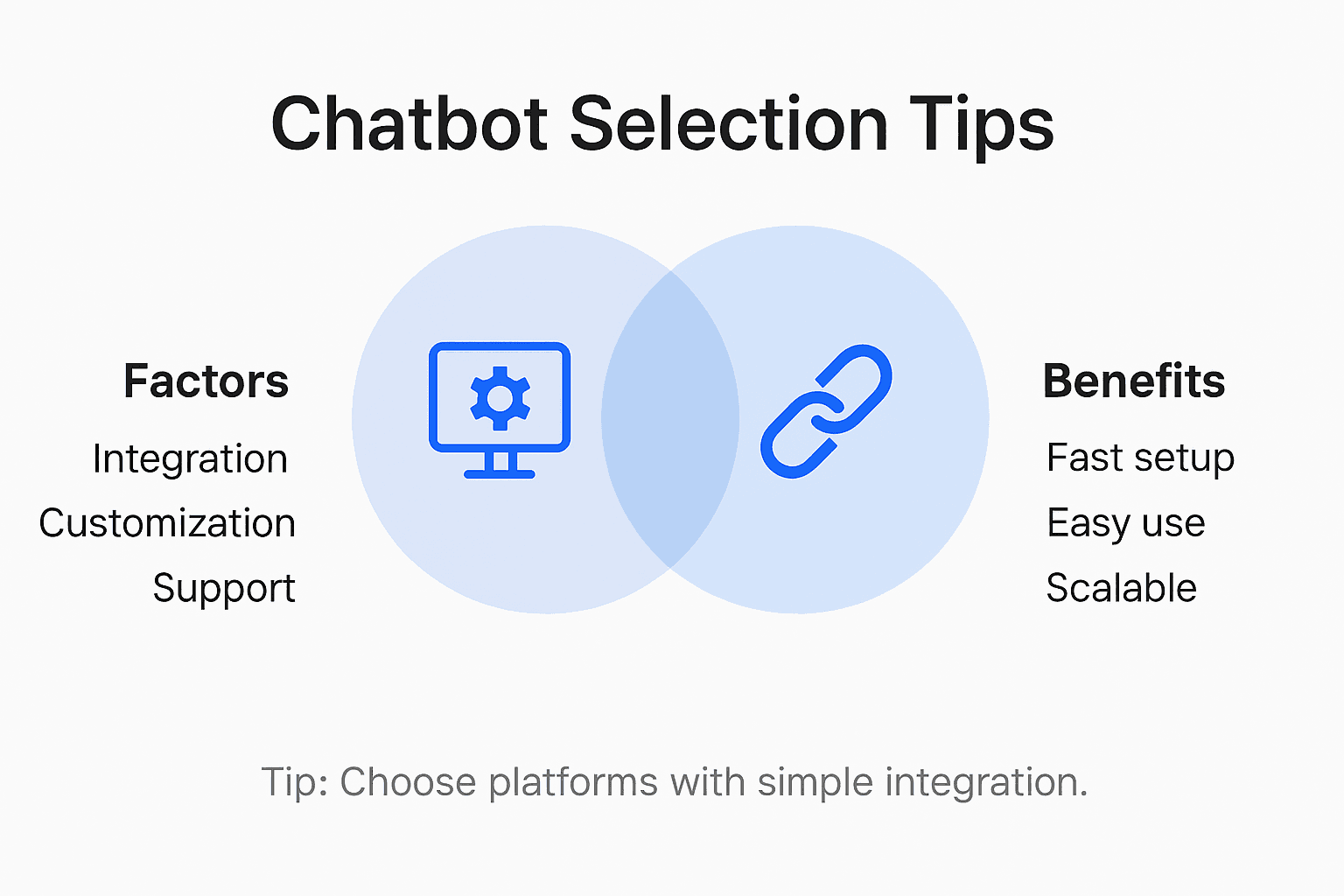
    Quick Tip: When selecting an AI chatbot for your startup, prioritize platforms offering easy integration, customization options, and clear analytics dashboards to maximize your return on investment.

    Infographic on selecting AI chatbots for startups

    Types of Chatbots and Key Features

    The world of AI chatbots encompasses a diverse range of technologies, each designed to address specific business needs. Comprehensive research reveals multiple chatbot architectures with unique interaction capabilities, enabling startups to select solutions precisely matched to their customer engagement strategies.

    Chatbots can be categorized into several primary types:

    • Rule-Based Chatbots: Operate through predefined conversation flows
    • AI-Powered Chatbots: Utilize machine learning for dynamic interactions
    • Hybrid Chatbots: Combine rule-based and AI-driven approaches
    • Voice-Enabled Chatbots: Support spoken language interactions

    Large language model technologies have dramatically expanded chatbot functionalities, enabling more sophisticated natural language understanding and contextual responses. Modern AI chatbots now feature advanced capabilities like sentiment analysis, intent recognition, and seamless integration with existing business systems.

    Key features that distinguish high-performance chatbots include multilingual support, customizable conversation flows, real-time learning algorithms, and robust analytics dashboards. These technologies empower startups to create intelligent, responsive customer interaction platforms without significant infrastructure investments.

    Here’s a summary of how different chatbot types meet common startup needs:

    Chatbot Type Best For Key Strength Limitation
    Rule-Based Simple FAQs Predictable responses Limited flexibility
    AI-Powered Complex conversations Learns from users Needs data to train
    Hybrid Broad use cases Balanced automation Requires management
    Voice-Enabled Hands-free support Natural experience Needs speech tech setup

    Pro Tip: When evaluating AI chatbot solutions, prioritize platforms offering flexible API integrations and comprehensive training capabilities to ensure long-term scalability and performance.

    Real Use Cases in E-Commerce Startups

    Case studies of AI chatbot deployments in e-commerce startups demonstrate remarkable transformations in customer interaction and operational efficiency, revealing powerful strategies for emerging online businesses. These intelligent systems have become game-changers for startups seeking scalable customer support solutions without massive infrastructure investments.

    Typical e-commerce chatbot applications include:

    • Product Recommendation: Personalized shopping suggestions based on customer preferences
    • Order Tracking: Real-time updates on shipping status and delivery information
    • Customer Support: Instant resolution of common inquiries and technical issues
    • Returns and Exchanges: Automated processing of return requests
    • Abandoned Cart Recovery: Proactive engagement to re-engage potential customers

    Global funding trends highlight the increasing investment in conversational AI technologies for online retail startups, underscoring their critical role in modern e-commerce strategies. Advanced AI chatbots now integrate seamlessly with inventory management systems, payment platforms, and customer relationship management tools, creating comprehensive support ecosystems.

    Product manager reviewing chatbot analytics

    Successful implementation requires strategic alignment between chatbot capabilities and specific business objectives. E-commerce startups can leverage these technologies to provide 24/7 customer support, reduce operational costs, and create more personalized shopping experiences that drive customer loyalty and repeat purchases.

    Compare common e-commerce chatbot functions and their business impact:

    Application User Experience Benefit Startup Value
    Product Recommendation Personalized suggestions Higher conversion rates
    Order Tracking Instant delivery updates Fewer support requests
    Returns & Exchanges Streamlined process Reduced manual workload
    Cart Recovery Timely reminders Increased sales

    Pro Tip: Implement a hybrid chatbot approach that combines automated responses with easy human handoff to ensure comprehensive and flexible customer support.

    Integrating AI Chatbots Without Coding

    Modern AI technologies have dramatically simplified chatbot deployment for non-technical startup founders, eliminating the traditional barriers of complex programming and technical expertise. Entrepreneurs can now leverage user-friendly platforms that enable rapid chatbot integration through intuitive interfaces and pre-configured templates.

    Key strategies for no-code chatbot implementation include:

    • Drag-and-Drop Interface: Visual design tools for conversation flow
    • API Integration: Seamless connections with existing business systems
    • Template Libraries: Pre-built conversation scenarios
    • Natural Language Training: Machine learning models that adapt to specific business contexts
    • Customization Options: Branding and design personalization

    User-friendly AI tools now provide incremental setup processes that make advanced chatbot deployment accessible to small businesses, requiring minimal technical background. These platforms offer step-by-step guidance, allowing startup founders to create sophisticated customer support systems without writing a single line of code.

    Successful no-code chatbot integration involves understanding your specific business requirements, selecting appropriate templates, and continuously refining the conversational experience based on user interactions. By focusing on clear communication goals and leveraging intuitive platforms, startups can quickly deploy intelligent support systems that enhance customer engagement.

    Pro Tip: Start with a basic chatbot template and incrementally improve its performance by analyzing real user interactions and gradually expanding its capabilities.

    Risks, Costs, and Common Mistakes

    AI chatbot implementations for startups involve complex challenges that require careful strategic planning and risk management, with potential pitfalls that can significantly impact operational effectiveness and financial investment.

    Common risks and mistakes in AI chatbot deployment include:

    • Bias in AI Responses: Unintentional prejudiced or inappropriate communication
    • Overreliance on Automation: Neglecting human oversight and intervention
    • Limited Context Understanding: Misinterpreting complex customer inquiries
    • Unexpected Implementation Costs: Hidden expenses beyond initial setup
    • Data Privacy Vulnerabilities: Potential security and compliance risks

    Ethical considerations and technical limitations present significant challenges for startups seeking to integrate AI-powered conversational technologies, requiring sophisticated approaches to mitigate potential errors and maintain customer trust. Successful implementation demands a nuanced understanding of AI capabilities and strategic human intervention.

    Startups must develop comprehensive strategies that balance technological innovation with robust risk management. This includes regular performance monitoring, continuous training of AI models, establishing clear escalation protocols for complex interactions, and maintaining transparency about the AI’s capabilities and limitations.

    Pro Tip: Implement a hybrid support model that combines AI chatbot interactions with accessible human support channels to ensure comprehensive and reliable customer service.

    Transform Your Startup’s Customer Support with AI Chatbots

    Startups often struggle with providing fast and scalable customer support while managing cost and complexity. This article highlights key challenges like the need for instant responses, seamless human handoff, and easy no-code integration—issues that can stall growth and frustrate customers. At ChatPirate.io, we understand these pain points and offer AI-powered chatbots specifically designed to enhance engagement without requiring technical skills or heavy infrastructure.

    Experience 24/7 instant support, customizable conversation flows, and powerful analytics dashboards that grow with your business. Our platform integrates effortlessly with popular website builders like WordPress and Shopify to help startups automate order tracking, lead qualification, and more. Say goodbye to overreliance on human agents and the risk of missing critical customer moments.

    https://chatpirate.io

    Ready to boost customer satisfaction and reduce support costs now? Explore how ChatPirate’s flexible AI chatbot solutions align perfectly with your startup goals in AI Chatbots for Startups. Don’t wait to level up your customer experience. Visit ChatPirate.io and start your free trial today to see the difference intelligent automation can make.

    Frequently Asked Questions

    What are AI chatbots and how do they benefit startups?

    AI chatbots are sophisticated software programs that simulate human conversation using natural language processing. They benefit startups by providing instant customer support, improving cost efficiency, handling multiple interactions simultaneously, and collecting valuable data on customer preferences.

    What are the different types of AI chatbots available for startups?

    The main types of AI chatbots include rule-based chatbots, AI-powered chatbots, hybrid chatbots, and voice-enabled chatbots. Each type serves different needs: rule-based chatbots follow predefined flows, AI-powered chatbots learn from interactions, hybrid chatbots combine both approaches, and voice-enabled chatbots support spoken interactions.

    How can startups integrate AI chatbots without technical expertise?

    Startups can integrate AI chatbots using user-friendly platforms that feature drag-and-drop interfaces, template libraries, and API integrations. These platforms allow non-technical founders to quickly deploy sophisticated chatbots without any coding experience.

    What are the common risks and mistakes to avoid when implementing AI chatbots?

    Common risks include bias in AI responses, overreliance on automation, limited context understanding, unexpected implementation costs, and data privacy vulnerabilities. To mitigate these risks, startups should focus on regular performance monitoring, continuous training, and maintaining a balance between AI interactions and human support.

  • 7 Essential AI Chatbot Best Practices for Success

    7 Essential AI Chatbot Best Practices for Success

    Over 60 percent of American online shoppers expect quick and personalized help every time they visit an e-commerce store. For businesses managed by sharp e-commerce professionals, matching these expectations can feel demanding, especially with limited resources. This guide brings you practical, actionable methods for setting up an AI chatbot that meets high customer standards and sharpens your competitive edge, whether you operate in the United States, France, India, or Brazil.

    Table of Contents

    Quick Summary

    Key Message Explanation
    1. Define Specific Goals Set clear, measurable goals that align with business objectives to guide chatbot development effectively.
    2. Train with Quality Content Use relevant, high-quality content to enhance chatbot accuracy and context in responses.
    3. Design for User Engagement Create an intuitive interface that fosters natural, helpful interactions and incorporates brand elements.
    4. Implement Human Handoff Ensure seamless transition to human agents for complex queries to maintain customer satisfaction.
    5. Regularly Analyze Performance Utilize analytics to track performance and improve chatbot functionality based on user interactions.

    1. Define Clear Goals for Your Chatbot

    Successful AI chatbot implementation starts with crystal clear objectives that align directly with your business strategy. Your chatbot isn’t just a technological add-on its a strategic tool designed to solve specific business challenges and enhance user experiences.

    When developing your chatbot, you need to identify precise goals that translate into measurable outcomes. These goals might include improving customer support response times, increasing sales conversions, reducing support ticket volume, or streamlining user onboarding processes. Implementing strategic chatbot goals requires careful alignment between organizational needs and user expectations.

    Start by conducting a comprehensive analysis of your current customer interaction pain points. Are customers struggling with product information? Do they need faster support during purchase decisions? Understanding these specific challenges helps you design a chatbot with targeted functionalities.

    Your chatbot goals should be specific, measurable, and directly tied to key performance indicators (KPIs). For example, if your goal is improving customer support, set clear metrics like average resolution time, customer satisfaction scores, or percentage of queries successfully handled without human intervention.

    Consider mapping out different use cases for your chatbot. An e-commerce business might focus on order tracking and product recommendations, while a SaaS company could prioritize technical support and user onboarding guidance. Each industry and business model demands a unique approach to chatbot goal setting.

    Key Goal-Setting Strategies:

    • Align chatbot objectives with broader business strategies
    • Define specific, measurable performance metrics
    • Identify target user segments and their primary needs
    • Prioritize features that deliver immediate business value
    • Plan for continuous performance evaluation and refinement

    Pro tip: Conduct user surveys and analyze existing customer interaction data to uncover the most impactful areas where an AI chatbot can provide immediate value to your organization.

    2. Train Chatbots with Relevant Content

    Training an AI chatbot is far more complex than simply uploading random information. Your chatbot needs a carefully curated content strategy that enables precise, contextually relevant responses tailored to your specific business needs.

    Combining large language models with targeted information retrieval methods ensures your chatbot delivers accurate and up-to-date answers. The key is feeding your AI system high quality domain specific content that reflects your organization’s unique knowledge base.

    Begin by identifying your primary content sources. These might include product manuals, customer support scripts, frequently asked question documents, website content, and internal knowledge repositories. Each piece of content should be meticulously reviewed and structured to help your chatbot understand nuanced context and generate intelligent responses.

    Effective Content Training Strategies:

    • Collect comprehensive content from multiple organizational sources
    • Clean and standardize training materials to ensure consistency
    • Remove redundant or outdated information
    • Tag and categorize content for precise retrieval
    • Continuously update training materials
    • Implement regular content review processes

    Content Quality Matters

    Quality trumps quantity when training AI chatbots. Focus on providing precise, current information rather than overwhelming your system with irrelevant data. Your training content should represent the most accurate representation of your brand voice, technical expertise, and customer interaction standards.

    Consider creating dedicated training datasets that cover different scenarios potential users might encounter. This approach helps your chatbot develop adaptive response capabilities that feel natural and helpful across various interaction types.

    Pro tip: Create a systematic content review process that updates your chatbot’s training materials quarterly to maintain accuracy and relevance.

    3. Prioritize User-Friendly Design

    A user-friendly chatbot design transforms complex interactions into smooth, intuitive experiences that feel natural and effortless. Your chatbot’s interface should function like a helpful guide that understands user needs and communicates with clarity and simplicity.

    User-centric design principles focus on creating conversational experiences that mirror natural human dialogue, enhancing overall engagement and satisfaction. This means designing an interface that feels less like interacting with a machine and more like conversing with a knowledgeable assistant.

    Key Design Elements for User Friendliness:

    • Create clear and concise conversation flows
    • Use simple language accessible to all users
    • Implement intuitive navigation options
    • Provide immediate value in each interaction
    • Design visually clean and uncluttered interfaces
    • Include clear exit and restart options

    Consider your chatbot’s personality and tone. It should reflect your brand while remaining approachable and helpful. Avoid technical jargon that might confuse users. Instead, aim for conversational language that feels warm and responsive.

    Visualize your chatbot as a digital representative of your organization. The design should incorporate your brand colors, use readable fonts, and present information in digestible chunks. Responsive design ensures the chatbot looks and functions well across different devices and screen sizes.

    Include multiple interaction pathways that allow users to reach their goals quickly. Offer suggested responses or quick action buttons that help users navigate complex processes with minimal effort. Remember that most users want fast solutions without unnecessary complexity.

    Pro tip: Conduct user testing with diverse groups to identify and eliminate potential friction points in your chatbot’s design and interaction flow.

    4. Enable Seamless Human Handoff

    Even the most advanced AI chatbots cannot replace human expertise entirely. A seamless human handoff mechanism ensures complex or nuanced customer interactions transition smoothly from automated systems to live support agents.

    The human handoff process is a critical bridge between artificial intelligence and genuine human connection. Your chatbot should recognize its limitations and proactively identify scenarios where human intervention becomes necessary. This might include handling complex technical support requests, managing sensitive customer concerns, or addressing unique problem scenarios that fall outside the chatbot’s programmed capabilities.

    Key Components of Effective Human Handoff:

    • Detect conversation complexity signals
    • Create clear transition protocols
    • Preserve conversation context during transfer
    • Minimize customer wait times
    • Provide transparent communication about handoff process
    • Ensure agent has complete interaction history

    Implement intelligent triggers that recognize when a conversation requires human expertise. These triggers might include detecting emotional language, identifying complex technical inquiries, or sensing customer frustration through specific conversation patterns.

    When designing your handoff mechanism, focus on maintaining a consistent customer experience. The transition should feel natural and seamless. Capture and transfer all relevant conversation context so human agents can immediately understand the customer’s situation without requiring customers to repeat their entire story.

    Your handoff process should also include real time data tracking. Monitor metrics like average transfer time, customer satisfaction during transitions, and resolution rates to continuously improve the interaction flow between AI and human support.

    Pro tip: Design a communication script that helps agents quickly understand the context of AI chatbot interactions to reduce customer frustration and minimize repetitive explanations.

    5. Monitor Performance with Analytics

    Analytics transform your AI chatbot from a static tool into a continuously improving system of customer engagement. By tracking key performance metrics, you can understand exactly how your chatbot performs and identify opportunities for strategic improvements.

    The goal of chatbot analytics is not just collecting data but extracting meaningful insights that drive tangible business outcomes. You want to understand how your chatbot contributes to customer satisfaction, operational efficiency, and overall business goals.

    Critical Performance Metrics to Track:

    • Conversation completion rates
    • Average response time
    • User satisfaction scores
    • Number of successful interactions
    • Percentage of queries resolved without human intervention
    • User engagement duration
    • Frequency of user interactions

    Set up comprehensive dashboards that provide real time visibility into your chatbot’s performance. Look beyond surface level metrics and dig into qualitative data that reveals user experience nuances. Are users getting frustrated at specific points? Are there recurring questions your chatbot struggles to answer?

    Implement a continuous feedback loop where analytics insights directly inform chatbot training and design improvements. This means regularly reviewing conversation logs, identifying communication gaps, and refining your chatbot’s knowledge base and conversation flows.

    Consider segmenting your analytics by different user groups or interaction types. This granular approach helps you understand how your chatbot performs across various scenarios and customer segments, allowing for more targeted optimization strategies.

    Remember that analytics are not just about identifying problems. They are powerful tools for discovering unexpected opportunities where your chatbot can add unique value to customer interactions.

    Pro tip: Schedule monthly analytics review sessions to systematically analyze chatbot performance data and prioritize improvement areas.

    6. Ensure Personalization and Branding

    Your AI chatbot is more than a functional tool its a digital representative of your brand. Personalization transforms automated interactions into meaningful connections that reflect your unique organizational identity.

    Personalization strategies enhance user engagement by adapting content to individual user characteristics, creating a more resonant and memorable interaction experience.

    Personalization and Branding Elements:

    • Develop a consistent brand voice
    • Match visual design to company aesthetic
    • Use company specific language and terminology
    • Create tailored response patterns
    • Incorporate brand personality traits
    • Design interaction flows that feel authentic

    Start by defining your brand personality. Are you professional and direct? Friendly and conversational? Innovative and cutting edge? Your chatbot should sound like a natural extension of your existing customer communication channels.

    Visual design plays a crucial role in personalization. Integrate your brand colors, logos, and design elements into the chatbot interface. This creates a seamless experience that feels integrated with your overall digital ecosystem.

    Consider collecting and leveraging user data responsibly to create more personalized interactions. This might include remembering previous conversation context, adapting language based on user preferences, or offering customized recommendations.

    Your chatbot should feel like a unique product of your organization not a generic automated system. Train it to use industry specific terminology, understand nuanced customer needs, and represent your brand values in every interaction.

    Pro tip: Create a detailed brand communication guide specifically for your AI chatbot that outlines voice, tone, language preferences, and interaction guidelines.

    7. Regularly Update and Improve Responses

    An AI chatbot is not a static tool but a dynamic system that requires continuous refinement. Keeping your chatbot’s responses current, accurate, and aligned with evolving user needs ensures long term effectiveness and user satisfaction.

    Ongoing updates and improvements are crucial for maintaining chatbot relevance and effectiveness across different interaction scenarios and user expectations.

    Key Update and Improvement Strategies:

    • Review conversation logs regularly
    • Analyze user feedback systematically
    • Identify knowledge gaps and response limitations
    • Retrain machine learning models periodically
    • Update content based on changing business information
    • Implement version control for response databases
    • Monitor emerging user interaction patterns

    Establish a structured process for chatbot response evaluation. This involves collecting and analyzing conversation transcripts, identifying areas where your chatbot struggles to provide satisfactory answers, and developing targeted improvements.

    Create a cross functional team responsible for chatbot maintenance. Include representatives from customer support, product development, and user experience to ensure comprehensive insights and holistic improvements.

    Leverage user feedback as a primary driver of chatbot refinement. Implement mechanisms that allow users to rate interactions, provide comments, and highlight areas where the chatbot could improve. This direct input is invaluable for understanding real world performance.

    Consider implementing machine learning techniques that enable your chatbot to learn and adapt automatically. Advanced AI models can help your system become more intelligent and responsive over time by analyzing interaction patterns and user feedback.

    Pro tip: Schedule quarterly comprehensive reviews of your chatbot’s performance metrics and user feedback to prioritize and implement strategic response improvements.

    Below is a comprehensive table summarizing the key strategies and practices discussed in the article for effectively implementing, enhancing, and optimizing AI chatbots within a business context.

    Aspect Description Key Actions
    Define Goals Establish clear chatbot objectives aligned with business strategies to address specific challenges. Conduct analysis of customer interactions, set measurable goals, and align features with KPIs.
    Train With Relevant Content Use curated domain-specific information for chatbot training to improve accuracy and relevance. Identify content sources, clean and structure materials, and regularly update training datasets.
    Emphasize User Design Design intuitive chatbot interfaces that ensure interactions feel natural and satisfying. Create simple conversation flows, use brand-aligned design, and include adaptive interaction pathways.
    Seamless Human Handoff Design processes for transitions from AI to human agents for complex queries. Recognize conversation complexity, transfer context effectively, and track related metrics.
    Monitor Performance Use analytics to track chatbot effectiveness and identify improvement areas. Evaluate trends in user interactions, use segment-specific analysis, and maintain performance dashboards.
    Personalization Make the chatbot reflect brand identity and provide personalized user experiences. Define brand personality, use relevant terminology, and adapt interactions based on user data.
    Ongoing Enhancements Continuously refine chatbot capabilities to meet evolving user needs. Review and analyze user feedback, update responses, and retrain models systematically.

    Elevate Your Business with AI Chatbots Built for Success

    The article “7 Essential AI Chatbot Best Practices for Success” highlights the challenges businesses face in defining clear goals, training chatbots with relevant content, ensuring user-friendly designs, and enabling seamless human handoff. If you want to reduce operational costs, improve customer satisfaction, and scale support effectively, addressing these pain points with a robust chatbot solution is critical. ChatPirate.io empowers your business with AI-powered chatbots that learn directly from your website content and knowledge base, providing instant, accurate responses 24/7 while maintaining your unique brand voice.

    https://chatpirate.io

    Discover how easy it is to implement customized AI chatbots tailored for your industry and business needs. With features like seamless human handoff, detailed analytics dashboards, and effortless setup through integrations with platforms like WordPress and Shopify, ChatPirate.io delivers a powerful tool to boost engagement and streamline support. Don’t wait to transform your customer experience into a strategic advantage. Start your journey today at ChatPirate.io and explore how to put these best practices into action with our customizable chatbot solutions.

    Explore more insights on chatbot strategy at ChatPirate.io and take the next step toward smarter customer support.

    Frequently Asked Questions

    What are the key goals I should set for my AI chatbot?

    Successful AI chatbot implementation starts with defining clear goals aligned with your business strategy. Focus on specific objectives like improving customer support response times or increasing sales conversions, and ensure these goals are measurable within a set time frame.

    How can I make my AI chatbot user-friendly?

    To enhance user-friendliness, design your chatbot with clear conversation flows and use simple, accessible language. Prioritize immediate value in interactions and consider user testing to identify and eliminate any confusing elements within the first few weeks of deployment.

    What should I include in my chatbot’s training content?

    Your chatbot’s training content should be comprehensive and sourced from product manuals, support scripts, and FAQs. Review and categorize this content to ensure it delivers precise, relevant responses, updating materials quarterly for accuracy.

    How do I properly implement a human handoff process with my chatbot?

    A seamless human handoff involves creating clear transition protocols that preserve conversation context when an AI chatbot needs to escalate to a human agent. Implement triggers to identify complex inquiries and monitor metrics like average transfer time to improve this process continuously.

    What performance metrics should I track for my AI chatbot?

    Monitor critical metrics such as conversation completion rates, average response time, and user satisfaction scores. By establishing a comprehensive dashboard, you can identify areas for improvement and adjust your chatbot’s performance within a few months effectively.

  • 7 Top Chatbot Features 2026 for E-commerce Managers

    7 Top Chatbot Features 2026 for E-commerce Managers

    Over 60 percent of American e-commerce managers expect to deploy AI chatbots that require no coding by 2026. Managing customer engagement and operational costs is more challenging as online retail expands globally. This guide reveals chatbot innovations that simplify setup, improve multilingual support, and introduce advanced learning tools, giving your business a competitive advantage while freeing your team to focus on strategy.

    Table of Contents

    Quick Summary

    Key Insight Explanation
    1. No Coding Required Deploy AI chatbots effortlessly with drag-and-drop tools, enabling non-technical teams to manage bots.
    2. Advanced Learning Capabilities Chatbots improve over time by learning from interactions, enhancing customer support and efficiency.
    3. Seamless E-commerce Integration Connect with platforms like Shopify to streamline tasks like tracking shipments and processing returns.
    4. 24/7 Multilingual Support Provide global customer support in multiple languages without needing a dedicated multilingual team.
    5. Smart Handoff Mechanism Facilitate smooth transitions from chatbots to human agents for complex inquiries, maintaining conversation context.

    1. Instant Setup With No Coding Required

    E-commerce managers can now deploy powerful AI chatbots without writing a single line of code. Advanced AI chatbot platforms have revolutionized the way businesses integrate conversational technologies by offering intuitive, user-friendly interfaces that anyone can navigate.

    These modern chatbot solutions eliminate traditional technical barriers by providing drag-and-drop configuration tools that allow non-technical team members to create, customize, and manage intelligent conversational agents. Recent studies from industry research confirm that low-code and no-code platforms are enabling businesses to implement AI chatbots faster than ever before.

    The setup process typically involves straightforward steps: connecting your existing website or e-commerce platform, selecting pre-built conversation templates, and configuring response rules through simple point-and-click interfaces. This means you can have a fully functional chatbot operational within hours instead of weeks or months.

    Key advantages of no-code chatbot deployment include rapid implementation, reduced technical overhead, lower development costs, and the ability to quickly adapt your conversational AI as business needs change. Your team can focus on strategy and customer experience rather than getting bogged down in complex technical configurations.

    Pro tip: Before finalizing your chatbot setup, always run multiple test conversations to ensure the bot understands and responds accurately to a wide range of potential customer inquiries.

    2. Advanced Website Content Learning Capabilities

    Modern e-commerce chatbots now possess extraordinary learning capabilities that transform how businesses interact with customers online. Website chatbots can now dynamically understand and process complex content through advanced natural language processing technologies.

    These intelligent systems leverage sophisticated machine learning algorithms to continuously analyze and absorb information from product catalogs, FAQ pages, and user interaction data. By creating dynamic knowledge graphs, chatbots can comprehend nuanced website content, enabling them to provide increasingly accurate and personalized responses over time.

    The learning process involves multiple sophisticated techniques such as domain ontology mapping, semantic understanding, and contextual pattern recognition. This means your chatbot becomes smarter with every customer interaction, learning to interpret product details, shipping policies, and customer preferences with remarkable precision.

    Practically speaking, these advanced learning capabilities allow e-commerce managers to reduce manual content management efforts while simultaneously improving customer support quality. The chatbot can automatically update its knowledge base, answer increasingly complex queries, and even provide personalized product recommendations based on accumulated interaction data.

    Pro tip: Regularly review and validate your chatbot’s learned responses to ensure accuracy and maintain a high quality of customer interaction.

    3. Seamless Integration With Major E-commerce Platforms

    Modern e-commerce chatbots now offer unprecedented connectivity with the most popular online selling platforms. Advanced chatbot technologies provide comprehensive integration across multiple digital ecosystems, transforming how businesses manage customer interactions.

    These intelligent systems can seamlessly connect with leading e-commerce platforms like Shopify, Magento, WooCommerce, and BigCommerce. The integration goes far beyond basic connection capabilities, enabling real-time synchronization of critical business data including inventory levels, customer profiles, order histories, and transaction details.

    By connecting directly with your existing e-commerce infrastructure, these chatbots can perform complex tasks such as tracking shipments, processing returns, answering product availability questions, and even recovering abandoned shopping carts. This deep integration means your chatbot becomes an active participant in your sales and customer support processes, not just a passive communication tool.

    The key advantage for e-commerce managers is dramatically reduced manual work. Chatbots can now automatically update product information, handle customer inquiries, and provide personalized recommendations without requiring constant human intervention. This creates a more efficient, responsive customer experience while reducing operational overhead.

    Pro tip: Conduct thorough testing of your chatbot integration to ensure smooth data flow and verify that all platform connections are functioning correctly before full deployment.

    4. 24/7 Multilingual Customer Support Automation

    The future of e-commerce customer support has arrived with intelligent chatbots that can communicate seamlessly across languages and time zones. Advanced AI technologies now enable comprehensive multilingual support that transforms global customer interactions.

    These sophisticated chatbots leverage natural language processing to understand and respond fluently in multiple languages, effectively breaking down communication barriers. Modern AI systems can detect and switch between languages instantly, providing nuanced and contextually appropriate responses that feel natural to customers from different linguistic backgrounds.

    For e-commerce managers, this means unprecedented global reach without the need to hire multilingual support staff. Your chatbot can simultaneously handle customer inquiries in Spanish, Mandarin, French, Arabic, and English, ensuring that international customers receive instant, high-quality support regardless of their native language or local time.

    The technological sophistication extends beyond simple translation. These chatbots understand cultural nuances, idiomatic expressions, and regional communication styles, making interactions feel personalized and authentic. They can process complex queries, provide product recommendations, and resolve customer issues with remarkable accuracy across different language contexts.

    Pro tip: Regularly update your chatbot’s language models and test interactions in multiple languages to ensure consistent quality and cultural sensitivity.

    5. Smart Human Handoff for Complex Issues

    Advanced AI chatbots now feature intelligent escalation mechanisms that seamlessly transition complex customer interactions from automated systems to human support agents. Sophisticated handoff protocols ensure continuous and contextual customer support with unprecedented precision and efficiency.

    These smart systems use advanced machine learning algorithms to recognize when a customer issue requires human intervention. By analyzing conversation complexity, emotional sentiment, and specific problem characteristics, the chatbot can identify scenarios that demand specialized human expertise or nuanced understanding.

    When a complex issue is detected, the chatbot performs a strategic handoff that preserves the entire conversation history. This means human agents receive complete context about the customer interaction, including previous steps, specific concerns, and attempted solutions. This approach eliminates the frustrating customer experience of repeating information and allows support teams to pick up exactly where the automated system left off.

    For e-commerce managers, this technology represents a significant breakthrough in customer support efficiency. Your support team can focus on high-value interactions while the chatbot handles routine inquiries, creating a streamlined and cost-effective support ecosystem that maintains high quality customer engagement.

    Pro tip: Configure your chatbot’s escalation thresholds carefully and conduct regular training sessions to help human agents understand how to interpret and continue conversations initiated by AI.

    6. Real-time Analytics and Performance Dashboards

    Modern e-commerce chatbots now come equipped with powerful analytics tools that transform how managers understand and optimize customer interactions. Advanced performance dashboards provide unprecedented insights into chatbot effectiveness across multiple operational dimensions.

    These sophisticated analytics platforms track a comprehensive range of key performance indicators including engagement rates, conversation resolution times, customer satisfaction scores, and conversion metrics. By presenting complex data through intuitive visual interfaces, these dashboards enable e-commerce managers to make rapid, informed decisions about their conversational AI strategies.

    The real-time nature of these analytics means you can monitor chatbot performance moment by moment, identifying trends, bottlenecks, and opportunities for improvement instantly. Managers can drill down into specific interaction types, analyze customer sentiment, and understand exactly how their chatbot is contributing to overall business objectives.

    Moreover, these dashboards offer granular insights that go beyond surface level metrics. You can track which types of queries are most common, identify areas where human handoff might be necessary, and continuously refine your chatbot’s conversational flows to enhance customer experience and operational efficiency.

    Pro tip: Schedule weekly dashboard reviews and set up automated alerts for critical performance metrics to ensure your chatbot remains optimized and aligned with your evolving business goals.

    7. Custom Branding and Lead Generation Tools

    Modern e-commerce chatbots offer unprecedented opportunities for businesses to create visually cohesive and strategically intelligent customer interaction platforms. Advanced chatbot technologies now enable comprehensive branding and lead generation capabilities that transform digital customer engagement.

    These sophisticated tools allow complete customization of chatbot appearance and conversational tone, ensuring that every interaction reflects your brand’s unique personality. From color schemes and logo placement to voice and language style, you can design a chatbot that feels like a natural extension of your brand identity rather than a generic automated system.

    Beyond aesthetic customization, these chatbots come equipped with powerful lead generation mechanisms. Interactive elements such as targeted quizzes, intelligent surveys, and automated follow-up sequences can capture potential customer information, qualify leads, and nurture prospects through personalized conversation flows. This approach transforms chatbots from simple support tools into strategic sales and marketing assets.

    The lead generation capabilities are particularly powerful, allowing businesses to collect critical customer data, understand user preferences, and create segmented communication strategies that drive conversions. By embedding smart qualification logic, these chatbots can instantly assess a prospect’s potential value and route them to appropriate sales channels.

    Pro tip: Design your chatbot’s lead generation questions to feel conversational and value-adding, not like an interrogation, to maximize user engagement and information collection.

    Below is a comprehensive table summarizing the key features and benefits of modern e-commerce AI chatbot technologies discussed in the article.

    Category Summary Main Benefits
    Instant Setup Enables rapid deployment without coding using intuitive, user-friendly tools. Reduced development time, cost efficiency, and focus on strategy.
    Learning Capabilities Incorporates advanced natural language processing and machine learning for continuous improvement. Personalized customer interactions and efficient support adaptation.

    Platform Integration Seamlessly connects with major e-commerce platforms for comprehensive functionality. Enhanced operational efficiency and automated data management.
    Multilingual Support Provides language-adaptive responses across time zones. Expands global customer reach and ensures localized experiences.
    Smart Human Handoff Escalates complex issues to human agents while maintaining context. Streamlined escalation process and improved problem resolution quality.
    Performance Analytics Includes real-time reporting tools for chatbot performance assessment. Facilitates decision-making through detailed insights and metrics.
    Branding and Lead Tools Offers customization options and lead generation capabilities to reflect brand identity. Builds brand recognition and supports customer acquisition and retention strategies.

    Unlock the Power of Advanced AI Chatbots for Your E-commerce Business

    E-commerce managers face the challenge of delivering instant, personalized support while managing complex operations such as multilingual service, seamless platform integration, and smart human handoff. The article “7 Top Chatbot Features 2026 for E-commerce Managers” highlights these critical pain points including the need for easy setup without coding, real-time learning from website content, and robust analytics to optimize customer engagement.

    At ChatPirate.io, we understand these challenges and provide AI-powered chatbot solutions that directly address them. Our platform enables you to rapidly deploy customizable chatbots that learn from your website, support multiple languages 24/7, integrate effortlessly with platforms like Shopify and WordPress, and escalate complex issues to human agents smoothly. With AI chatbots tailored for e-commerce, you gain a strategic tool to reduce operational costs, enhance customer satisfaction, and automate lead generation while preserving your unique brand identity.

    Take control of your customer experience today. Discover how ChatPirate.io can transform your support system into a proactive revenue driver.

    https://chatpirate.io

    Explore our solutions and get started now at ChatPirate.io. Don’t wait to empower your business with intelligent automation and superior customer engagement.

    Frequently Asked Questions

    How can I set up an AI chatbot without coding?

    You can set up an AI chatbot using user-friendly, no-code platforms that offer drag-and-drop configuration tools. Follow the intuitive steps to connect your website, select templates, and configure response rules, allowing you to deploy a functional chatbot within hours.

    What are the learning capabilities of modern e-commerce chatbots?

    Modern e-commerce chatbots utilize advanced natural language processing to learn from customer interactions and website content. Regularly review the chatbot’s responses to ensure it provides accurate and personalized information, enhancing customer experience over time.

    How do I integrate a chatbot with my e-commerce platform?

    Integrate your chatbot with your e-commerce platform by connecting it directly to systems like Shopify, Magento, or WooCommerce. Conduct thorough tests to ensure that product information and customer data synchronize correctly, streamlining customer support and engagement.

    Can chatbots provide multilingual support for global customers?

    Yes, modern chatbots can communicate fluently in multiple languages, breaking communication barriers for global customers. Regularly update their language models and test interactions in different languages to maintain high-quality customer support.

    What is the smart human handoff feature and how does it improve customer service?

    The smart human handoff feature enables chatbots to transition complex customer inquiries to human agents seamlessly, preserving conversation history. Configure your chatbot to recognize when to escalate issues so that human support can quickly address customer needs without restarting conversations.

    How can I use chatbot analytics to improve customer interactions?

    Leverage chatbot analytics tools to track key performance indicators like engagement rates and customer satisfaction scores. Schedule weekly reviews of your dashboard for actionable insights that can help you refine chatbot conversational flows and enhance customer experience.

  • 7 Top Chatbot Features for Support Teams to Boost Engagement

    7 Top Chatbot Features for Support Teams to Boost Engagement

    More than 60 percent of American SaaS companies report that delayed support frustrates their customers and damages brand loyalty. Every support manager knows how a slow response or limited availability can push users away at critical moments. If you are searching for practical ways to engage users instantly and shrink response times, you will discover how chatbots help American teams deliver round-the-clock answers, automate routine tasks, and keep your brand accessible no matter the hour.

    Table of Contents

    Quick Summary

    Takeaway Explanation
    1. Implement 24/7 Chatbot Support Offering continuous chatbot assistance improves customer satisfaction and reduces wait times significantly.
    2. Utilize Automated Knowledge Base Responses Leverage chatbots to provide instant, accurate answers from your information repositories, improving support efficiency.
    3. Ensure Seamless Human Handoff Develop protocols to transition complex inquiries from chatbots to human agents, enhancing customer experience.
    4. Choose Easy Integration Platforms Select chatbot solutions that easily integrate with popular website builders, allowing for rapid deployment without technical expertise.
    5. Customize Chatbot Branding Tailor your chatbot’s tone and visual elements to reflect your brand, increasing user engagement and trust.

    1. Instant Response and 24/7 Availability

    Customer support teams are increasingly recognizing the critical importance of providing round-the-clock, immediate assistance. Modern chatbots deliver an unprecedented level of responsiveness that transforms customer interaction models by ensuring instant support availability.

    AI-powered chatbots revolutionize support by operating continuously without human limitations. These intelligent systems can simultaneously handle multiple customer inquiries across different time zones, eliminating wait times and frustration. Unlike traditional support models restricted by business hours, chatbots provide consistent, immediate engagement whether it’s 2 PM or 2 AM.

    The operational benefits are substantial. Companies implementing 24/7 chatbot support see significant improvements in customer satisfaction and retention. By offering instant responses, businesses demonstrate commitment to customer needs and reduce potential friction points in the customer journey.

    Technically, these chatbots leverage advanced natural language processing to understand context, interpret customer questions, and generate appropriate responses within milliseconds. This capability ensures that customers receive accurate, helpful information immediately, without experiencing delays or routing complexities.

    Pro tip: When implementing a 24/7 chatbot, configure multiple response scenarios and integrate fallback mechanisms to maintain high-quality support during complex inquiries.

    2. Automated Answers from Knowledge Bases

    Customer support teams are increasingly turning to intelligent solutions that can rapidly extract and deliver accurate information. Automated knowledge base responses represent a transformative approach to handling customer inquiries with unprecedented speed and precision.

    Modern chatbots leverage advanced natural language processing to scan vast repositories of information and generate contextually relevant answers. These systems can quickly analyze extensive databases and retrieve precise information faster than human agents would typically manage. By connecting directly to company documentation, product manuals, frequently asked questions, and support archives, chatbots provide instant access to critical information.

    The technological mechanism behind automated answers involves sophisticated algorithms that understand query intent, match relevant content, and generate human readable responses. Artificial intelligence enables these systems to comprehend nuanced language, interpret complex questions, and deliver targeted information with remarkable accuracy.

    Businesses implementing automated knowledge base responses typically see significant improvements in support efficiency. Reduced response times, consistent answer quality, and the ability to handle high volume inquiries simultaneously translate into measurable operational benefits. Support teams can redirect human resources toward more complex problem solving while routine questions get handled automatically.

    Pro tip: Regularly update and curate your knowledge base content to ensure chatbot responses remain accurate and reflective of current product information and support strategies.

    3. Seamless Human Handoff for Complex Cases

    Not every customer inquiry can be resolved through automated systems. The ability to smoothly transition complex interactions from chatbots to human agents represents a critical feature in modern customer support strategies.

    Seamless human handoff involves intelligent routing mechanisms that recognize when an interaction requires nuanced understanding beyond artificial intelligence capabilities. Advanced chatbot systems can now detect conversation complexity by analyzing query depth, emotional context, and resolution difficulty. When these systems identify scenarios requiring specialized human intervention, they can transfer the entire conversation history instantly.

    The technical architecture behind successful handoffs involves maintaining contextual continuity. This means human agents receive complete background information from the initial chatbot interaction including previous messages, customer details, and attempted resolution steps. Such comprehensive transfer eliminates customer frustration of repeating information and demonstrates a sophisticated support approach.

    Businesses implementing intelligent handoff strategies see significant improvements in customer satisfaction. By creating a fluid transition between AI and human support, companies can address complex issues efficiently while preserving a personalized customer experience. The key is designing handoff protocols that feel natural and supportive rather than disruptive.

    Pro tip: Develop clear escalation criteria and train both chatbot algorithms and human agents on smooth transition protocols to minimize customer friction during complex support scenarios.

    Small businesses and support teams no longer need advanced technical skills to implement sophisticated chatbot solutions. Modern chatbot platforms now offer seamless integration with popular website builders transforming how companies approach online customer engagement.

    Website builders like WordPress, Wix, and Squarespace have revolutionized how businesses can quickly embed intelligent chatbot systems. These platforms provide user friendly interfaces that allow even non technical users to add advanced AI support tools through simple plugins or drag and drop widgets. The integration process typically involves minimal configuration allowing support teams to deploy chatbots within minutes.

    The technological breakthrough lies in the no code approach to chatbot implementation. Support managers can now customize chatbot appearance, define conversation flows, and set up automated responses without writing a single line of programming code. This democratization of AI technology means smaller organizations can access enterprise level support capabilities previously available only to large corporations.

    Businesses implementing these integrated chatbot solutions see immediate benefits including increased website visitor engagement, faster customer support response times, and the ability to provide 24/7 automated assistance. The low barrier to entry means companies can experiment and optimize their chatbot strategies with minimal financial and technical investment.

    Pro tip: Select a chatbot platform that offers native integrations with your specific website builder and provides comprehensive customization options to match your brand aesthetic.

    5. Custom Branding to Match Company Identity

    Your chatbot is more than just a support tool its a direct representation of your brand’s personality and communication style. Chatbot branding research demonstrates that visual and linguistic customization significantly impacts user perception and trust.

    Custom branding transforms chatbots from generic support interfaces into unique extensions of your company’s identity. This involves carefully designing conversational tone, visual aesthetics, and interaction patterns that reflect your organization’s core values and communication philosophy. Support teams can now configure chatbot personalities that sound and feel exactly like their brand voice creating a cohesive user experience.

    The technical capabilities of modern chatbot platforms allow for granular customization. Companies can adjust color schemes, typography, interaction language, and even implement brand specific humor or communication nuances. These customization options go far beyond surface level design helping create a more engaging and authentic customer interaction.

    Businesses implementing branded chatbots see measurable improvements in user engagement and perceived authenticity. By making chatbot interactions feel like a natural extension of their brand communication users develop stronger emotional connections and increased trust in the support experience.

    Pro tip: Develop a comprehensive chatbot personality guide that outlines specific communication guidelines tone parameters and visual design rules to maintain consistent brand representation across all automated interactions.

    6. Analytics Dashboards for Performance Tracking

    Support teams need more than intuition to optimize their chatbot performance. Advanced analytics dashboards provide comprehensive insights into chatbot interactions and engagement metrics, transforming raw data into actionable intelligence.

    Modern analytics dashboards go far beyond basic interaction counting. These sophisticated tools leverage machine learning algorithms to analyze conversation depth, resolution rates, user sentiment, and response efficiency. Support managers can now track intricate performance indicators that reveal not just how many conversations occurred but the quality and effectiveness of those interactions.

    The power of these dashboards lies in their ability to generate predictive insights. By examining historical interaction data, support teams can identify patterns in customer inquiries, anticipate potential bottlenecks, and proactively adjust their chatbot configurations. Real time visualization of key performance indicators enables rapid decision making and continuous improvement of support strategies.

    Businesses implementing comprehensive analytics tracking typically see significant improvements in customer support efficiency. These dashboards help teams understand user behavior, refine automated response strategies, and allocate human support resources more strategically. The data driven approach replaces guesswork with precise performance measurement.

    Pro tip: Schedule weekly dashboard reviews and set specific performance benchmarks to systematically improve your chatbot’s effectiveness and customer engagement rates.

    7. Lead Generation and Qualification Tools

    Traditional lead generation methods are becoming obsolete in the fast-paced digital marketplace. AI powered chatbots now offer real time lead qualification and engagement strategies that transform how businesses capture and nurture potential customers.

    Modern chatbot technology goes beyond simple conversation routing. These intelligent systems use advanced natural language processing to instantly assess visitor intent, collect critical contact information, and score leads based on predefined qualification criteria. Instead of waiting for manual follow up, businesses can now have sophisticated lead screening happening automatically in the background of every website interaction.

    The technological breakthrough lies in the chatbot ability to conduct dynamic conversations that feel personalized and engaging. By asking strategic questions and analyzing response patterns, these tools can quickly categorize website visitors into different potential customer segments. Sales teams receive pre qualified leads with comprehensive context reducing time spent on unproductive initial conversations.

    Businesses implementing AI driven lead generation tools typically see substantial improvements in conversion rates. The ability to engage potential customers instantly and gather meaningful information creates a more efficient sales pipeline. Chatbots can operate around the clock capturing leads that might otherwise be lost during off hours or when human sales representatives are unavailable.

    Pro tip: Design your chatbot qualification flow with increasingly specific questions that progressively filter and score potential leads based on your ideal customer profile.

    Below is a comprehensive table summarizing the main practices and technological innovations described in the article that enhance customer support through AI-driven chatbot integrations.

    Key Aspect Details Implications
    Instant Response and 24/7 Availability AI chatbots eliminate downtime and provide consistent support round the clock. Reduced wait times, increased customer satisfaction.
    Automated Answers from Knowledge Bases Direct interfacing with company documentation ensures rapid and precise responses. Streamlined operations, enhanced query resolution accuracy.
    Seamless Human Handoff for Complex Cases Intelligent routing enables smooth transitions to human agents for intricate issues. Higher resolution rates, improved customer experience.
    Easy Integration with Website Builders Integration with platforms like WordPress and Wix requires minimal technical expertise. Broader accessibility, quicker implementation.
    Custom Branding to Match Company Identity Support tools reflect organizational branding through visual and linguistic adjustments. More personalized customer interactions, enhanced brand loyalty.
    Analytics Dashboards for Performance Tracking Advanced tools provide insights into chatbot activity and efficiency. Data-driven optimization, improved service strategies.
    Lead Generation and Qualification Tools AI chatbots actively qualify visitor leads and collect critical information. Enhanced sales pipeline efficiency, increased conversion rates.

    Elevate Your Support Team with AI-Powered Chatbots

    Customer support teams often struggle with providing instant help, seamless handoffs to humans, and capturing leads effectively as outlined in the article “7 Top Chatbot Features for Support Teams to Boost Engagement.” Common pain points like slow response times, limited availability, and repetitive inquiries can frustrate customers and drain resources. At ChatPirate.io, we understand these challenges and offer a powerful solution that matches exactly the features you need to transform your customer support.

    Our AI-driven chatbots deliver instant responses 24/7, learn directly from your knowledge bases, and easily integrate with popular website builders like WordPress and Wix without any coding required. They provide seamless human handoff for complex issues assuring your customers never feel stuck. Plus, customizable branding ensures your chatbot truly reflects your company identity while built-in analytics and sophisticated lead qualification tools help you optimize support and sales efforts continuously.

    Discover how you can reduce operational costs, enhance customer satisfaction, and scale your support with minimal effort by exploring ChatPirate’s platform.

    https://chatpirate.io

    Take action now to empower your support team with chatbot solutions tailored to boost engagement and streamline every interaction. Visit ChatPirate.io to get started today.

    Frequently Asked Questions

    What are the main features of chatbots that can enhance customer engagement?

    Chatbots with features such as instant response, automated knowledge base answers, and seamless human handoff significantly boost customer engagement. To start, evaluate which features align with your support goals and implement them accordingly to see improvements within weeks.

    How can I implement a 24/7 chatbot for my support team?

    To implement a 24/7 chatbot, choose a chatbot platform that allows for easy setup without the need for extensive technical skills. Focus on configuring response scenarios and integrating fallback mechanisms to ensure round-the-clock support.

    What should I focus on when customizing my chatbot’s branding?

    When customizing your chatbot’s branding, focus on aligning its visual design and tone with your company’s identity. Create a chatbot personality guide that outlines communication guidelines and visual elements to maintain consistency across interactions.

    How do analytics dashboards help in improving chatbot performance?

    Analytics dashboards provide critical insights into user interactions, allowing support teams to track engagement metrics and identify areas for improvement. Schedule regular reviews of these dashboards to inform adjustments and potentially improve performance metrics by 20% or more.

    What strategies can I use to ensure proper human handoff for complex inquiries?

    To ensure a smooth human handoff, develop clear escalation criteria for your chatbot and train both the chatbot and human agents on the process. This will help preserve contextual continuity and reduce customer frustration during complex interactions.

  • Branding Your Support Chatbot for an Engaging Experience

    Branding Your Support Chatbot for an Engaging Experience

    Most american consumers now expect consistent brand experiences across every digital touchpoint, including support chats. For e-commerce managers, missing the mark on a chatbot’s look or tone can erode customer trust in seconds. Knowing how to align your chatbot’s style and messaging with your business identity is no small task. This practical guide highlights the critical steps to create a support chatbot that truly feels like part of your brand, from audit to real customer testing.

    Table of Contents

    Quick Summary

    Key Point Explanation
    1. Understand Your Brand Identity Conduct a brand audit to clarify your visual and verbal assets, establishing a foundation for your chatbot’s personality.
    2. Customize Chatbot Appearance Use your brand’s logo, color palette, and typography to create a visual identity that resonates with your customers.
    3. Define Messaging and Tone Develop a messaging guide that outlines preferred language, tone, and emotional nuances to maintain brand consistency.
    4. Test with Real Users Implement a testing strategy using analytics, focus groups, and feedback to refine your chatbot’s performance and alignment with your brand.
    5. Iterate Based on Feedback Continuously improve the chatbot by analyzing interactions and making adjustments, ensuring it meets customer expectations and reflects your brand’s voice.

    Step 1: Assess your brand identity and assets

    Before diving into chatbot branding, you need a crystal clear understanding of your existing brand identity. This assessment will serve as the foundation for creating a chatbot that genuinely reflects your company’s personality and values.

    Start by conducting a comprehensive brand audit that examines your current visual and verbal assets. Research shows that articulating clear identity traits significantly influences consumer perception. Gather all your brand materials including logos, color palettes, typography, messaging guidelines, and previous communication examples. Document the core elements that define your brand voice such as whether you sound professional, friendly, technical, or conversational.

    Map out your brand’s personality traits by creating a detailed profile. Are you authoritative and precise? Warm and approachable? Innovative and cutting edge? These characteristics will directly inform how your chatbot communicates. Analyze your existing customer communication channels to understand the tone and language that resonates most with your audience. Review email exchanges, social media interactions, and customer support transcripts to identify your most effective communication patterns.

    Pro Tip: Create a one-page “brand personality cheat sheet” that distills your brand’s core identity traits to serve as a quick reference guide when designing your chatbot’s communication style.

    Here’s a summary of essential brand identity elements and how they influence your chatbot’s personality:

    Brand Element Impact on Chatbot Example in Use
    Logo Sets visual recognition Bot avatar displays company logo
    Color Palette Creates brand consistency Chat window matches brand colors
    Voice/Tone Shapes communication style Bot greets in a friendly manner
    Messaging Guides response authenticity Answers mirror brand values

    Step 2: Set up chatbot basics on ChatPirate.io

    Now that you understand your brand identity, it is time to start building your support chatbot using ChatPirate.io’s straightforward platform. Your goal is to configure a chatbot that seamlessly represents your brand and provides exceptional customer support.

    Begin by logging into ChatPirate.io and navigating to the chatbot creation dashboard. When setting up your initial chatbot configuration, focus on defining clear instructions and structuring your bot’s core logic. Start by selecting a unique name for your chatbot that reflects your brand personality. Consider how this name will appear to customers and ensure it sounds professional and approachable. Upload your brand logo and choose a color palette that matches your existing visual identity to create a consistent visual experience.

    Next, craft your chatbot’s initial instructions and training data. Input your company’s key information, frequently asked questions, and preferred communication style. This step is crucial for ensuring your chatbot sounds authentic and provides accurate information. Pay special attention to training your bot with real customer interaction examples to help it understand context and nuance. Review the training data carefully to confirm that the responses align with your brand voice and communication standards.

    Pro Tip: Start with a minimal viable chatbot and iteratively improve its performance by analyzing customer interactions and feedback rather than trying to create a perfect bot in your first attempt.

    Step 3: Customize design to match your brand

    With your chatbot’s basic configuration complete, it is time to transform its appearance into a seamless extension of your brand identity. The visual design of your chatbot plays a critical role in creating a consistent and engaging user experience.

    Designer customizing chatbot visual features

    Anthropomorphic design features can significantly influence users’ perceptions and emotional responses to your chatbot. Begin by uploading your brand logo and selecting a color palette that precisely matches your existing visual materials. Pay close attention to details like chat window background, message bubbles, and interaction buttons. Choose typography that mirrors your brand’s communication style whether that means clean and modern or warm and approachable.

    Infographic visualizing chatbot branding workflow

    Navigate through ChatPirate.io’s design customization options to fine-tune your chatbot’s visual elements. Ensure that every visual touchpoint reflects your brand’s personality. This includes selecting an appropriate avatar or chat interface icon that represents your brand. Consider the emotional response you want to evoke when customers interact with your chatbot. Are you aiming for a professional corporate feel or a friendly conversational approach? Your design choices should communicate these nuanced brand attributes clearly and consistently.

    Pro Tip: Test your chatbot’s design with a small group of customers or team members to gather feedback on how well the visual design represents your brand and creates a positive user experience.

    Step 4: Personalize messaging and tone

    Now that your chatbot looks the part, it is time to give it a voice that truly represents your brand. Your chatbot’s messaging and tone are the core elements that will determine how customers perceive and interact with your virtual support representative.

    Research on tone-aware chatbots reveals sophisticated techniques for aligning dialog style with brand personality. Start by creating a comprehensive messaging guide that outlines your brand’s communication style. Are you direct and technical? Warm and empathetic? Playful and creative? Define specific language parameters including preferred word choices, sentence structures, and emotional undertones. Consider creating a list of approved phrases and another of words or expressions to avoid. This will help maintain consistency across all automated interactions.

    Within ChatPirate.io’s customization settings, input your specific messaging guidelines. Program response templates that reflect your brand voice while providing flexible frameworks for handling diverse customer inquiries. Pay attention to nuances like how you want the chatbot to handle error messages, express empathy, or inject subtle humor. The goal is to create a conversational experience that feels authentic and aligned with your brand personality. Remember that your chatbot is not just a tool but an extension of your customer service team.

    Pro Tip: Create a small matrix of typical customer scenarios and draft sample responses to help calibrate your chatbot’s tone before full deployment.

    Step 5: Test branding across real customer chats

    With your chatbot configured and styled, the critical phase of real-world testing begins. This step will help you validate whether your carefully crafted brand personality translates effectively in actual customer interactions.

    Robust frameworks for evaluating chatbot interactions can provide comprehensive insights into user experience and emotional responsiveness. Start by implementing a staged rollout strategy that allows you to monitor and analyze initial conversations. Use ChatPirate.io’s analytics dashboard to track key metrics such as user sentiment, response accuracy, and engagement levels. Pay close attention to how customers react to your chatbot’s tone and language choices. Look for patterns in customer feedback that indicate whether the bot sounds authentic and aligned with your brand personality.

    Conduct both quantitative and qualitative assessments of your chatbot’s performance. Collect direct user feedback through short surveys immediately after chat interactions. Review conversation transcripts to identify moments where the chatbot’s messaging feels natural versus artificial. Be prepared to make iterative adjustments to your communication guidelines based on real customer interactions. Remember that effective branding is an ongoing process of refinement and adaptation.

    Pro Tip: Create a small focus group of loyal customers who can provide detailed feedback on your chatbot’s communication style before full deployment.

    Before launching, compare key testing and feedback methods for chatbot branding effectiveness:

    Testing Method Data Collected Business Benefit
    Analytics Dashboard Sentiment, engagement, accuracy Identifies strengths and weak spots
    Focus Groups In-depth feedback on tone Calibrates user experience
    Surveys Instant post-chat opinions Reveals satisfaction drivers
    Transcript Reviews Real conversation examples Spots unnatural responses

    Elevate Your Brand with a Custom Chatbot That Truly Connects

    Branding your support chatbot is essential for creating an engaging customer experience that reflects your business personality and values. The article highlights key challenges such as aligning your chatbot’s tone, messaging, and visual design with your brand identity while ensuring consistent and authentic communication. If you want to overcome these hurdles and provide instant, accurate responses that resonate with your customers ChatPirate.io offers the perfect solution. Our AI-powered platform lets you build and customize chatbots with ease so your chatbot becomes a natural extension of your brand voice and style.

    With features like seamless branding customization including avatars logos and color palettes plus training your chatbot with your real company content you can ensure every interaction feels genuine and supportive. Plus our analytics dashboard and human handoff capabilities help you continuously improve customer satisfaction and engagement. Ready to create a branded chatbot that delights your customers and drives business growth?

    https://chatpirate.io

    Explore how ChatPirate.io’s user-friendly platform can transform your customer support into a consistent brand experience. Visit ChatPirate.io to start your free trial now and see how easy it is to build a personalized chatbot that matches your unique brand identity. Don’t wait to deliver faster stronger support that your customers will trust and appreciate.

    Frequently Asked Questions

    How do I assess my brand identity before creating a support chatbot?

    To assess your brand identity, conduct a comprehensive brand audit that examines your visual and verbal assets. Gather all relevant materials like logos, color palettes, and messaging guidelines, and document the core elements of your brand voice.

    What steps should I follow to set up my chatbot on ChatPirate.io?

    Start by logging into ChatPirate.io and navigating to the chatbot creation dashboard. Define clear instructions, select a unique name, upload your brand logo, and input your company’s key information, including frequently asked questions and preferred communication style.

    How can I customize the design of my chatbot to match my brand?

    Customize the design of your chatbot by uploading your brand logo and selecting a color palette that aligns with your existing visual materials. Adjust the chat window background and message bubbles to create a cohesive, branded user experience.

    What messaging guidelines should I create for my chatbot?

    Create a comprehensive messaging guide that outlines your brand’s communication style, including preferred word choices and emotional undertones. Incorporate specific response templates that reflect your brand’s voice, ensuring consistency across all automated interactions.

    How can I analyze the performance of my chatbot after deployment?

    Analyze your chatbot’s performance by implementing a staged rollout strategy and using analytics tools to track metrics such as user sentiment and engagement. Collect direct user feedback through surveys post-chat and review conversation transcripts to identify areas for improvement.

    What should I do if my chatbot’s tone does not resonate with users?

    If your chatbot’s tone does not resonate, be prepared to make iterative adjustments based on real customer interactions. Gather feedback regularly and use it to refine your messaging guidelines and response templates until you find a tone that feels authentic and engaging.

    Article generated by BabyLoveGrowth

  • Chatbot User Experience: Impact on E-commerce Success

    Chatbot User Experience: Impact on E-commerce Success

    Most e-commerce managers know that more than 80 percent of online shoppers expect instant support during purchases. Yet creating seamless chatbot experiences often feels out of reach for small business teams without technical backgrounds. With fierce global competition and rising user expectations, understanding chatbot user experience means more than just quick replies. This practical guide breaks down how smart, human-like AI chatbots can help you improve customer support, maximize satisfaction, and cut frustration for online shoppers.

    Table of Contents

    Key Takeaways

    Point Details
    User Experience Matters Focus on creating chatbots with intuitive navigation, rapid problem resolution, and emotional intelligence to enhance customer satisfaction.
    Understand Chatbot Types Select the appropriate chatbot type—rule-based, AI-powered, or hybrid—based on your business needs and customer engagement objectives.
    Prioritize Key Features Implement advanced features such as contextual understanding and real-time responses to improve overall user interaction and engagement.
    Continuous Improvement Regularly gather user feedback and refine chatbot functionality to address issues and enhance performance based on real-world interactions.

    Defining Chatbot User Experience in E-commerce

    Chatbot User Experience (CUX) in e-commerce represents the comprehensive interaction between online shoppers and automated conversational interfaces designed to enhance customer engagement and support. Exploring the intricate design methodologies of chatbot interactions reveals a complex landscape where technology meets human communication expectations.

    At its core, chatbot user experience encompasses several critical dimensions that shape customer perception and satisfaction. These include interface design, conversational flow, personalization capabilities, response accuracy, and emotional intelligence. Qualitative research on customer perceptions demonstrates that shoppers evaluate chatbots not just on functional performance, but on how closely these digital assistants can mimic genuine human interaction.

    Successful e-commerce chatbot experiences are characterized by intuitive navigation, rapid problem resolution, contextual understanding, and the ability to seamlessly transition between automated responses and human support. Key elements include natural language processing, adaptive learning algorithms, and transparent communication about the chatbot’s capabilities and limitations. By prioritizing user-centric design principles, businesses can transform these digital interfaces from mere transactional tools into meaningful interaction points that build trust and enhance customer loyalty.

    Pro tip: When designing your e-commerce chatbot, focus on creating a conversational flow that feels natural and human-like, prioritizing clarity and empathy over complex technical jargon.

    Types of E-commerce Chatbots and How They Differ

    E-commerce chatbots represent a diverse technological ecosystem, with multiple operational models and interaction strategies designed to meet specific customer engagement needs. These digital assistants can be broadly categorized into three primary types: rule-based, AI-powered, and hybrid chatbots, each offering unique capabilities and interaction approaches for online shopping experiences.

    Rule-based chatbots operate through predefined decision trees and scripted responses, providing straightforward interactions with limited complexity. In contrast, AI-powered chatbots leverage advanced natural language processing and machine learning algorithms to understand context, interpret user intent, and generate more dynamic, personalized responses. Hybrid chatbots represent a sophisticated middle ground, combining structured rules with adaptive learning capabilities to offer more flexible and intelligent customer interactions.

    The technological sophistication of these chatbot types directly impacts their performance across different e-commerce scenarios. Text-based chatbots excel in customer support and product inquiries, voice-enabled chatbots provide hands-free shopping experiences, and advanced AI models can offer personalized product recommendations, handle complex transactional processes, and even simulate human-like conversational nuances. By understanding the strengths and limitations of each chatbot type, businesses can strategically implement solutions that align with their specific customer engagement objectives and technological infrastructure.

    Here’s a summary comparing the main types of e-commerce chatbots and their operational advantages:

    Chatbot Type Core Technology Best Use Case Key Advantage
    Rule-based Scripted decision trees Order queries, FAQ Simple, predictable behaviors
    AI-powered Natural language processing Product recommendations Personalized dynamic replies
    Hybrid Rules + machine learning Complex support, escalation Flexible, intelligent handling

    Pro tip: Select a chatbot type that matches your e-commerce platform’s complexity and customer interaction requirements, prioritizing scalability and adaptability in your implementation strategy.

    Key Features That Shape User Interaction

    Advanced natural language processing technologies are fundamental in crafting sophisticated e-commerce chatbot interactions that go beyond simple transactional exchanges. These technologies enable digital assistants to understand context, interpret nuanced user intents, and deliver personalized responses that feel increasingly human-like and intelligent. By leveraging complex algorithms and domain-specific knowledge graphs, modern chatbots can decode user queries with remarkable precision, transforming traditional customer support paradigms.

    The communication manner of chatbots plays a critical role in shaping user perceptions and engagement levels. Research demonstrates that responsiveness, interaction style, and perceived usability directly impact customer satisfaction, with key interaction features including real-time support, conversational flexibility, and adaptive communication strategies. Successful chatbots balance technical efficiency with emotional intelligence, carefully calibrating their communication tone between professional clarity and conversational warmth to create meaningful digital interactions.

    Manager analyzing chatbot versus human chat interface

    Multilingual capabilities, rapid response generation, and seamless system integrations represent additional crucial features that elevate chatbot performance. These advanced functionalities allow e-commerce platforms to provide consistent, personalized support across diverse customer segments, breaking down communication barriers and enhancing overall user experience. By implementing intelligent recommendation systems, context-aware dialogue management, and sophisticated natural language understanding, chatbots can transform from simple query-response mechanisms to comprehensive digital shopping assistants.

    Below is a reference table outlining critical chatbot features and their business impact:

    Feature User Benefit Business Impact
    Contextual understanding Accurate query responses Reduces support volume
    Emotional intelligence Engaging, human-like dialogue Boosts customer loyalty
    Multilingual support Inclusive global access Expands market reach
    Real-time response Immediate assistance provided Increases conversion rates

    Pro tip: Prioritize chatbot features that create a conversational experience feeling more like a helpful human assistant and less like a robotic information dispenser.

    Real-World Use Cases for E-commerce Managers

    Practical e-commerce chatbot applications reveal transformative potential across multiple operational domains, enabling managers to revolutionize customer interactions through intelligent automation. These digital assistants serve far beyond simple query resolution, functioning as comprehensive support mechanisms that streamline customer engagement, reduce operational costs, and enhance overall shopping experiences. From handling routine customer inquiries to providing personalized product recommendations, chatbots have emerged as critical tools for improving digital commerce efficiency.

    Global retail brands demonstrate sophisticated chatbot implementation strategies that address diverse business challenges. Advanced chatbots now handle complex scenarios such as order tracking, product recommendations, customer support escalation, and even loyalty program management. For example, e-commerce platforms can deploy chatbots to provide instant order status updates, guide customers through return processes, offer size and fit recommendations, and proactively address potential shipping or product concerns before they escalate into formal complaints.

    E-commerce managers can leverage chatbots across multiple strategic dimensions, including customer acquisition, retention, and support optimization. These intelligent systems can qualify leads by engaging potential customers, provide instant product information, manage abandoned cart scenarios, and deliver personalized marketing messages based on individual user behaviors and preferences. By integrating natural language processing and machine learning technologies, chatbots transform from passive communication tools into active business intelligence platforms that continuously learn and adapt to evolving customer expectations.

    Infographic visualizing e-commerce chatbot benefits

    Pro tip: Start with a focused chatbot implementation targeting your most frequent customer interaction points, and gradually expand its capabilities based on real user feedback and interaction data.

    Risks, Challenges, and Common Pitfalls

    User mistrust and technological limitations represent significant challenges in e-commerce chatbot implementation, requiring strategic and nuanced approaches to overcome potential barriers. E-commerce managers must recognize that chatbots are not infallible technological solutions, but complex systems requiring continuous monitoring, refinement, and human oversight. The primary risks emerge from technological constraints, user expectations, and potential miscommunication that can dramatically impact customer experience and brand perception.

    Legal and operational risks present another critical dimension of chatbot deployment, demanding rigorous compliance and proactive risk management strategies. Potential challenges include data privacy concerns, potential exposure to biased responses, insufficient user consent mechanisms, and regulatory non-compliance. Advanced chatbots must navigate complex ethical landscapes, ensuring transparent communication, protecting user data, and maintaining appropriate boundaries between automated and human-driven interactions.

    Common pitfalls in chatbot implementation often stem from overestimating technological capabilities and underestimating the importance of human-centric design. Critical failure points include inadequate natural language processing, poor conversation flow, lack of emotional intelligence, and ineffective escalation protocols for complex customer inquiries. Successful chatbot strategies require continuous learning algorithms, robust error handling mechanisms, and seamless integration with human customer support teams to address scenarios beyond automated resolution.

    Pro tip: Implement comprehensive testing protocols and maintain a flexible chatbot infrastructure that allows rapid adjustments based on real-world user interactions and feedback.

    Best Practices for Optimizing Chatbot Experience

    Empirical research reveals critical strategies for enhancing chatbot user experience through sophisticated personalization and contextual adaptation techniques. Successful e-commerce chatbots go beyond simple scripted interactions, employing advanced emotional intelligence and rapid intent recognition to create meaningful digital conversations. By understanding and anticipating user needs, these intelligent systems can transform routine customer interactions into personalized, engaging experiences that build trust and drive customer satisfaction.

    Holistic design approaches emphasize the critical balance between technological automation and human-like empathy, requiring a nuanced implementation strategy. Key optimization practices include developing context-aware conversational flows, integrating seamless human handoff mechanisms, and continuously refining interaction models based on real-world user feedback. Successful chatbots must dynamically adjust their communication style, technical depth, and problem-solving approach to match individual user preferences and inquiry complexity.

    Implementing robust feedback collection and analysis mechanisms represents a fundamental best practice for ongoing chatbot optimization. E-commerce managers should focus on creating multi-layered evaluation systems that capture both quantitative performance metrics and qualitative user sentiment. This includes tracking response accuracy, conversation completion rates, user satisfaction scores, and identifying potential interaction bottlenecks that might frustrate customers or impede effective problem resolution.

    Pro tip: Develop a comprehensive chatbot performance dashboard that tracks key interaction metrics and includes direct user feedback channels to enable continuous, data-driven improvements.

    Transform Your E-commerce Chatbot Experience with ChatPirate

    The article highlights crucial challenges e-commerce businesses face such as delivering accurate, human-like conversational flows combined with rapid problem resolution and seamless escalation to human agents. You want a solution that not only improves customer satisfaction but also reduces operational costs and boosts engagement through personalization, real-time responses, and emotional intelligence in chatbot interactions. ChatPirate.io addresses these needs by offering AI-powered customizable chatbots that learn from your own website content and knowledge base to provide instant, context-aware support 24/7.

    With easy integrations on popular platforms like WordPress and Shopify, ChatPirate simplifies deploying scalable chatbots without coding skills. Features such as seamless human handoff, analytics dashboards, and lead generation tools empower you to optimize your customer interactions continuously. Start improving your e-commerce success today by transforming chatbot user experience into a competitive advantage.

    Ready to elevate your customer support and engagement? Discover how ChatPirate can help you implement AI chatbots tailored to your e-commerce goals.

    https://chatpirate.io

    Start your free trial or book a demo now at https://chatpirate.io and see how smarter chatbot technology can drive conversion and satisfaction.

    Frequently Asked Questions

    What is Chatbot User Experience (CUX) in e-commerce?

    Chatbot User Experience (CUX) refers to the quality of interactions between online shoppers and chatbots, including factors like interface design, conversational flow, and personalization, which ultimately shape customer satisfaction.

    What are the different types of e-commerce chatbots?

    E-commerce chatbots can be categorized into three main types: rule-based chatbots, AI-powered chatbots, and hybrid chatbots. Rule-based chatbots follow predefined scripts, AI-powered chatbots utilize natural language processing for dynamic interactions, and hybrid chatbots combine both approaches for flexible user engagement.

    How can chatbots enhance the customer experience in e-commerce?

    Chatbots improve customer experience by providing real-time support, personalized product recommendations, and seamless transitions between automated responses and human assistance, ultimately enhancing engagement and satisfaction during online shopping.

    What are some common challenges in implementing e-commerce chatbots?

    Challenges include user mistrust due to technological limitations, insufficient natural language understanding, and legal risks related to data privacy. To succeed, businesses need to prioritize user-centric design and ensure ongoing monitoring and improvement of chatbot performance.