Blog

  • Step by Step Chatbot Setup for E-Commerce Success

    Step by Step Chatbot Setup for E-Commerce Success

    Every online store owner knows how quickly customer support can become overwhelming as sales grow and questions pile up. For E-commerce managers working across diverse regions, finding a solution that balances efficiency with a personal touch is challenging. By focusing on a step-by-step approach to setting up an easy-to-use chatbot, this guide reveals how intelligent chatbot integration can relieve repetitive support tasks, foster seamless engagement, and make your support team’s workload more manageable.

    Table of Contents

    Quick Summary

    Important Insight Detailed Explanation
    1. Identify Automation Opportunities Assess customer support to find repetitive interactions suitable for AI to handle and improve efficiency.
    2. Ensure Technical Compatibility Evaluate your systems for API connections to guarantee that ChatPirate.io integrates smoothly with your e-commerce platform.
    3. Customize for Brand Identity Tailor your chatbot’s appearance and tone to match your brand, creating a cohesive customer experience that reflects your company’s style.
    4. Continuously Train Your Chatbot Regularly update training content based on customer interactions to enhance response accuracy and relevance.
    5. Test and Optimize Regularly Conduct performance reviews weekly to improve chatbot effectiveness and adapt responses to better meet customer needs.

    Step 1: Assess ChatPirate.io Integration Needs

    Successfully integrating an AI chatbot into your e-commerce platform requires strategic planning and a clear understanding of your specific support requirements. Your goal is to map out exactly how an intelligent chatbot can transform customer interactions and streamline your operational workflow.

    Starting your assessment involves examining your current customer support infrastructure and identifying precise pain points where automation can make significant improvements. Consumer chatbot responses depend critically on task complexity and platform design, which means you need a nuanced approach to implementation. Begin by analyzing your typical customer inquiries tracking common questions, complaint categories, and support request volumes. Look for repetitive interactions that consume substantial agent time yet follow predictable patterns ideal for AI handling.

    Carefully evaluate your technical capabilities and integration requirements. This means checking your current website platform, understanding API compatibility, and determining whether ChatPirate.io can seamlessly connect with your existing systems. Some key considerations include response time expectations, multilingual support needs, and the specific types of transactions your chatbot must handle.

    Pro tip: Create a detailed spreadsheet documenting every potential customer interaction scenario to help you systematically map out your chatbot integration strategy.

    Here’s a summary of critical factors to evaluate before integrating ChatPirate.io:

    Evaluation Area Why It Matters Example Questions
    Support Bottlenecks Identifies automation opportunities Which issues recur daily?
    Technical Compatibility Ensures smooth integration Can your site handle API connections?
    Response Expectations Aligns with customer needs How fast should replies be?
    Language Requirements Provides global customer support Do you need multilingual assistance?

    Step 2: Register and Configure Your ChatPirate.io Account

    Your journey to implementing an intelligent e-commerce chatbot begins with creating a robust and secure ChatPirate.io account. This crucial first step sets the foundation for your automated customer support strategy, ensuring you have the right access and configuration to maximize your chatbot’s potential.

    To get started, navigate to the ChatPirate.io website and locate the registration page. Secure login processes require careful credential management and attention to detail. Begin by entering your professional email address, creating a strong password that includes a mix of uppercase and lowercase letters, numbers, and special characters. Select the e-commerce plan that best matches your business size and support volume. During registration, you will be prompted to provide essential information about your business including website URL, expected monthly customer interactions, and primary support languages.

    Once your account is created, proceed to the configuration dashboard where you can customize your chatbot’s core settings. This involves uploading your brand logo, selecting color schemes that match your website, and defining initial conversation flows. Pay special attention to the integration settings that will connect your chatbot with your existing e-commerce platform. Review API connection options, test webhook configurations, and ensure smooth data synchronization between your chatbot and customer management systems.

    User sets up chatbot on dashboard at desk

    Pro tip: Before finalizing your account setup, create a test conversation flow and run multiple scenarios to verify your chatbot responds accurately and aligns with your brand voice.

    Step 3: Customize Chatbot Appearance and Branding

    Transforming your ChatPirate.io chatbot from a generic support tool to a powerful brand ambassador requires thoughtful customization that reflects your unique business identity. Your goal is to create a chatbot interface that not only provides excellent customer support but also seamlessly represents your company’s visual and communication style.

    Chatbot customization demands careful interface design that aligns with your brand personality. Start by selecting a color palette that precisely matches your existing website and marketing materials. Upload your company logo and choose font styles that echo your brand guidelines. Consider the personality of your chatbot conversational tone choose between professional and formal or friendly and conversational depending on your target audience and industry. In the ChatPirate.io customization dashboard, you can adjust welcome messages, define conversation flows, and set up automated responses that sound authentically like your brand voice.

    Pay special attention to the visual and interactive elements of your chatbot. This includes selecting an avatar or character that represents your brand, customizing button styles, and ensuring the chat window design feels integrated with your website aesthetic. Test different configurations to ensure the chatbot feels like a natural extension of your customer experience rather than an obvious third party tool.

    Pro tip: Create multiple chatbot design variations and conduct small user tests to determine which version feels most engaging and true to your brand identity.

    Step 4: Train Your Chatbot with Store Content

    Training your ChatPirate.io chatbot transforms it from a generic support tool into a knowledgeable representative of your e-commerce store. Your goal is to create an intelligent assistant that understands your specific products, services, and customer interaction patterns with remarkable accuracy.

    Preparing data for AI training requires systematic organization to ensure optimal performance. Begin by gathering critical store content including product descriptions, frequently asked questions, shipping policies, return procedures, and past customer support transcripts. Upload these documents directly into the ChatPirate.io training interface, which uses advanced machine learning algorithms to analyze and extract relevant information. Pay special attention to structuring your content in clear concise formats that help the AI understand context and nuance. This might involve creating dedicated sections for different product categories, organizing support documents by theme, and ensuring each piece of content provides comprehensive yet digestible information.

    The training process involves multiple iterative steps. Start with core content uploads, then use the platform’s testing tools to simulate customer conversations and validate the chatbot’s response accuracy. Review interaction logs carefully identify areas where the chatbot might need additional training or clarification. Adjust your training materials based on these insights repeating the process until your chatbot demonstrates consistent and reliable performance across various potential customer interactions.
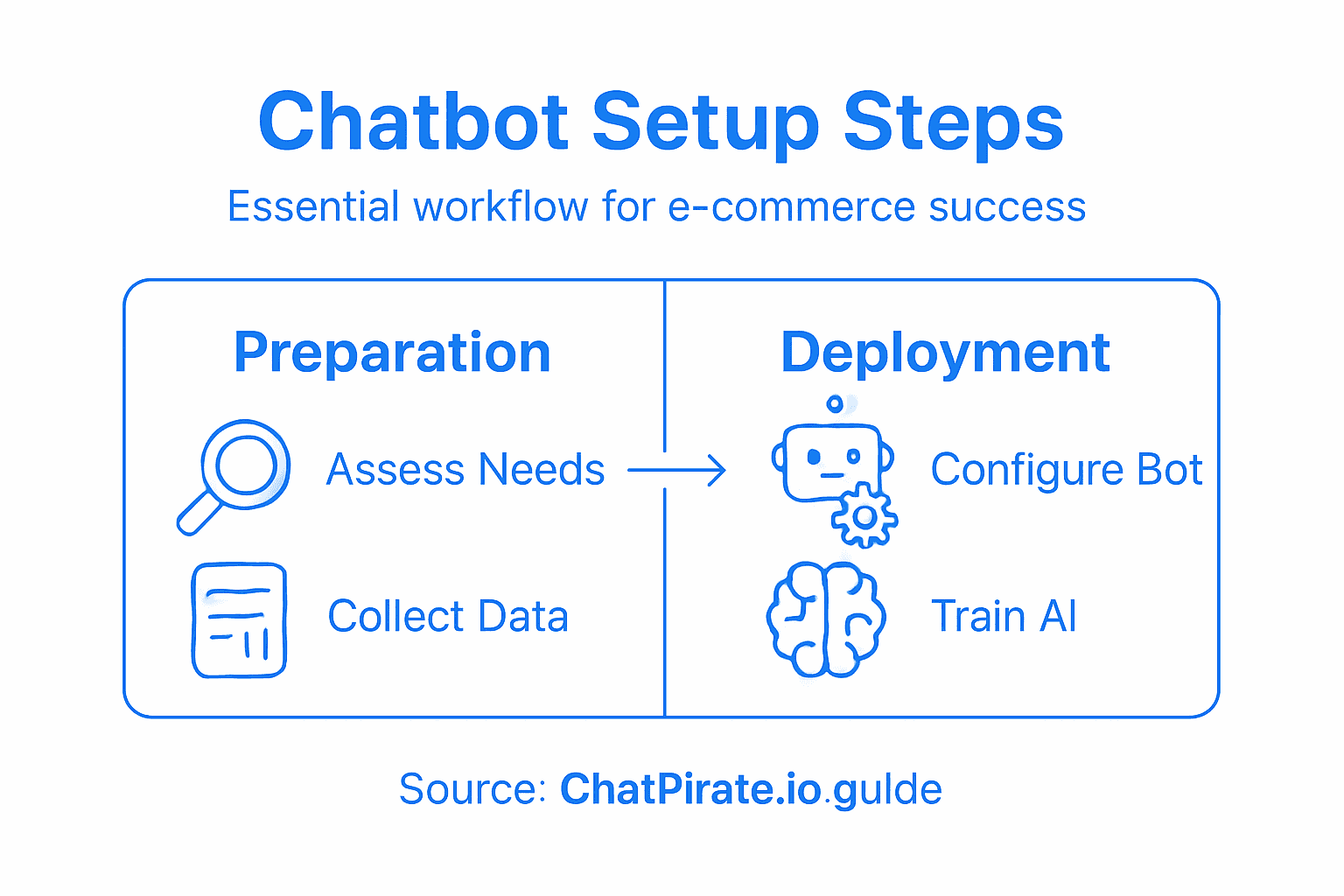
    Infographic showing chatbot setup step flow

    Pro tip: Create a separate test environment where you can experiment with training scenarios without impacting your live customer support system.

    Step 5: Deploy Chatbot on Your Online Store

    The final stage of your ChatPirate.io integration involves strategically implementing your newly trained chatbot onto your e-commerce platform. This critical step transforms your carefully configured AI assistant from a concept into an active customer support tool that will enhance user experience and streamline interactions.

    Open source deployment platforms offer robust integration strategies that can guide your implementation process. Begin by accessing the integration section within your ChatPirate.io dashboard and selecting your specific e-commerce platform WordPress, Shopify, WooCommerce, or custom website. Each platform requires slightly different embedding techniques so carefully follow the platform specific instructions. Generate your unique chatbot embed code and paste it into the designated area of your website header or footer section. Most platforms provide simple copy paste integration that requires minimal technical expertise.

    Verify your chatbot functionality by conducting thorough testing across multiple device types and screen sizes. Check that the chatbot loads correctly responds promptly and maintains the visual branding you established earlier. Pay special attention to mobile responsiveness ensure the chat interface remains clean and accessible on smaller screens. Monitor initial interactions closely and be prepared to make quick adjustments to improve performance and user experience.

    Pro tip: Always activate your chatbot in staging or test mode first allowing you to validate performance without risking live customer interactions.

    Step 6: Test and Optimize Chatbot Performance

    Optimizing your ChatPirate.io chatbot transforms it from a basic support tool into a sophisticated customer engagement platform. Your mission is to continuously refine its performance ensuring precise, helpful, and contextually accurate interactions that elevate your e-commerce customer experience.

    Performance benchmarking requires systematic evaluation strategies across multiple interaction scenarios. Start by creating comprehensive test cases that simulate realistic customer inquiries covering product questions, order tracking, returns, and technical support. Utilize ChatPirate.io analytics dashboard to track key metrics including response accuracy, average resolution time, customer satisfaction scores, and conversation completion rates. Review interaction logs meticulously identifying patterns where the chatbot struggles or provides incomplete responses. Pay special attention to edge cases and complex queries that might challenge your AI assistant.

    Implement an iterative optimization process where you continuously train and retrain your chatbot based on actual interaction data. Regularly update your knowledge base with new product information, recently added FAQs, and refined conversation flows. Conduct A/B testing on different response strategies and linguistic approaches to determine which communication style resonates most effectively with your specific customer base. Consider creating multiple conversation paths for different customer personas to ensure a more personalized support experience.

    Pro tip: Allocate at least 30 minutes weekly to review chatbot performance metrics and make targeted improvements based on actual customer interaction data.

    Compare major ChatPirate.io setup and improvement steps:

    Step Main Activity Key Outcome
    Configure Account Set access and preferences Secure, tailored account
    Brand Customization Adjust appearance and tone Cohesive customer interface
    AI Training Upload product/store content Accurate, useful responses
    Optimization Cycle Review performance data Ongoing chatbot improvement

    Unlock Seamless Chatbot Integration for Your E-Commerce Success

    If you found the step-by-step guide on setting up a chatbot helpful but feel overwhelmed by technical details or customization challenges take comfort knowing ChatPirate.io is built to simplify this entire process. The article highlights key hurdles such as assessing your support bottlenecks, configuring your account, customizing branding, training the AI with your store content, and deploying your chatbot without needing advanced coding skills. These steps reflect common pain points where businesses often struggle to balance quick setup with maintaining a unique brand voice and providing accurate 24/7 customer support.

    ChatPirate.io offers a streamlined SaaS platform designed to address exactly these challenges and more. Our solution empowers you to create AI-powered chatbots that integrate smoothly with leading platforms like WordPress and Shopify while learning intelligently from your documents and product details. You get the benefit of custom branding that fits your identity and powerful analytics to continuously optimize your chatbot’s performance. Say goodbye to costly support delays and inconsistent replies and hello to rapid, on-brand, automated customer engagement that scales.

    Take the next step now by visiting ChatPirate.io to experience how effortless effective chatbot setup can be. Discover detailed features, integration options, and tailored plans built specifically for e-commerce success with intelligent automation.

    Boost your customer satisfaction and reduce operational costs with a solution designed to get your chatbot live fast and performing flawlessly. Learn more about setting up your smart assistant at ChatPirate.io and turn your customer support into a competitive advantage.

    Drive your e-commerce growth forward by embracing simplicity and power together with ChatPirate.io
    https://chatpirate.io

    Explore how easy chatbot deployment can be for your store and start your free trial at ChatPirate.io today

    Frequently Asked Questions

    What are the first steps for setting up a ChatPirate.io chatbot for my e-commerce site?

    To begin setting up a ChatPirate.io chatbot, assess your integration needs by analyzing your current customer support system and identifying areas for automation. Create a detailed spreadsheet of potential customer interactions to guide your implementation strategy.

    How do I customize my chatbot’s appearance and branding?

    Customize your chatbot by selecting a color scheme, uploading your company logo, and defining the tone of voice for conversations. This will help your chatbot align with your brand’s visual and communication style, making it feel like a natural extension of your customer experience.

    What content should I train my chatbot with to ensure effective performance?

    Train your chatbot by gathering essential store content such as product descriptions, FAQs, and support policies. Ensure that the information is well-organized and formatted clearly, which will enable the AI to understand context and provide accurate answers.

    How can I ensure my chatbot integration is successful on my online store?

    Implement your chatbot by following the integration steps specific to your e-commerce platform and embedding the generated code in the correct section of your website. Conduct thorough testing across multiple devices to verify that the chatbot functions properly and meets user expectations.

    What metrics should I monitor to optimize my chatbot’s performance?

    Monitor key metrics like response accuracy, average resolution time, and customer satisfaction scores to evaluate your chatbot’s performance. Set aside time weekly to review these metrics and identify areas for improvement, aiming for consistent enhancements over time.


  • What Is AI Chatbot? Boosting Customer Support Online

    What Is AI Chatbot? Boosting Customer Support Online

    Over 60 percent of American shoppers expect instant responses when they reach out to online businesses. In e-commerce, meeting customer expectations for quick, personalized support can set you apart from global competitors. Understanding the essentials of customizable AI chatbots will help you deliver meaningful conversations while saving time and resources.

    Table of Contents

    Key Takeaways

    Point Details
    AI Chatbots Utilize Advanced Technologies Modern AI chatbots leverage Natural Language Processing and machine learning to generate intelligent, human-like interactions, improving user engagement.
    Choose the Right Chatbot Type Businesses should select between rule-based and conversational AI chatbots based on their specific interaction needs and complexities.
    Focus on Key Features for Success Successful chatbots require capabilities like sentiment analysis, real-time data integration, and continuous learning to enhance customer experiences.
    Assess Risks and Integration Needs Organizations must evaluate costs, ongoing maintenance, and potential ethical concerns to ensure effective and responsible AI chatbot deployment.

    AI Chatbots Explained: Definition and Core Concepts

    AI chatbots represent advanced digital communication tools designed to simulate intelligent human conversation through sophisticated technological frameworks. Conversational AI technologies leverage large language models trained on massive datasets, enabling these virtual agents to generate contextually relevant and human-like responses across multiple digital platforms.

    At their core, chatbots utilize natural language processing (NLP) and machine learning algorithms to understand, interpret, and respond to user inquiries. Unlike traditional rule-based systems, modern AI chatbots can analyze complex language nuances, learn from interactions, and provide personalized experiences. Virtual agents with advanced NLP have transformed how businesses and users interact by offering instant, intelligent support without human intervention.

    The technological evolution of chatbots has been remarkable. Early versions were limited to predefined scripts and basic keyword matching, but contemporary AI chatbots can understand context, detect sentiment, and generate dynamic responses. These intelligent systems integrate multiple technologies including neural networks, deep learning, and semantic understanding to create increasingly sophisticated conversational experiences.

    Pro tip: When implementing an AI chatbot, focus on training the model with high-quality, domain-specific data to ensure more accurate and relevant interactions.

    Types of AI Chatbots: Rule-Based vs. Conversational

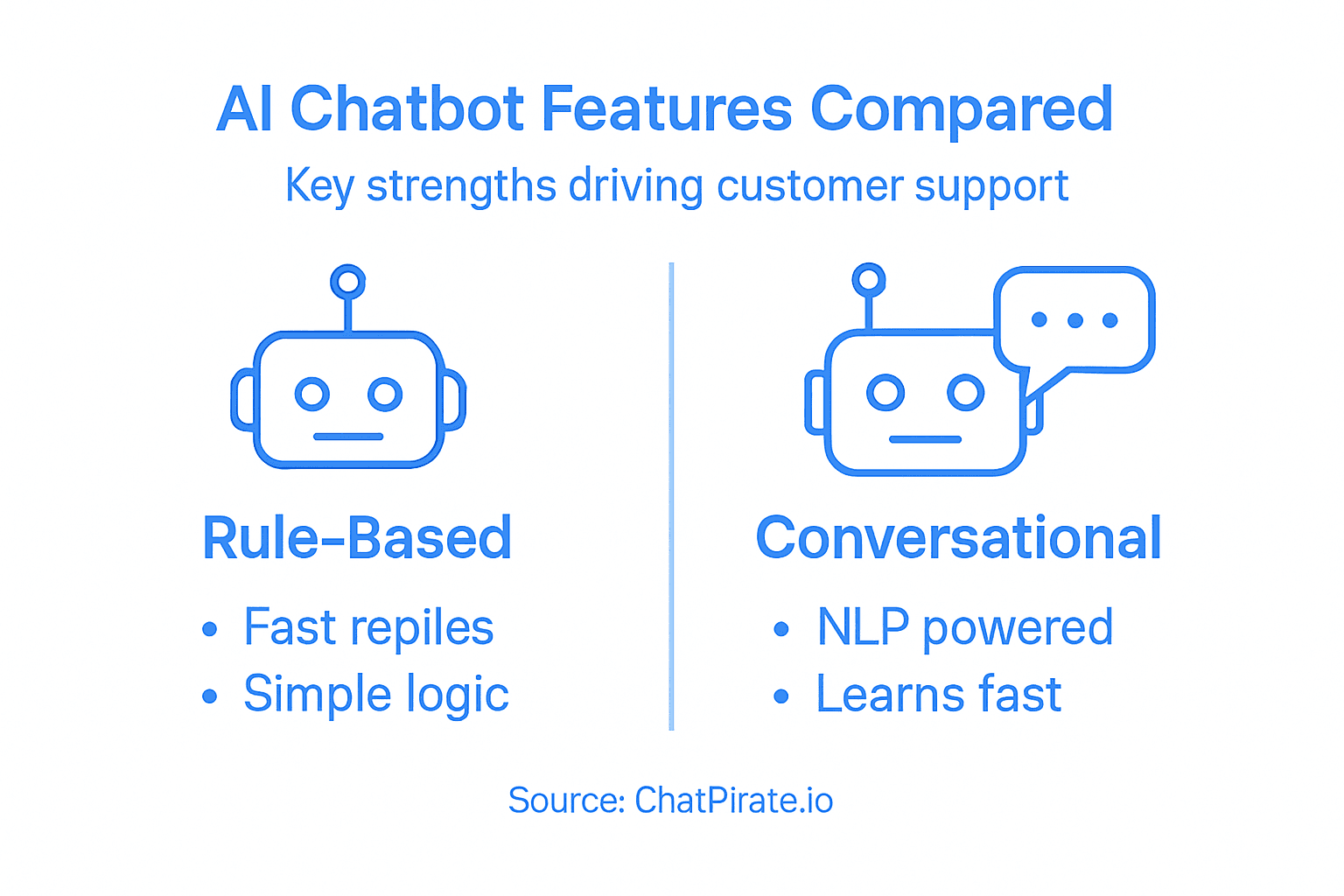
    AI chatbots have evolved into two distinct architectural models, each offering unique capabilities and interaction approaches. Rule-based chatbot systems represent the traditional approach, where interactions are governed by predefined scripts and decision trees that provide structured, predictable responses to specific user queries.

    Team brainstorming AI chatbot architecture

    In contrast, conversational AI chatbots leverage advanced machine learning and natural language processing to generate more dynamic and intelligent interactions. Conversational AI models can understand context, interpret user intent, and generate contextually relevant responses that closely mimic human communication. These sophisticated systems utilize large language models trained on extensive datasets, enabling them to adapt and learn from each interaction.

    The key differences between these chatbot types are significant. Rule-based chatbots excel in scenarios with clearly defined workflows and limited variability, such as basic customer support inquiries or guided troubleshooting. Conversational AI chatbots, however, shine in complex interaction scenarios that require nuanced understanding, emotional intelligence, and the ability to handle unpredictable user inputs across multiple domains like customer service, sales support, and personalized recommendations.

    Here’s a comparison of rule-based and conversational AI chatbots to highlight key differences and use cases:

    Aspect Rule-Based Chatbot Conversational AI Chatbot
    Interaction Method Predefined scripts Dynamic language understanding
    Learning Ability No self-learning Learns from user interactions
    Best Suited For Simple workflows Complex, nuanced conversations
    Implementation Cost Lower upfront cost Higher investment required

    Pro tip: Select your chatbot type based on your specific business requirements, considering factors like interaction complexity, budget, and desired user experience.

    Essential Features Driving Chatbot Success

    The foundation of a successful AI chatbot lies in its ability to deliver intelligent, responsive, and user-centric interactions. Key technological features include advanced natural language understanding that can accurately interpret user intent, maintain contextual awareness, and generate personalized responses across multiple communication channels.

    Infographic comparing chatbot feature types

    Modern AI chatbots must possess sophisticated capabilities that extend beyond basic communication. Comprehensive chatbot integration involves backend system connectivity for real-time data access, robust sentiment analysis to gauge user emotions, and the flexibility to handle increasingly complex queries. These features enable chatbots to provide nuanced, intelligent support that feels remarkably human-like and adaptable to diverse user needs.

    Critical performance drivers for AI chatbots include continuous learning mechanisms, multi-channel support, and scalable infrastructure. Successful implementations focus on creating chatbots that can dynamically improve their response quality, seamlessly transition between communication platforms, and maintain consistent performance under varying interaction volumes. Security and data protection remain paramount, ensuring user trust and compliance with evolving digital communication standards.

    This summary table showcases the most impactful AI chatbot features and their business benefits:

    Feature Business Impact Example Use Case
    Sentiment Analysis Enhances customer satisfaction Identifying frustrated users
    Real-Time Data Integration Enables instant, relevant replies Order status updates
    Multi-Channel Support Expands audience reach Support via chat and email
    Continuous Learning Improves response quality over time Adaptive customer support

    Pro tip: Prioritize chatbot features that align directly with your specific business objectives and target audience communication preferences.

    AI Chatbots in E-Commerce and Service Businesses

    Transformative AI chatbot technologies have revolutionized customer interaction strategies in e-commerce and service industries, enabling businesses to provide round-the-clock support and personalized engagement. These intelligent systems handle complex customer inquiries, streamline order processing, and create seamless digital experiences that adapt to global market demands, effectively bridging communication gaps between businesses and consumers.

    In service-oriented sectors, AI chatbots serve as critical operational tools that extend far beyond traditional customer support models. Multilingual customer interaction platforms enable businesses to qualify leads, collect real-time feedback, and resolve customer problems instantly across diverse cultural contexts. By leveraging advanced natural language processing, these chatbots can understand nuanced customer intents, provide accurate recommendations, and maintain consistently high-quality interactions without human intervention.

    The strategic implementation of AI chatbots offers quantifiable benefits for businesses. They dramatically reduce operational costs by automating routine tasks, increase customer satisfaction through immediate response times, and provide scalable solutions that can handle multiple simultaneous interactions. From e-commerce product recommendations to technical support in service industries, these intelligent systems are transforming how companies engage with their customers, making interactions more efficient, personalized, and data-driven.

    Pro tip: Design your AI chatbot with clear escalation paths to human representatives for complex inquiries that require specialized attention.

    Key Risks, Costs, and Integration Considerations

    AI chatbot deployment challenges encompass a complex landscape of technological, financial, and ethical considerations that businesses must carefully navigate. Organizations must critically evaluate initial development costs, ongoing maintenance expenses, and potential technological infrastructure requirements before implementing AI chatbot solutions. These investments extend beyond mere financial calculations, requiring comprehensive strategic planning and alignment with broader organizational objectives.

    The potential risks associated with AI chatbot implementation are multifaceted and demand rigorous assessment. Ethical AI integration strategies highlight critical concerns such as potential algorithmic biases, data privacy vulnerabilities, and the risk of generating misinformation. Businesses must establish robust governance frameworks that ensure transparent AI operations, protect user data, and maintain clear accountability mechanisms to mitigate potential negative consequences.

    Successful AI chatbot integration requires a holistic approach that balances technological capabilities with human oversight. Organizations need to invest in comprehensive staff training programs, develop clear escalation protocols, and continuously monitor chatbot performance. This approach helps minimize operational disruptions, ensures compliance with evolving global regulations, and maintains a delicate balance between automated efficiency and human-centered customer experiences.

    Pro tip: Conduct regular audits of your AI chatbot’s performance metrics and user feedback to identify potential biases and continuously refine its conversational capabilities.

    Elevate Your Customer Support with AI Chatbots from ChatPirate.io

    The article highlights the challenge of delivering intelligent, responsive, and personalized customer interactions around the clock. Many businesses struggle with complex support queries, maintaining contextual understanding, and providing seamless human handoff when needed. If you seek to reduce operational costs while enhancing customer satisfaction through scalable AI solutions, embracing conversational AI chatbots is a key step.

    ChatPirate.io offers an easy-to-deploy, AI-powered chatbot platform designed to learn from your unique website content and knowledge bases. Our customizable bots integrate smoothly with popular website builders like WordPress, Shopify, Wix, and Webflow, enabling you to automate order support, lead qualification, and appointment handling with minimal setup. Enjoy features like continuous learning, real-time data integration, and brand customization that align perfectly with the core concepts of natural language understanding and dynamic conversation presented in the article.

    Ready to transform your customer support experience and boost operational efficiency? Unlock the power of advanced AI chatbots designed for your business needs at ChatPirate.io.

    https://chatpirate.io

    Explore how our seamless integrations and intelligent chatbots can enhance your online engagement now. Visit ChatPirate.io to get started today and see why businesses trust us for smarter customer support.

    Frequently Asked Questions

    What is an AI chatbot?

    AI chatbots are advanced digital tools that simulate human conversation using natural language processing and machine learning, enabling them to provide intelligent, contextually relevant responses across various digital platforms.

    How do rule-based chatbots differ from conversational AI chatbots?

    Rule-based chatbots operate on predefined scripts and decision trees, while conversational AI chatbots use advanced language processing to understand context and user intent, allowing for dynamic and nuanced interactions.

    What key features should I look for in an AI chatbot?

    Key features include advanced natural language understanding, real-time data integration, sentiment analysis, multi-channel support, and continuous learning capabilities to improve response quality over time.

    How can AI chatbots enhance customer support for businesses?

    AI chatbots enhance customer support by providing 24/7 assistance, handling complex inquiries, automating routine tasks, and delivering personalized engagement, ultimately improving customer satisfaction and operational efficiency.

  • 7 Examples of AI Chatbots for Business Success

    7 Examples of AI Chatbots for Business Success

    Most american e-commerce managers discover their teams spend up to 70 percent of customer service hours answering routine questions and tracking orders. Managing support for international buyers often means juggling time zones and limited staff resources. This article shows how AI chatbots are helping retailers provide instant, accurate order updates and automate customer interactions for better satisfaction and reduced costs.

    Table of Contents

    Quick Summary

    Key Message Explanation
    1. AI chatbots enhance e-commerce support AI chatbots provide instant, accurate responses, reducing response times and improving customer satisfaction in order support.
    2. Automate FAQs to save resources Implementing AI chatbots for frequently asked questions reduces the workload of support teams while ensuring timely and accurate responses for customers.
    3. Improve lead qualification efficiency AI chatbots automate initial interactions, swiftly assessing prospects and allowing sales teams to concentrate on high-potential leads.
    4. Streamline appointment bookings AI chatbots can facilitate real-time scheduling, reducing administrative burdens and managing multiple appointments without staff involvement.
    5. Enhance brand consistency through customization Customizable chatbots reflect a company’s unique brand voice, fostering trust and creating cohesive customer experiences across platforms.

    1. AI Chatbots for E-Commerce Order Support

    E-commerce businesses face significant customer service challenges that AI chatbots can strategically resolve. These intelligent digital assistants are transforming how online retailers handle order support by providing instant, accurate responses to customer inquiries.

    AI chatbots leverage advanced natural language processing to automate complex order support tasks, dramatically reducing response times and improving customer satisfaction. They excel at managing critical functions like order tracking, delivery updates, and addressing common customer questions without human intervention.

    Customer support automation through AI chatbots enables e-commerce platforms to handle multiple inquiries simultaneously, ensuring no customer query goes unanswered. By integrating directly with inventory and shipping systems, these chatbots can provide real-time order status updates, estimated delivery times, and proactively address potential shipping concerns.

    Businesses implementing AI chatbots typically see significant operational improvements. They can reduce customer service staff workload by up to 70%, while maintaining high-quality support and increasing overall customer engagement. The chatbots work 24/7, providing consistent support across different time zones and languages.

    Pro tip: When implementing an AI chatbot for order support, start by mapping your most common customer inquiries and train your chatbot to handle those scenarios first to maximize immediate effectiveness.

    2. Chatbots for Automating Customer FAQs

    Customer frequently asked questions (FAQs) represent a critical touchpoint for businesses seeking to optimize their support efficiency. AI chatbots offer a sophisticated solution for automating these repetitive yet essential interactions.

    Modern AI technologies enable chatbots to leverage advanced natural language processing for understanding and responding to customer inquiries with remarkable accuracy. These intelligent systems can instantly interpret complex questions, match them against comprehensive knowledge bases, and deliver precise answers without human intervention.

    By implementing AI chatbots for FAQ automation, businesses can dramatically reduce support team workload while maintaining high quality customer service. These digital assistants work around the clock, providing consistent responses that eliminate human error and variability. They can handle multiple inquiries simultaneously, ensuring no customer is left waiting and every question receives a prompt resolution.

    The key advantages of FAQ automation through AI chatbots include reduced operational costs, faster response times, and enhanced customer satisfaction. Companies can program these chatbots with industry specific terminology, company policies, and product information, creating a dynamic self service solution that adapts to evolving customer needs.

    Pro tip: When developing an FAQ chatbot, prioritize creating a comprehensive and regularly updated knowledge base that covers 80% of your most common customer questions to maximize automation effectiveness.

    3. Lead Qualification with AI Chatbots

    Lead qualification represents a critical business process where AI chatbots are revolutionizing traditional sales and marketing approaches. These intelligent digital assistants can systematically evaluate potential customer interests and match them with appropriate sales opportunities.

    AI chatbots transform lead qualification by automating initial user interaction through sophisticated conversational algorithms. They can instantly assess a prospect’s needs, budget, timeline, and decision making potential by asking strategic questions and analyzing responses in real time.

    The core advantage of using AI chatbots for lead qualification lies in their ability to operate continuously without human fatigue. These systems can simultaneously engage multiple potential leads, collecting critical information and scoring them based on predefined criteria. This approach allows sales teams to focus exclusively on high potential prospects who have already been pre screened and demonstrate genuine interest.

    Businesses implementing AI chatbot lead qualification strategies typically see significant improvements in conversion rates. By providing immediate, personalized interactions, these chatbots can reduce response times from hours or days to mere seconds, dramatically increasing the likelihood of capturing a potential customer’s attention and interest.

    Pro tip: Design your AI chatbot lead qualification workflow with progressively more detailed questions, allowing the system to gradually build a comprehensive profile of each potential lead while maintaining an engaging conversational experience.

    4. AI Chatbots for Booking and Appointment Management

    Appointment scheduling represents a time consuming administrative task that can significantly drain organizational resources. AI chatbots are transforming this process by providing intelligent, automated booking solutions across multiple industries.

    Modern AI chatbots can streamline complex booking workflows through advanced natural language processing capabilities. These digital assistants can understand user intent, check availability in real time, and schedule appointments with minimal human intervention.

    Businesses ranging from healthcare clinics to professional service providers can leverage AI chatbot technology to dramatically reduce administrative overhead. These systems can handle multiple scheduling requests simultaneously, provide instant confirmation, send automated reminders, and even manage rescheduling or cancellation processes without requiring direct staff involvement.

    The key advantages of AI appointment management include 24/7 availability, instant response times, reduced human error, and seamless integration with existing calendar management systems. By automating scheduling workflows, organizations can free up staff time for more complex and strategic tasks while maintaining a high level of customer service.

    Pro tip: Configure your AI chatbot with flexible scheduling parameters that allow for buffer times between appointments and automatic synchronization with your primary calendar management platform.

    5. Customizable Chatbots for Branding Consistency

    Branding consistency represents a critical factor in creating memorable customer experiences across digital platforms. AI chatbots now offer unprecedented opportunities for organizations to extend their unique brand personality through intelligent conversational interfaces.

    Companies can now develop personality driven chatbot strategies that reflect their specific organizational voice and communication style. These advanced chatbots go beyond simple scripted responses by incorporating nuanced language patterns, tone, and interaction styles that align precisely with brand identity.

    Customizable chatbots enable businesses to create digital assistants that sound like authentic representatives of their brand. This means the chatbot can adopt specific communication characteristics whether the brand voice is professional, friendly, technical, or playful. Organizations can program specific vocabulary, adjust response complexity, and even integrate brand specific humor or terminology.

    The strategic implementation of branded chatbots provides multiple benefits. They create consistent user experiences, reinforce brand messaging, increase customer engagement, and provide a unified communication approach across multiple digital touchpoints. By maintaining a coherent personality, these AI chatbots help build trust and recognition.

    Pro tip: Develop a comprehensive brand communication guide for your AI chatbot that includes specific language rules, preferred terminology, and acceptable communication styles to ensure consistent representation.

    6. Analytics-Driven Chatbot Insights for Growth

    Analytics represent the powerful engine that transforms AI chatbots from simple communication tools into strategic business intelligence platforms. By systematically capturing and analyzing user interactions, businesses can unlock unprecedented insights into customer behavior and organizational performance.

    Modern AI chatbots are capable of generating comprehensive interaction analytics that go far beyond basic conversation tracking. These intelligent systems collect detailed data points including response times, user sentiment, frequently asked questions, conversation completion rates, and user engagement metrics.

    Businesses can leverage these analytics to make data informed decisions about product development, customer service improvements, and overall user experience optimization. The insights generated provide a granular understanding of customer needs, pain points, and preferences that traditional feedback methods cannot capture.

    By implementing robust analytics frameworks, organizations can continuously refine their chatbot performance. This iterative approach allows for real time adjustments to conversation flows, response accuracy, and overall chatbot functionality based on actual user interaction data.

    Pro tip: Establish a regular review cycle of your chatbot analytics at least once per quarter to identify emerging trends, optimize conversation paths, and ensure your AI remains aligned with evolving customer expectations.

    7. Seamless Human Handoff with AI Chatbots

    AI chatbots represent powerful initial support tools, but complex customer inquiries often require nuanced human intervention. Seamless human handoff mechanisms enable businesses to create intelligent support workflows that combine automated efficiency with personalized human expertise.

    The most advanced AI chatbots are now designed with intelligent escalation protocols that recognize conversation complexity and transfer interactions to human agents at precisely the right moment. These sophisticated systems analyze conversation context, detect user sentiment, and determine when machine generated responses no longer adequately address customer needs.

    Effective human handoff strategies involve creating clear communication pathways between AI chatbots and human support teams. This means developing robust integration systems that transfer complete conversation histories, context markers, and preliminary problem assessments directly to human agents, ensuring a smooth and informed transition.

    By implementing intelligent handoff mechanisms, businesses can optimize their customer support operations. The AI chatbot handles routine inquiries and initial screening, while human agents focus on resolving more complex, nuanced customer challenges that require emotional intelligence and advanced problem solving skills.

    Pro tip: Design your AI chatbot handoff workflow with predefined escalation triggers based on conversation complexity, user frustration levels, and specific keyword recognition to ensure timely and appropriate human intervention.

    Below is a table summarizing the roles and benefits of AI chatbots in various business applications as detailed in the article.

    Application Description Key Benefits
    E-Commerce Order Support Automation of tracking, resolving inquiries, and delivery updates. Reduced response times and improved customer satisfaction.
    FAQ Automation Addressing repetitive customer inquiries with AI-driven responses. Decrease in support workload and 24/7 consistent service.
    Lead Qualification Evaluating and engaging potential customer leads through intelligent queries. Increased conversion rates and efficient lead processing.
    Appointment Management Scheduling and managing appointments through conversational interfaces. Reduced administrative load and real-time booking efficiency.
    Branding Consistency Implementing tailored communication styles within chatbot interactions. Reinforced brand identity and cohesive user experiences.
    Analytics-Driven Insights Gathering and analyzing interaction data for strategic improvements. Enhanced service optimization and data-informed decisions.
    Human Handoff Integration Seamless transfer of complex issues to human agents. Efficient escalation with comprehensive context sharing.

    Transform Your Business with AI Chatbots from ChatPirate.io

    The article highlights common challenges businesses face such as managing customer inquiries quickly, automating FAQs, qualifying leads efficiently, and maintaining brand consistency through intelligent AI chatbots. These pain points often result in overwhelmed support teams, lost sales opportunities, and inconsistent customer experiences. At ChatPirate.io, we understand these issues and offer a powerful, customizable AI chatbot platform designed to reduce operational costs, enhance customer support speed, and boost satisfaction around the clock.

    Our platform seamlessly integrates with popular website builders like WordPress and Shopify, allowing businesses of all sizes to deploy smart chatbots that learn from your own content and knowledge bases. Whether you need automation for order support, lead qualification, appointment scheduling, or branding consistency, ChatPirate.io delivers solutions tailored to your needs with easy setup and real-time analytics.

    Ready to elevate your customer engagement and streamline your operations today

    https://chatpirate.io

    Discover how ChatPirate.io can transform your business with intelligent chatbot solutions that grow with you. Visit our landing page now to get started and explore our customizable chatbot features that put your brand first while delivering instant, accurate customer responses every time.

    Frequently Asked Questions

    What types of support can AI chatbots provide for e-commerce businesses?

    AI chatbots can handle various customer inquiries such as order tracking, delivery updates, and addressing common questions. By implementing an AI chatbot, e-commerce businesses can improve response times significantly and manage multiple inquiries simultaneously, enhancing overall customer satisfaction.

    How can I use chatbots to automate customer FAQs effectively?

    To effectively automate customer FAQs, prioritize creating a comprehensive knowledge base that covers about 80% of your most common customer questions. This will allow the chatbot to respond accurately and consistently, reducing support team workload and improving efficiency.

    What are the key benefits of using AI chatbots for lead qualification?

    AI chatbots streamline lead qualification by automating the initial interaction with prospects, gathering essential information like needs, budget, and timeline. This approach can lead to increased conversion rates by allowing sales teams to focus on high-potential leads who are genuinely interested, often reducing response times from hours to a few seconds.

    How can AI chatbots enhance appointment scheduling for my business?

    AI chatbots can facilitate appointment scheduling by checking real-time availability, confirming bookings, and sending automated reminders. By using a chatbot, businesses can reduce administrative overhead and free up staff to concentrate on more strategic tasks while ensuring 24/7 availability for customers.

    In what ways can I customize an AI chatbot to reflect my brand’s personality?

    You can customize an AI chatbot by programming it to use specific vocabulary, tone, and communication styles that align with your brand identity. This ensures a consistent user experience and reinforces your brand messaging, enhancing customer engagement and trust.

    How can I analyze the performance of my AI chatbot?

    To analyze the performance of your AI chatbot, establish a regular review cycle to examine user interaction data, response times, and engagement metrics. This will help you identify trends and areas for improvement, allowing you to make real-time adjustments to enhance the overall customer experience.

  • Why Use Chatbots: Powering Ecommerce Results

    Why Use Chatbots: Powering Ecommerce Results

    Around 62% of American shoppers now expect instant answers every time they visit an online store. For E-commerce managers worldwide, meeting these expectations means more than just responding quickly. Fast, intelligent support shapes loyalty and sales, and AI chatbots deliver this edge with effortless conversations and round-the-clock support. Discover how embracing these advanced tools can drive real results in customer engagement while making daily operations smoother for your growing brand.

    Table of Contents

    Key Takeaways

    Point Details
    Understanding Chatbots Chatbots utilize advanced AI and natural language processing to simulate human conversation and improve customer interactions.
    E-commerce Applications Different types of chatbots, such as support, sales, recommendation, and marketing, enhance specific aspects of online shopping experiences.
    Benefits of Implementation Integrating chatbots can lead to reduced support costs, improved customer engagement, and increased conversion rates for businesses.
    Strategic Integration Proper planning, user testing, and attention to data quality are essential for successful chatbot deployment and ongoing performance.

    What Are Chatbots And How They Work

    Chatbots are advanced artificial intelligence systems designed to simulate human conversation and provide intelligent, automated interactions across digital platforms. These sophisticated virtual agents leverage cutting-edge technologies like natural language processing to understand, interpret, and respond to user queries with remarkable precision and context awareness.

    At their core, chatbots function through complex algorithms that enable them to process text or voice inputs and generate contextually relevant responses. Modern chatbots utilize machine learning and large language models, allowing them to move far beyond simple rule-based scripted interactions. They can understand nuanced language, learn from previous conversations, and adapt their communication style to match user preferences. This technological evolution means chatbots are no longer just automated response systems but intelligent conversational partners capable of handling complex customer service scenarios.

    The technical architecture of chatbots typically involves several key components. First, the natural language understanding (NLU) module interprets user inputs, breaking down sentences into meaningful components. Next, the dialog management system determines the most appropriate response based on the interpreted input. Finally, the natural language generation module crafts human-like responses that sound natural and contextually appropriate. This multi-stage process happens in milliseconds, creating seamless interactions that feel surprisingly human.

    Pro tip: When implementing a chatbot, prioritize training it on your specific business context to ensure more accurate and relevant customer interactions.

    Types Of Ecommerce Chatbots Explained

    E-commerce chatbots represent a spectrum of technological sophistication, ranging from basic rule-based systems to advanced artificial intelligence platforms. Rule-based chatbots function through predefined decision trees, offering static responses to common customer inquiries. These simple chatbots follow programmed pathways, providing straightforward answers to frequently asked questions about shipping, returns, and product information.

    Agent chatting with online shoppers via chatbot

    More advanced chatbots leverage sophisticated natural language processing and machine learning capabilities. These AI-driven chatbots can understand nuanced user intent, generate personalized responses, and continuously learn from each interaction. They offer dynamic customer experiences by providing intelligent product recommendations, conducting conversational product searches, and even simulating personalized shopping assistance. Unlike rule-based systems, these chatbots can adapt their communication style, understand context, and provide more human-like interactions that significantly enhance customer engagement.

    E-commerce platforms typically deploy several specialized chatbot types to address different operational needs. Support chatbots handle customer service inquiries, order tracking, and complaint resolution. Sales chatbots focus on guiding customers through purchase decisions, offering product suggestions, and answering pre-sale questions. Recommendation chatbots utilize customer data and browsing history to suggest personalized products. Marketing chatbots engage users through targeted campaigns, abandoned cart recovery, and promotional interactions. Each chatbot type is strategically designed to improve specific aspects of the online shopping experience.

    Here’s a summary of common e-commerce chatbot types and their main business value:

    Chatbot Type Key Function Business Impact
    Support Chatbot Answers customer questions Reduces support costs and response time
    Sales Chatbot Guides purchase decisions Increases conversion rates
    Recommendation Chatbot Suggests products Boosts average order value
    Marketing Chatbot Sends promotions Improves customer retention

    Pro tip: Select a chatbot solution that offers flexible customization and integrates seamlessly with your existing e-commerce platform to maximize customer interaction effectiveness.

    Key Benefits: Speed, Cost, And Engagement

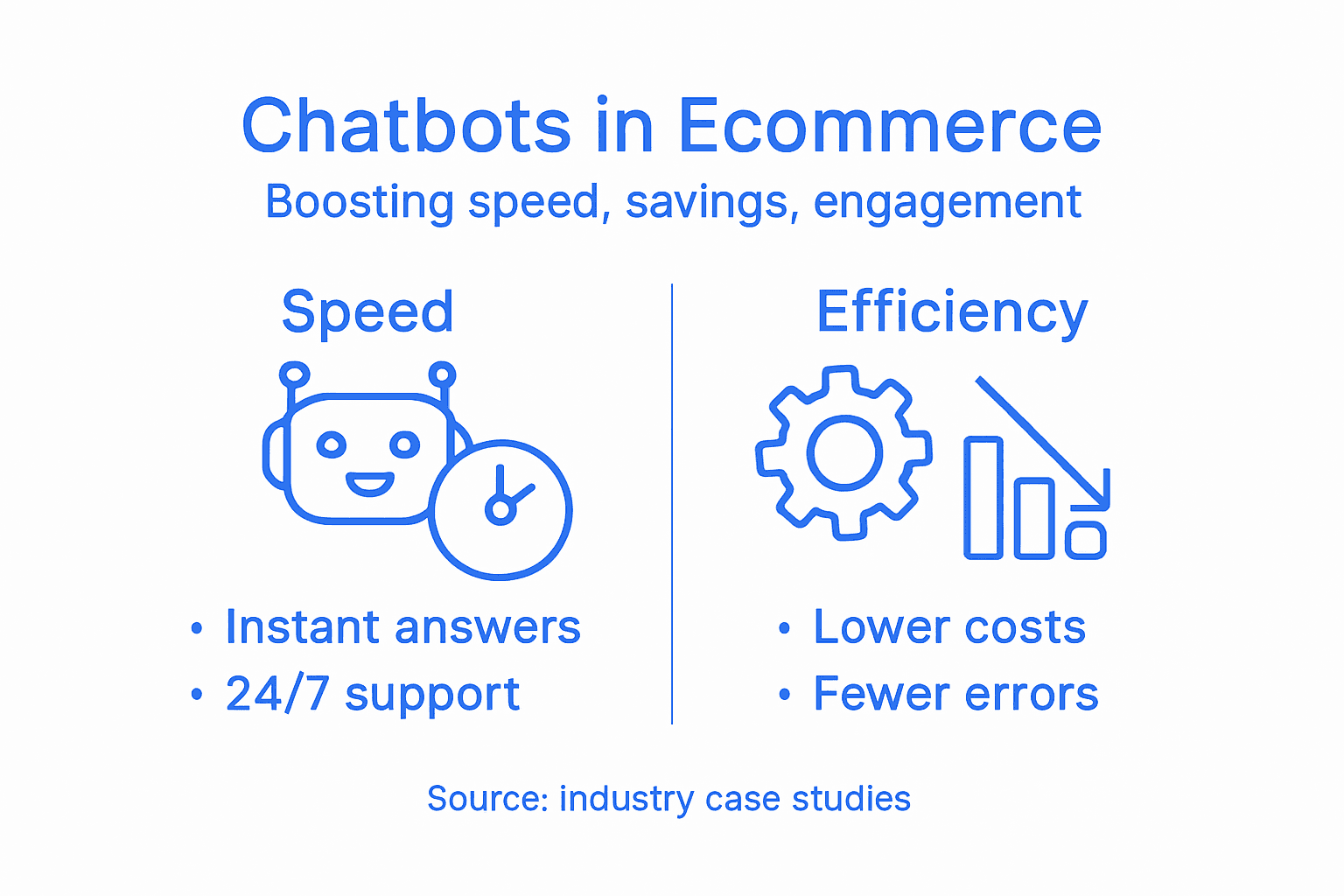
    E-commerce chatbots deliver transformative advantages that fundamentally reshape customer interaction strategies. AI chatbots enhance customer engagement by providing instantaneous, round-the-clock support that dramatically improves user experience. These intelligent systems can simultaneously handle multiple customer inquiries, eliminating traditional wait times and ensuring customers receive immediate, accurate assistance regardless of time or complexity of their request.

    Minimalist infographic shows chatbot ecommerce benefits

    From a cost perspective, chatbots represent a significant operational efficiency breakthrough. By automating routine customer service interactions, businesses can substantially reduce labor expenses associated with traditional support models. A single chatbot can replace multiple customer service representatives, handling thousands of interactions simultaneously without additional staffing costs. This automation translates into direct financial savings while maintaining high-quality customer support, allowing companies to reallocate human resources toward more complex, strategic tasks that require nuanced problem-solving and emotional intelligence.

    Engagement metrics demonstrate the profound impact of chatbots on customer satisfaction and retention. These intelligent systems go beyond simple query resolution, offering personalized recommendations, guiding purchase decisions, and creating interactive shopping experiences. By understanding individual customer preferences through machine learning algorithms, chatbots can deliver tailored product suggestions, answer specific questions, and create a more intuitive, responsive shopping environment. The result is increased customer loyalty, higher conversion rates, and a more dynamic, responsive e-commerce ecosystem that feels uniquely attuned to each user’s needs.

    Pro tip: Implement chatbot analytics to continuously refine your conversational strategies and track key performance indicators like response time, user satisfaction, and conversion rates.

    Proven Ecommerce Use Cases And Results

    E-commerce chatbots have revolutionized customer interaction across multiple operational domains. Chatbots streamline customer support by automating complex interactions and providing instantaneous, intelligent assistance. Specific use cases demonstrate their transformative potential across different stages of the customer journey, from initial product discovery to post-purchase support.

    Key implementation scenarios include real-time product recommendations, order tracking, and comprehensive customer service. Support chatbots efficiently handle routine inquiries about shipping status, return policies, and product specifications, freeing human agents to address more nuanced customer needs. Sales-oriented chatbots guide potential buyers through purchase decisions by offering personalized suggestions based on browsing history and preferences. Marketing chatbots re-engage customers through abandoned cart recovery, targeted promotions, and interactive conversational experiences that maintain brand connection.

    Measurable results highlight the substantial impact of chatbot integration. Businesses report significant improvements in key performance metrics, including reduced customer response times, increased conversion rates, and enhanced overall customer satisfaction. Advanced chatbots can decrease support costs by up to 30%, while simultaneously improving engagement through 24/7 availability and personalized interactions. By leveraging machine learning algorithms, these intelligent systems continuously improve their response accuracy, creating a dynamic, adaptive customer support ecosystem that evolves with user interactions.

    Pro tip: Implement A/B testing with your chatbot to systematically refine conversation flows and optimize user engagement strategies.

    Integration Steps And Common Pitfalls

    Successfully implementing e-commerce chatbots requires a strategic, comprehensive approach that goes beyond simple technological deployment. Chatbot integration demands careful planning and a holistic understanding of both technological capabilities and business objectives. The process begins with clearly defining specific goals: whether improving customer support, increasing sales conversions, or enhancing overall user engagement.

    The integration journey involves multiple critical stages. First, businesses must conduct a thorough assessment of their existing technological infrastructure and customer interaction patterns. This includes mapping current customer journey touchpoints, identifying potential automation opportunities, and selecting chatbot technologies compatible with existing systems. Key technical considerations include natural language processing capabilities, machine learning potential, and seamless integration with customer relationship management (CRM) platforms, inventory systems, and e-commerce backends. Equally important is designing conversational flows that feel intuitive and authentic, avoiding robotic or overly scripted interactions that might frustrate users.

    While implementing chatbots offers tremendous potential, several common pitfalls can undermine success. Many businesses rush implementation without adequate user testing, leading to poor interaction experiences. Other critical mistakes include insufficient training data, which results in limited or inaccurate responses, and neglecting continuous performance monitoring and refinement. Privacy and data security represent another crucial consideration, requiring robust protocols to protect customer information and maintain trust. Successful chatbot integration demands an ongoing commitment to technological adaptation, user feedback incorporation, and strategic alignment with evolving customer expectations.

    The following table outlines key integration steps and potential pitfalls to avoid:

    Integration Step Critical Action Common Pitfall
    Goal Setting Define clear objectives Vague project goals
    Tech Assessment Analyze system compatibility Overlooking infrastructure gaps
    Data Training Use diverse, quality data Inadequate data leads to errors
    User Testing Gather real user feedback Insufficient scenario coverage

    Pro tip: Conduct comprehensive user testing with diverse scenarios and continuously collect feedback to iteratively improve your chatbot’s performance and user experience.

    Unlock the Full Potential of Ecommerce with AI-Powered Chatbots

    The challenges outlined in “Why Use Chatbots: Powering Ecommerce Results” highlight how crucial it is for businesses to reduce customer support costs, speed up response times, and boost engagement through intelligent automation. If you’ve experienced frustration with slow answers or costly staffing while trying to keep customers happy, you are not alone. ChatPirate.io offers a powerful solution with customizable AI-driven chatbots that seamlessly integrate with popular platforms like WordPress, Shopify, Wix, and Webflow. These chatbots learn directly from your own website content and knowledge base to provide instant and accurate support 24/7, helping you overcome common pitfalls such as inadequate data training and poor user testing.

    https://chatpirate.io

    Take the next step toward transforming your ecommerce experience today by exploring how ChatPirate.io can reduce operational expenses while improving customer satisfaction and engagement. Enjoy easy setup with no coding skills required, plus advanced features like seamless human handoff and detailed analytics dashboards. Start delivering smarter customer interactions that drive sales and loyalty now by visiting ChatPirate.io and see why businesses trust our AI chatbot platform to meet their evolving customer service and sales needs.

    Frequently Asked Questions

    What are the main benefits of using chatbots in e-commerce?

    E-commerce chatbots enhance customer engagement by providing instant, 24/7 support, reducing wait times, and allowing businesses to handle multiple inquiries simultaneously. They also lower operational costs by automating routine tasks and enabling better allocation of human resources.

    How do AI-driven chatbots differ from rule-based chatbots?

    AI-driven chatbots utilize natural language processing and machine learning, enabling them to understand user intent, create personalized responses, and learn from interactions. In contrast, rule-based chatbots follow predefined paths and provide static answers to common questions, limiting their adaptability.

    What are some common use cases for e-commerce chatbots?

    Common use cases include providing real-time product recommendations, handling customer support inquiries, assisting with order tracking, and recovering abandoned carts through personalized marketing interactions.

    What steps are involved in integrating chatbots into an e-commerce platform?

    Key steps include setting clear goals, assessing existing technologies, training chatbots with quality data, and conducting user testing to refine conversational flows. Continuous monitoring and adaptation are essential for long-term success.

  • Role of Chatbots in Order Support Success

    Role of Chatbots in Order Support Success

    Nearly half of American consumers now expect instant replies to order questions from online stores. For e-commerce managers juggling customer support worldwide, falling short can mean lost sales and negative reviews. As digital shopping habits evolve, understanding how AI chatbots transform order support is crucial. Discover which chatbot solutions can deliver faster, more accurate responses and keep satisfaction high across every market.

    Table of Contents

    Key Takeaways

    Point Details
    Chatbots Enhance Customer Support E-commerce chatbots automate and streamline order inquiries, offering 24/7 support and instant responses.
    Diverse Chatbot Models Different types of chatbots, such as rule-based and AI-powered, cater to various customer interaction needs.
    Operational Efficiency Gains Implementing chatbots can significantly reduce costs and improve response times, leading to better customer engagement.
    Strategic Implementation Is Key Careful planning, rigorous training, and continuous monitoring are vital for successful chatbot deployment.

    Defining Chatbots in E-Commerce Order Support

    Chatbots in e-commerce order support represent intelligent software applications designed to automate and streamline customer interactions throughout the purchasing journey. These advanced digital assistants utilize artificial intelligence and natural language processing to provide instantaneous, personalized support for order-related inquiries, transforming how online businesses manage customer communication.

    At their core, e-commerce chatbots function as sophisticated communication tools that systematically analyze customer interactions to deliver real-time assistance. They handle critical tasks such as order tracking, delivery updates, product recommendations, and addressing frequently asked questions without requiring human intervention. By integrating seamlessly with existing e-commerce platforms, these AI-powered assistants can instantly retrieve order information, process basic customer requests, and provide 24/7 support across multiple digital channels.

    The technological capabilities of modern e-commerce chatbots extend far beyond simple scripted responses. Advanced AI technologies enable personalized shopping experiences that adapt to individual customer preferences and behaviors. These intelligent systems can understand context, interpret complex customer queries, and provide nuanced responses that mimic human-like interaction. By leveraging machine learning algorithms, chatbots continuously improve their understanding and response accuracy, making them increasingly valuable tools for enhancing customer engagement and satisfaction.

    Pro tip: When implementing an e-commerce chatbot, prioritize training the AI with comprehensive, industry-specific knowledge bases to ensure accurate and contextually relevant customer support.

    Key Chatbot Types and Essential Capabilities

    E-commerce businesses can leverage different types of chatbots, each with unique technological approaches designed to enhance customer order support. Chatbot classification reveals distinct architectural models that range from simple rule-based systems to advanced artificial intelligence-driven platforms, providing varying levels of interaction and problem-solving capabilities.

    The primary chatbot types include rule-based, AI-powered, hybrid, and platform-based systems. Rule-based chatbots operate using predefined conversation paths and specific keyword triggers, making them ideal for handling straightforward, predictable customer inquiries. In contrast, AI-powered chatbots utilize sophisticated natural language processing and machine learning algorithms to understand context, interpret complex queries, and generate dynamic responses that adapt to individual customer interactions.

    Hybrid chatbots represent an innovative middle ground, combining the structured reliability of rule-based systems with the adaptive intelligence of AI technologies. These advanced systems can seamlessly switch between predefined scripts and intelligent response generation, ensuring consistent and intelligent customer support. Advanced chatbot technologies support complex user interactions by integrating multiple communication strategies, enabling more nuanced and personalized customer experiences across various digital platforms.

    Here’s a visual comparison of the main chatbot types used in e-commerce order support:

    Chatbot Type Technology Used Best For Limitations
    Rule-based Decision trees, keywords Simple, repetitive inquiries Limited adaptability
    AI-powered Machine learning, NLP Complex, dynamic conversations Requires ongoing training
    Hybrid Rules + AI algorithms Balanced support, escalation Higher integration effort
    Platform-based APIs, plug-in modules Multi-channel deployment Platform dependency

    Pro tip: When selecting a chatbot for order support, prioritize solutions that offer flexible integration capabilities and demonstrate strong natural language understanding to ensure seamless customer interactions.

    How Chatbots Handle Order Inquiries

    Order inquiry management represents a critical function for e-commerce chatbots, enabling businesses to provide instant, accurate support throughout the customer purchasing journey. Automated order support technologies allow these intelligent systems to process a wide range of customer questions rapidly, from tracking shipments to resolving basic order-related concerns without human intervention.

    The core capabilities of chatbots in handling order inquiries include real-time status updates, precise order tracking, and intelligent routing of complex issues. Natural language processing enables these systems to understand nuanced customer questions, interpreting intent beyond simple keyword matching. Chatbots can instantly retrieve order details, provide estimated delivery times, explain shipping policies, and even help customers modify or cancel existing orders through conversational interfaces that feel intuitive and responsive.

    Support agent checks chatbot order dashboard

    Advanced chatbots go beyond basic information retrieval by implementing sophisticated intent recognition techniques. Intelligent query management technologies allow these systems to distinguish between different types of customer requests, categorize their complexity, and determine the most appropriate response strategy. When an inquiry exceeds the chatbot’s capabilities, these systems can seamlessly escalate the conversation to human customer support representatives, ensuring that no customer query goes unresolved.

    Pro tip: Configure your chatbot with comprehensive order-related knowledge bases and implement clear escalation protocols to maximize automated support effectiveness while maintaining high customer satisfaction levels.

    Benefits and Limitations for Businesses

    E-commerce businesses increasingly recognize the transformative potential of chatbot technologies in customer support operations. Comprehensive AI chatbot analysis reveals a nuanced landscape of significant advantages balanced against critical implementation challenges. These intelligent systems offer unprecedented opportunities for operational efficiency, customer engagement, and cost management across digital service environments.

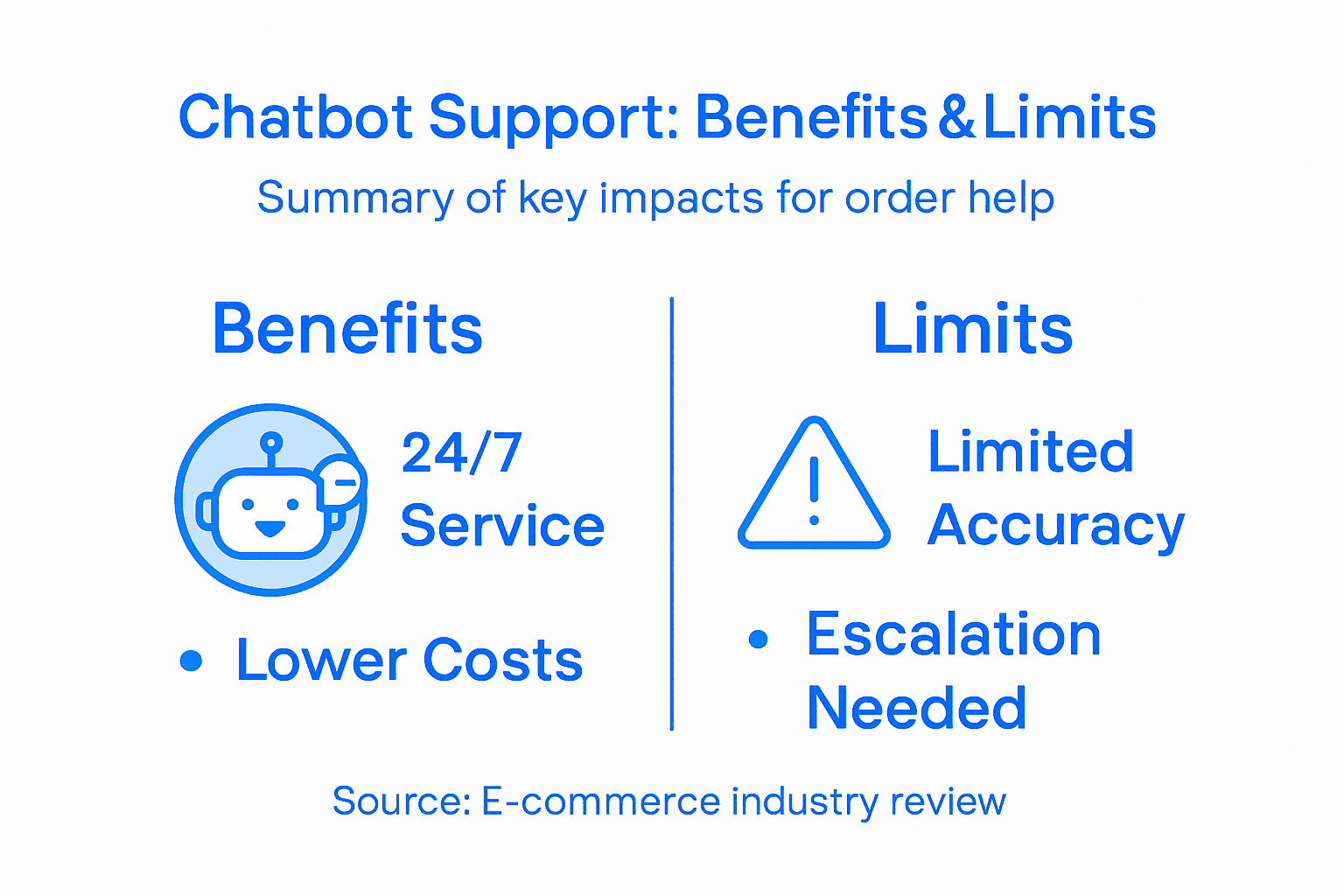
    The primary benefits of chatbot deployment include substantial cost reduction, round-the-clock customer support, and dramatically improved response times. Businesses can leverage these technologies to handle multiple simultaneous inquiries, provide instant answers, and create personalized interaction experiences that would be impossible with traditional human-only support models. Business efficiency through automated systems enables companies to scale customer support capabilities without proportionally increasing human resource investments, allowing smaller teams to manage increasingly complex customer interaction demands.

    Infographic: Chatbot order support pros and cons

    This table summarizes top business impacts of implementing e-commerce chatbots:

    Benefit Description Example Outcome
    Operational efficiency Automates routine customer tasks Reduced workload on staff
    Customer engagement Instant, personalized responses Higher satisfaction scores
    Cost management Scales support without hiring Lower support expenses
    24/7 service Always available for shoppers Increased order conversions

    However, chatbot implementations are not without significant limitations. Critical challenges include potential response inaccuracies, data privacy concerns, and the ongoing need for sophisticated training and maintenance. These systems require continuous refinement of their knowledge bases, careful monitoring of interaction quality, and strategic human oversight to ensure they maintain high standards of customer service and avoid potential misunderstandings or inappropriate responses that could damage customer relationships.

    Pro tip: Implement a robust hybrid support model that combines AI chatbot capabilities with human expert oversight, ensuring seamless escalation and continuous performance improvement.

    Avoiding Common Chatbot Implementation Pitfalls

    Successful chatbot deployment requires a strategic approach that anticipates and mitigates potential implementation challenges. Responsible chatbot design frameworks emphasize the critical importance of understanding potential pitfalls before launching an automated support system. E-commerce businesses must recognize that chatbot implementation is not a simple plug-and-play solution but a complex process demanding careful planning and ongoing management.

    Some of the most significant implementation challenges include misaligned expectations, poor system integration, and inadequate training. Many businesses fall into the trap of expecting chatbots to function as all-knowing, perfectly responsive systems without recognizing their inherent limitations. Strategic chatbot implementation techniques reveal that successful deployments require clear objective setting, comprehensive knowledge base development, and robust integration with existing customer support infrastructures. This means investing time in mapping out precise use cases, understanding the specific scenarios where chatbots can add value, and creating fallback mechanisms for complex inquiries.

    Technical challenges also demand careful consideration. Businesses must address potential issues such as data privacy, response accuracy, and system scalability. This involves implementing rigorous testing protocols, establishing clear guidelines for data handling, and creating transparent escalation paths that allow seamless transitions between automated and human support. Continuous monitoring and iterative improvement are crucial, ensuring that chatbot performance evolves in alignment with changing customer expectations and technological capabilities.

    Pro tip: Develop a comprehensive chatbot implementation roadmap that includes pilot testing, continuous performance evaluation, and adaptive learning strategies to minimize potential operational risks.

    Elevate Your E-Commerce Order Support with AI-Powered Chatbots

    The article highlights key challenges businesses face in delivering instant, accurate order support while managing costs and ensuring customer satisfaction. Chatbots must provide real-time order tracking, handle complex inquiries with natural language understanding, and offer seamless escalation to human agents when needed. If you are striving to reduce operational workload while enhancing the customer experience, leveraging customizable AI chatbots that learn from your unique business data is critical.

    At ChatPirate.io, we specialize in empowering businesses to overcome these very obstacles. Our platform delivers AI chatbots designed to automate e-commerce order support effortlessly. With easy integration options for WordPress, Shopify, Wix, and Webflow, you can deploy a smart assistant that offers 24/7 instant replies, understands complex queries, and escalates to human support seamlessly. Imagine improving customer engagement, cutting support costs, and scaling your order support efficiently with a solution tailored to your brand and needs.

    Transform your order support today by exploring how customizable AI chatbots can become your business’s most reliable assistant.

    https://chatpirate.io

    Boost your customer satisfaction and operational efficiency now by visiting ChatPirate.io. Start your chatbot journey and experience the future of order support success.

    Frequently Asked Questions

    What are the capabilities of chatbots in handling order inquiries?

    Chatbots are designed to provide real-time status updates, precise order tracking, and intelligent routing of complex customer issues. They utilize natural language processing to understand nuanced questions and can instantly retrieve order details, provide estimated delivery times, and assist with order modifications.

    How do chatbots improve customer engagement in e-commerce?

    Chatbots enhance customer engagement by offering instant, personalized responses to inquiries around the clock. Their ability to handle multiple simultaneous interactions allows businesses to provide immediate support, resulting in higher customer satisfaction scores and increased order conversions.

    What types of chatbots are used in e-commerce order support?

    The main types of chatbots include rule-based, AI-powered, hybrid, and platform-based systems. Rule-based chatbots handle straightforward inquiries, while AI-powered chatbots use advanced techniques to manage complex conversations. Hybrid chatbots combine both approaches for balanced support, and platform-based systems facilitate multi-channel deployment.

    What are common pitfalls to avoid when implementing a chatbot in e-commerce?

    Common pitfalls include misaligned expectations, poor system integration, and inadequate training. To ensure a successful deployment, businesses should set clear objectives, develop comprehensive knowledge bases, and establish robust integration with existing customer support systems.

  • What Is Conversational AI and Its Impact on Support

    What Is Conversational AI and Its Impact on Support

    Over 50 percent of American online shoppers say they expect instant help when contacting customer service. For e-commerce managers at small and medium-sized businesses, meeting these expectations can quickly stretch resources and budgets. Conversational AI offers a smart way to deliver rapid, personalized support without sacrificing quality or driving up operational costs, giving your team more time to focus on growth instead of repetitive queries.

    Table of Contents

    Key Takeaways

    Point Details
    Importance of Conversational AI Conversational AI enhances customer interactions by enabling nuanced, human-like communication that adapts to user intent.
    Types of Conversational AI Technologies Choosing the right technology—rule-based, retrieval-based, or generative—is crucial for matching specific business needs.
    Business Benefits Organizations benefit through improved efficiency, reduced costs, and enhanced customer satisfaction across various sectors.
    Risk Management Companies must address ethical challenges and financial considerations, ensuring robust governance and continuous monitoring for AI systems.

    Conversational AI Defined for E-Commerce Teams

    Conversational Artificial Intelligence (CAI) represents a transformative technology enabling machines to interact with humans through natural, intuitive communication. At its core, conversational AI enables software agents to understand and respond to human language with remarkable sophistication. For e-commerce teams, this means creating dynamic digital interactions that feel genuinely human-like and contextually intelligent.

    Unlike traditional rule-based chatbots, modern conversational AI leverages advanced machine learning and natural language processing to comprehend user intent, interpret nuanced communication, and generate contextually appropriate responses. These intelligent systems can understand customer queries, provide personalized recommendations, handle complex support requests, and even predict potential customer needs before they are explicitly stated. By analyzing previous interactions and learning continuously, AI-powered conversational agents improve communication effectiveness with each customer engagement.

    E-commerce teams can utilize conversational AI across multiple critical functions. These include automated customer support, personalized product recommendations, order tracking, returns processing, and proactive customer engagement. The technology allows businesses to provide 24/7 support, reduce response times, and scale customer interactions without proportionally increasing human resources. Key capabilities include multilingual support, sentiment analysis, and the ability to handle multiple concurrent conversations with consistent quality.

    Pro tip: Start by mapping your most common customer interaction scenarios and train your conversational AI system to handle those specific use cases with high accuracy before expanding to more complex interactions.

    Major Types of Conversational AI Technologies

    Conversational AI technologies have evolved into sophisticated systems with distinct architectural approaches, each offering unique capabilities for digital interactions. Conversational AI broadly encompasses three primary technological categories: rule-based systems, retrieval-based chatbots, and generative conversational agents. These technologies represent increasingly complex methods of simulating human-like communication, with each type presenting specific strengths and limitations for e-commerce applications.

    Rule-based systems represent the most fundamental approach, operating through predefined scripts and decision trees that provide structured, predictable responses. Retrieval-based chatbots offer more flexibility by selecting optimal responses from a curated database using advanced matching algorithms. In contrast, generative conversational systems use deep learning models to create entirely novel responses, enabling more dynamic and contextually nuanced interactions. These generative models leverage transformer architectures and large language models to understand complex user intents and generate human-like replies.

    For e-commerce teams, selecting the right conversational AI technology depends on specific business requirements. Rule-based systems work well for straightforward, predictable interactions like order tracking or basic product inquiries. Retrieval-based chatbots excel in scenarios with well-defined conversation paths, such as technical support or FAQ resolution. Generative AI models represent the cutting edge, offering unprecedented flexibility for handling complex, unpredictable customer interactions with greater linguistic sophistication and adaptive learning capabilities.

    Here’s a summary of major conversational AI technologies and where they excel:

    Technology Type Core Mechanism Ideal Use Case Key Limitation
    Rule-Based Predefined scripts and logic Simple, repetitive inquiries Lacks flexibility for complex issues
    Retrieval-Based Database response selection Technical support, FAQs Limited to existing database responses
    Generative Deep learning, model-based generation Unpredictable, complex conversations May produce inaccurate or off-topic replies

    Pro tip: When implementing conversational AI, start with a hybrid approach that combines rule-based accuracy with generative flexibility, allowing your system to progressively learn and improve its interaction capabilities.

    How Conversational AI Works in Practice

    Conversational AI operates through a sophisticated multilayered process that transforms human language into intelligent, contextual interactions. Natural language processing systems break down user inputs into comprehensible components, analyzing linguistic nuances, intent, and underlying meaning. This intricate deconstruction allows artificial intelligence to understand not just the literal words, but the actual purpose behind a customer’s communication.

    The core mechanism involves three critical components working in seamless synchronization. Natural Language Understanding (NLU) identifies the user’s specific intent and extracts key information, while Dialogue Management tracks the conversation’s context and determines the most appropriate response pathway. Natural Language Generation creates human-like replies that sound natural and contextually relevant, using advanced machine learning algorithms to craft responses that feel authentic and personalized.

    Analyst reviewing workflow for conversational AI

    For e-commerce applications, this technological process translates into powerful customer interaction capabilities. The AI can understand complex product inquiries, handle support requests, process returns, and even provide personalized recommendations based on previous interactions. Machine learning algorithms continuously refine the system’s understanding, enabling increasingly sophisticated and accurate responses over time. This means e-commerce teams can provide instantaneous, intelligent support that adapts and improves with each customer interaction, reducing operational costs and enhancing overall customer satisfaction.

    Pro tip: Implement a continuous feedback loop that allows human agents to review and rate AI-generated responses, helping to train and improve the conversational AI system’s accuracy and contextual understanding.

    Business Benefits and Industry Use Cases

    Business benefits of conversational AI extend far beyond simple customer interactions, transforming operational capabilities across multiple industries. By automating routine tasks and providing intelligent, personalized communication channels, organizations can dramatically reduce operational costs while simultaneously improving customer engagement and satisfaction. The technology enables businesses to handle complex interactions with unprecedented efficiency, scaling support capabilities without proportional increases in human resource investments.

    Across different sectors, conversational AI demonstrates remarkable versatility. In e-commerce, it powers personalized shopping experiences, answers product inquiries, and manages order tracking. Financial institutions leverage these systems for fraud detection, account management, and customer support. Healthcare applications include appointment scheduling, patient triage, and providing preliminary medical information. Generative AI assistants have shown significant productivity improvements, with studies indicating a potential 14% increase in overall support team performance, particularly benefiting less experienced workers by disseminating best practice knowledge.

    The technological capabilities of conversational AI translate into tangible business advantages. By providing 24/7 support, reducing human error, and offering instantaneous responses, companies can enhance customer satisfaction while simultaneously reducing operational overhead. Machine learning algorithms continuously refine the system’s understanding, meaning the AI becomes more sophisticated and accurate with each interaction. This creates a dynamic, self-improving support ecosystem that adapts to changing customer needs and market dynamics, giving businesses a significant competitive advantage.

    Infographic of conversational AI business benefits

    Below is a quick reference on common business benefits and deployment examples by industry:

    Benefit E-Commerce Example Finance Example
    Increased Efficiency 24/7 automated support AI-powered fraud alerts
    Cost Reduction Fewer agents needed Automated account management
    Enhanced Satisfaction Personalized recommendations Rapid query resolution

    Pro tip: Start by implementing conversational AI in your most repetitive and high-volume customer interaction channels, using detailed analytics to track performance and iteratively improve the system’s response accuracy.

    Potential Risks and Cost Considerations

    Conversational AI technologies introduce complex ethical and operational challenges that businesses must carefully navigate. While the potential benefits are significant, organizations need to understand the potential risks associated with implementation. These risks include algorithmic bias, potential misinformation generation, privacy concerns, and the financial investment required to develop and maintain sophisticated AI systems that can genuinely add value to customer interactions.

    The primary risks extend beyond technological limitations. Ethical considerations and potential misuse of AI technologies remain critical concerns for responsible implementation. Conversational AI systems can inadvertently perpetuate existing biases, generate inaccurate or misleading information, and potentially compromise customer data privacy. Companies must invest in robust governance frameworks, continuous monitoring, and regular audits to ensure the AI system maintains accuracy, fairness, and alignment with organizational values.

    From a financial perspective, implementing conversational AI involves substantial upfront and ongoing costs. Initial investments include technology infrastructure, machine learning model development, data collection and training, integration with existing systems, and ongoing maintenance. Small to medium-sized businesses must carefully assess the return on investment, considering factors such as expected efficiency gains, reduced support personnel costs, and potential improvements in customer satisfaction. The complexity of AI systems means that continuous refinement and human oversight are essential to mitigate risks and ensure optimal performance.

    Pro tip: Develop a comprehensive risk management strategy that includes regular bias audits, transparent AI decision-making processes, and clear protocols for human intervention when AI systems encounter complex or sensitive scenarios.

    Transform Your Customer Support with Conversational AI Today

    The challenges outlined in “What Is Conversational AI and Its Impact on Support” highlight how businesses struggle with providing fast, accurate, and scalable customer service around the clock. Key pain points such as long response times, inability to handle complex or multiple conversations, and the need for continuous learning and personalization demand a robust solution.

    At ChatPirate.io, we deliver AI-powered chatbots that learn directly from your existing website content, knowledge bases, and documents to provide instant, accurate responses 24/7. Our platform removes the complexity of setup with seamless integrations for popular website builders, empowering your team to reduce operational costs while enhancing support speed and customer satisfaction. With advanced features like human handoff, analytics dashboards, and branding customization, ChatPirate.io fits perfectly with the evolving needs of growing businesses seeking AI that adapts, scales, and delivers real results.

    Experience how conversational AI can transform your support experience by exploring ChatPirate.io.

    https://chatpirate.io

    Don’t wait to elevate your customer service with intelligent automation that keeps pace with your business growth. Visit ChatPirate.io now to start your free trial and see how easy and powerful conversational AI implementation can be. Unlock smarter support that works day and night so you can focus on what matters most.

    Frequently Asked Questions

    What is conversational AI?

    Conversational AI refers to advanced technologies that enable machines to interact with humans through natural, intuitive communication, often using natural language processing and machine learning for more human-like interactions.

    How can conversational AI improve customer support in e-commerce?

    Conversational AI can enhance customer support by providing 24/7 automated assistance, handling multiple inquiries simultaneously, offering personalized recommendations, and improving response times, thereby increasing overall customer satisfaction.

    What are the different types of conversational AI technologies used in support?

    The primary types of conversational AI technologies include rule-based systems, retrieval-based chatbots, and generative conversational agents, each with its strengths and suitable use cases for customer interactions.

    What are the potential risks associated with implementing conversational AI?

    Potential risks include algorithmic bias, misinformation generation, privacy concerns, and significant financial investment for development and maintenance. Companies must implement robust governance and monitoring frameworks to mitigate these risks.

  • How to Improve Customer Satisfaction With Chatbots

    How to Improve Customer Satisfaction With Chatbots

    Over 60 percent of American e-commerce businesses report that slow customer service leads to lost sales. In the competitive online market, support managers know every minute counts when addressing customer requests. Learning how to enhance your support workflows with chatbots enables your team to deliver consistent, immediate responses, uncover hidden inefficiencies, and raise customer satisfaction while lightening the load on your staff.

    Table of Contents

    Quick Summary

    Key Insight Explanation
    1. Assess Your Current Workflows Analyze existing customer support processes to identify inefficiencies and potential improvements before implementing chatbots.
    2. Integrate an AI Chatbot Solution Choose and configure a chatbot that meets your specific organizational needs, enhancing support interactions across various channels.
    3. Customize Responses for Consistency Develop a response library that reflects your brand’s voice while ensuring accuracy and variety in chatbot communication.
    4. Monitor Interactions for Quality Regularly review chatbot performance metrics to maintain high support quality and identify areas for improvement.
    5. Analyze Feedback for Optimization Continuously collect and analyze user feedback to refine the chatbot’s effectiveness and adapt to changing customer expectations.

    Step 1: Assess Current Customer Support Workflows

    To optimize your customer support strategy using chatbots, you first need to conduct a comprehensive analysis of your existing support workflows. This critical step allows you to identify bottlenecks, inefficiencies, and opportunities for improvement before implementing an AI-powered solution.

    Start by collecting and analyzing your customer interaction data. Advanced clustering techniques can help you understand user intents and sentiment patterns across your support channels. Review customer service records, chat transcripts, email interactions, and phone support logs to gain a holistic view of how customers currently engage with your support team. Look for common questions, frequent pain points, average response times, and resolution rates.

    Make sure to map out your entire customer support journey from initial contact to final resolution. Document each touchpoint, interaction type, and the current human resources involved. This workflow mapping will reveal where chatbots can most effectively augment or replace manual processes. Understanding query complexity helps configure AI systems that can handle routine inquiries while seamlessly transferring more nuanced requests to human agents.

    Pro Tip: Create a visual workflow diagram to help your team easily understand current support processes and identify potential automation opportunities.

    Step 2: Integrate and Configure AI Chatbot Solution

    Once you have assessed your current customer support workflows, it is time to integrate and configure an AI chatbot solution that will transform your customer service experience. This crucial step involves selecting the right technology and tailoring it precisely to your organization’s specific needs and communication patterns.

    Begin by implementing microservices architecture that allows for flexible and scalable chatbot deployment. Choose a platform that supports advanced natural language processing capabilities, enabling your chatbot to understand complex customer intents and provide contextually relevant responses. Focus on solutions that offer robust intent recognition, sentiment analysis, and seamless human agent handoff mechanisms. These features ensure your chatbot can handle routine inquiries efficiently while escalating more nuanced interactions to human support staff.

    Configuration is key to creating an intelligent and responsive chatbot. Train your AI system using existing customer interaction data, focusing on common questions, support tickets, and typical communication patterns. Personalized AI assistance strategies can significantly improve customer satisfaction by enabling more natural and empathetic interactions. Integrate your chatbot across multiple channels including website, mobile app, and messaging platforms to provide consistent and accessible support.

    Pro Tip: Test your chatbot thoroughly with diverse scenarios and continuously monitor its performance metrics to refine its responses and improve accuracy.

    Here’s a summary of key business benefits enabled by AI chatbot integration:

    Benefit How Chatbots Deliver It Impact on Support Teams
    Faster Response Times Immediate automated replies Reduces manual workload
    Consistent Messaging Predefined response styles Strengthens brand reliability
    24/7 Availability Continuous service presence Improves customer satisfaction
    Data-Driven Insights Analytics on interactions Informs process improvement

    Step 3: Customize Chatbot Responses for Consistency

    Customizing your chatbot’s responses is critical for creating a seamless and professional customer support experience. Your goal is to develop a communication style that reflects your brand’s unique voice while maintaining accuracy and reliability across all interactions.

    IT specialist editing chatbot responses

    Context-aware response techniques help you create more nuanced and intelligent conversational patterns. Start by developing a comprehensive response template library that covers common customer inquiries. These templates should include variations in language to prevent robotic repetition while preserving core messaging consistency. Analyze your existing customer communication records to identify typical conversation flows, frequent questions, and preferred language styles specific to your customer base.

    Work closely with your support team to refine chatbot language models. Natural language processing strategies enable you to build conversational paths that sound natural yet remain professionally consistent. Implement sentiment analysis tools to help your chatbot detect emotional nuances and adjust responses accordingly. Create multiple response variations for each interaction type to prevent monotonous exchanges while maintaining a uniform communication standard. Regularly review and update your response templates based on customer feedback and changing communication trends.

    Pro Tip: Create a comprehensive style guide for your chatbot that outlines acceptable language, tone, and response structures to maintain consistent communication across all customer interactions.

    Step 4: Monitor Customer Interactions for Quality

    Monitoring your chatbot’s customer interactions is crucial for maintaining high-quality support and continuously improving your automated communication strategies. By systematically tracking and analyzing conversation performance, you can identify areas of improvement and ensure your chatbot meets customer expectations.

    Advanced NLP monitoring techniques enable you to gain deep insights into customer interactions. Implement comprehensive analytics tools that track key performance metrics such as response accuracy, resolution rates, customer sentiment, and conversation duration. Pay close attention to intent recognition accuracy and emotional tone to understand how effectively your chatbot is addressing customer needs. Regularly review conversation logs to identify patterns of customer frustration, misunderstandings, or repeated queries that might indicate gaps in your chatbot’s knowledge base or response strategies.

    Infographic of five steps for chatbot satisfaction

    User satisfaction analysis methods provide critical insights into your chatbot’s performance. Develop a systematic approach to collecting and analyzing customer feedback, including post-interaction surveys, sentiment scoring, and direct user comments. Set up automated alerts for conversations that trigger negative sentiment indicators, allowing your support team to quickly intervene and understand the root causes of customer dissatisfaction. Create a continuous improvement cycle where insights from monitoring directly inform updates to your chatbot’s response templates, conversation flows, and overall interaction design.

    Pro Tip: Create a weekly review process that includes a comprehensive analysis of chatbot interaction data to identify trends, potential improvements, and opportunities for enhancing customer experience.

    Step 5: Analyze Feedback and Optimize Automation

    Analyzing customer feedback is the key to transforming your chatbot from a basic automated system into an intelligent, responsive support tool. By systematically evaluating user interactions, you can continuously refine your chatbot’s performance and ensure it meets evolving customer expectations.

    Multi-layer feedback analysis techniques provide powerful insights into your chatbot’s effectiveness. Implement advanced sentiment and semantic analysis tools that go beyond simple satisfaction scores. Break down customer interactions into granular components such as intent recognition accuracy, emotional tone, response relevance, and resolution speed. Pay attention to subtle nuances in communication patterns that might reveal deeper insights about user experience and potential areas for improvement.

    Continuous feedback loop strategies enable dynamic chatbot optimization. Develop a structured approach to collect quantitative and qualitative feedback through multiple channels including post interaction surveys, direct user comments, and automated sentiment tracking. Use machine learning algorithms to identify recurring themes, unexpected user queries, and performance gaps. Create a responsive improvement framework where insights directly inform updates to your chatbot’s knowledge base, conversation flows, and response templates. Regularly validate these improvements through controlled testing and comparative performance metrics.

    Pro Tip: Implement a quarterly comprehensive review process that not only analyzes chatbot performance but also involves cross functional teams to provide diverse perspectives on potential improvements.

    Below is a comparison of feedback analysis methods for chatbot optimization:

    Method Approach Key Advantage
    Sentiment Scoring Automated emotion detection Reveals user satisfaction
    Semantic Analysis Parses conversation meaning Identifies response gaps
    Post-Interaction Surveys Direct user comments Uncovers experience issues
    Machine Learning Theme Mining Detects trends automatically Spots recurring problems

    Elevate Customer Satisfaction with AI Chatbots Tailored to Your Needs

    The article highlights common challenges like slow response times, inconsistent messaging, and difficulty handling complex queries that reduce customer satisfaction. If you are looking to transform your customer support workflows and implement AI-driven chatbots that deliver faster responses and consistent, brand-aligned communication then ChatPirate.io offers the perfect solution. Our platform enables you to quickly deploy customizable AI chatbots that learn from your website content and knowledge bases to provide instant, accurate answers 24/7 with seamless human handoff when needed.

    Key benefits you gain include:

    • Immediate replies that reduce customer wait time
    • Personalized conversational styles matching your brand voice
    • Scalable automation that grows with your business
    • Deep analytics to monitor and optimize chatbot quality continuously

    https://chatpirate.io

    Experience how easy it is to enhance your support strategy by visiting ChatPirate.io and unleashing powerful AI chatbots designed to boost satisfaction and reduce operational costs now. Get started with simple integration on popular platforms like WordPress and Shopify and turn every customer interaction into a positive experience. Don’t wait to improve your support team performance and delight more customers today.

    Frequently Asked Questions

    How can chatbots improve customer satisfaction?

    Chatbots can enhance customer satisfaction by providing immediate responses and 24/7 availability. To leverage this, analyze customer inquiries and program the chatbot to handle common questions within the first 30 days of implementation.

    What initial steps should I take to assess my customer support workflows before implementing a chatbot?

    Start by analyzing customer interaction data to identify common pain points and slow response times. Create a visual workflow diagram to map the customer support journey over the next two weeks, highlighting where chatbots can be most beneficial.

    How do I customize chatbot responses to match my brand’s voice?

    Develop a response template library that reflects your brand’s tone while providing accurate answers. Review the templates regularly to incorporate customer feedback and make updates at least quarterly to ensure consistency.

    What key performance metrics should I monitor for my chatbot?

    Focus on metrics like response accuracy, resolution rates, and customer sentiment. Set up a weekly monitoring process to track these metrics and identify trends for improvement.

    How can I use customer feedback to optimize my chatbot?

    Analyze feedback to identify gaps in the chatbot’s knowledge and response accuracy. Implement a continuous feedback loop, making iterative updates to your chatbot’s responses based on customer insights every 60 days.

  • 7 Key Advantages of AI Chatbots for SMBs in 2026

    7 Key Advantages of AI Chatbots for SMBs in 2026

    Over 60 percent of American online shoppers expect instant help every time they visit an e-commerce site. Meeting this demand is a growing challenge for small and medium businesses juggling limited resources and constant support requests. AI chatbots now offer a practical path for e-commerce managers worldwide to automate customer assistance, reduce costs, and deliver seamless experiences day and night. Discover how these solutions can transform your support strategy and keep shoppers satisfied while protecting your budget.

    Table of Contents

    Quick Summary

    Takeaway Explanation
    1. Implement AI Chatbots for 24/7 Support AI chatbots can operate continuously, providing instant responses and freeing human agents for complex issues.
    2. Reduce Customer Support Costs Automating routine inquiries significantly lowers staffing expenses while maintaining high service quality.
    3. Enhance Customer Engagement Personalization through AI chatbots transforms interactions, fostering brand loyalty and improved customer experiences.
    4. Seamless Website Integration Available AI chatbots can be easily integrated into popular platforms, enhancing functionality without technical difficulties.
    5. Efficient Sales Lead Generation Automating customer engagement enables continuous lead qualification, improving efficiency in capturing potential clients.

    1. Automate 24/7 Customer Support for Instant Help

    AI chatbots represent a revolutionary solution for small and medium sized businesses seeking continuous customer support without massive staffing costs. By implementing advanced generative AI technologies, businesses can now provide seamless 24/7 customer interactions that operate around the clock.

    Traditional customer support models require human agents working in shifts to manage inquiries. AI chatbots eliminate these constraints by leveraging natural language processing and machine learning to deliver instant responses. These intelligent systems can handle multiple customer interactions simultaneously, reducing wait times and providing consistent service quality regardless of time or geographical location.

    The operational benefits are substantial. By automating routine inquiries, AI chatbots free human agents to focus on more complex customer issues that require nuanced problem solving. This approach significantly improves operational efficiency and customer satisfaction. Small businesses can now offer enterprise level support without proportional increases in staffing or infrastructure costs.

    Implementation is straightforward for most online businesses. Modern AI chatbot platforms integrate seamlessly with existing websites, allowing businesses to deploy intelligent support systems within hours. The key is selecting a solution that can learn from your specific business context and continuously improve its response accuracy.

    Key Implementation Strategies:
    • Train your chatbot using existing customer support documentation
    • Configure clear escalation paths to human agents
    • Regularly review and update chatbot conversation logs
    • Monitor key performance metrics like resolution rate and customer satisfaction

    Pro tip: Start with a narrowly defined scope for your AI chatbot and gradually expand its capabilities as you gain confidence in its performance.

    2. Lower Support Costs Without Sacrificing Quality

    Small and medium businesses face constant pressure to optimize customer support while managing tight budgets. AI chatbots offer a transformative solution by dramatically reducing customer service expenses without compromising interaction quality.

    Traditional customer support models require substantial human resources. Multiple agents working in shifts generate significant overhead costs. AI chatbots fundamentally change this economic equation by handling up to 80% of routine customer inquiries automatically. These intelligent systems provide consistent high quality responses while dramatically reducing labor expenses.

    The financial benefits extend beyond simple staffing reductions. Modern AI chatbots leverage advanced natural language processing to understand context and deliver personalized interactions. This means businesses can maintain professional service standards while simultaneously cutting operational expenses. The technology learns from each interaction improving response accuracy and efficiency over time.

    Key Cost Saving Strategies:
    • Automate standard customer inquiries
    • Reduce full time support staff requirements
    • Minimize training and onboarding expenses
    • Provide 24/7 support without shift work costs
    • Scale support capabilities without linear cost increases

    Performance Metrics Matter: Successful AI chatbot implementation requires careful monitoring. Track resolution rates customer satisfaction scores and total interaction times to validate your cost saving approach.

    Pro tip: Start with a narrow scope of automated interactions and progressively expand your chatbot’s capabilities as you validate its performance and cost effectiveness.

    3. Boost Customer Engagement With Personalized Replies

    Customer engagement has entered a new era with AI chatbots capable of delivering hyper personalized interactions. By understanding user intents and sentiments in real time, these intelligent systems transform standard customer communication into meaningful conversations.

    Traditional customer support often feels generic and impersonal. AI chatbots revolutionize this experience by analyzing individual user contexts and adapting responses dynamically. These systems leverage natural language processing to recognize emotional nuances, providing empathetic and contextually relevant replies that make customers feel genuinely understood.

    Personalization goes beyond simply addressing customers by name. Advanced AI chatbots can recognize previous interactions, purchase history, and specific preferences to craft responses that feel uniquely tailored. This approach transforms routine support interactions into engaging experiences that build brand loyalty and emotional connection.

    Personalization Strategies:
    • Analyze individual customer interaction history
    • Adapt conversation tone based on user sentiment
    • Provide contextually relevant product recommendations
    • Remember past preferences and support requests
    • Offer proactive assistance based on user behavior

    Critical Consideration: Successful personalization requires continuous learning. Regularly update your chatbot’s training data to ensure responses remain accurate and relevant.

    Pro tip: Configure your AI chatbot to maintain a consistent brand voice while delivering personalized interactions, striking a balance between automation and authentic communication.

    4. Seamlessly Integrate With Leading Website Platforms

    Modern AI chatbots have transformed website functionality by integrating naturally with major platforms through advanced APIs and plug-in technologies. Small businesses can now enhance their digital presence without complex technical requirements.

    Website integration has traditionally been a challenging process for small and medium businesses. Now AI chatbots offer plug and play solutions that work seamlessly across popular website builders like WordPress, Shopify, Wix, and Webflow. These intelligent systems can be deployed within minutes without requiring advanced coding skills or extensive technical knowledge.

    The integration process goes beyond simple installation. Modern AI chatbots can learn from your existing website content, extracting context from your pages, product descriptions, and support documents. This means your chatbot becomes a knowledgeable extension of your brand, providing accurate and contextually relevant responses to customer inquiries.

    Key Integration Features:
    • Simple one click installation
    • Automatic content extraction
    • Customizable design matching
    • Cross platform compatibility
    • Real time learning capabilities

    Performance Optimization: Successful chatbot integration requires continuous monitoring and refinement. Regularly review interaction logs and adjust your chatbot’s knowledge base to improve response accuracy.

    Pro tip: Select an AI chatbot platform that offers native integrations with your current website infrastructure to minimize technical complexity and maximize deployment speed.

    5. Generate and Qualify More Sales Leads Efficiently

    AI chatbots have revolutionized sales lead generation by automating customer engagement processes with unprecedented efficiency. Small businesses can now capture and qualify potential customers without dedicating extensive human resources.

    Traditional lead generation methods require significant manual effort tracking and nurturing potential customers. AI chatbots transform this process by engaging website visitors 24/7, collecting critical information, and applying intelligent qualification algorithms. These systems can ask targeted questions, understand customer intent, and segment leads based on their potential value and readiness to purchase.

    The strategic advantage lies in the chatbot’s ability to operate continuously. While human sales representatives have limited availability, AI chatbots engage prospects instantly. They can provide personalized product recommendations, answer preliminary questions, and guide potential customers through initial stages of the sales funnel with consistent precision.

    Lead Generation Strategies:
    • Capture visitor contact information
    • Ask qualifying demographic questions
    • Track user interaction patterns
    • Provide instant product recommendations
    • Route high potential leads to sales team

    Performance Metrics: Successful lead generation requires continuous monitoring. Track conversion rates, engagement times, and lead quality scores to refine your chatbot’s approach.

    Pro tip: Configure your AI chatbot with progressive questioning techniques that gradually build rapport and extract valuable lead information without overwhelming potential customers.

    6. Enhance Data Insights Using Analytics Dashboards

    AI chatbots are transforming business intelligence by delivering conversational data insights directly through interactive analytics dashboards. Small businesses can now access complex data interpretations without requiring advanced technical skills.

    Traditional business analytics often feel overwhelming and inaccessible. Modern AI chatbot dashboards break down this complexity by presenting actionable insights through intuitive interfaces. These intelligent systems can connect with multiple data sources including enterprise resource planning systems, cloud databases, and customer relationship management platforms to generate comprehensive visualizations.

    The true power lies in real time data interpretation. AI powered analytics dashboards can translate raw numbers into meaningful business narratives. Instead of static reports, you receive dynamic insights that adapt to your specific business context. Managers can ask conversational questions and receive immediate graphical representations of key performance indicators.

    Key Analytics Dashboard Features:
    • Real time data visualization
    • Conversational query interfaces
    • Customizable reporting metrics
    • Cross platform data integration
    • Predictive trend analysis

    Performance Monitoring: Successful data insights require continuous refinement. Regularly validate dashboard accuracy and adjust data connection parameters to maintain reliability.

    Pro tip: Configure your analytics dashboard with role based access controls to ensure team members see only the most relevant insights for their specific responsibilities.

    7. Easily Scale Customer Support as Your Business Grows

    AI chatbots represent a breakthrough solution for small businesses seeking to expand customer support without massive investments. These intelligent systems can handle customer inquiries with unprecedented flexibility and efficiency.

    Traditional customer support models require linear scaling linear scaling proportional to business growth. As your customer base expands, you would typically need to hire more support representatives. AI chatbots disrupt this model by providing scalable support that grows seamlessly with your business without corresponding increases in human resources.

    The technological advantage allows businesses to manage exponentially more customer interactions simultaneously. Unlike human agents limited by shift work and individual capacity, AI chatbots operate continuously across multiple communication channels. They can handle hundreds of customer inquiries concurrently maintaining consistent response quality and response times.

    Scalability Strategies:
    • Implement multi channel support systems
    • Configure automated escalation protocols
    • Create comprehensive knowledge bases
    • Design flexible conversation workflows
    • Enable seamless human agent handoff

    Performance Optimization: Successful scaling requires continuous learning. Regularly update your chatbot’s training data to improve accuracy and adapt to changing customer needs.

    Pro tip: Begin with a narrow scope of automated interactions and progressively expand your chatbot’s capabilities as you validate its performance and customer satisfaction metrics.

    Below is a comprehensive table summarizing the key opportunities and strategies for AI chatbots in business applications as described in the article.

    Topic Details Benefits
    Automate Customer Support AI chatbots provide 24/7 support through NLP and machine learning. Reduces wait times and ensures consistent service quality.
    Lower Support Costs Automates handling of inquiries with up to 80% coverage. Decreases labor expenses while maintaining high-quality service.
    Boost Customer Engagement Delivers personalized interactions using sentiment and intent analysis. Builds brand loyalty and enhances customer satisfaction.
    Seamless Website Integration Integrates with platforms like WordPress and Shopify using plug-in technologies. Simplifies deployment and creates a knowledgeable brand extension.
    Efficient Sales Lead Generation Captures and qualifies leads using intelligent engagement algorithms. Improves lead conversion rates and optimizes resource utilization.
    Enhance Data Insights Uses analytics dashboards for actionable business intelligence. Provides real-time data visualization and predictive analysis.
    Scale Customer Support Supports growing businesses with scalable AI-powered systems. Handles more inquiries without increasing resource needs.

    Unlock Seamless 24/7 Customer Support and Drive Growth with AI Chatbots

    Small and medium sized businesses often struggle with delivering instant, high quality customer support while managing costs and scaling efficiently. The challenges of continuous support, lead qualification, and personalized engagement outlined in “7 Key Advantages of AI Chatbots for SMBs in 2026” directly connect to what many business leaders face today. Key pain points include reducing operational expenses, scaling support without hiring more staff, and fostering meaningful customer conversations that build loyalty.

    At ChatPirate.io, we understand these challenges and offer an AI-powered chatbot platform specifically tailored to help businesses automate 24/7 support using smart, customizable bots that learn from your website content and integrate effortlessly with popular platforms like WordPress and Shopify. Our solution allows you to free your team from routine inquiries while providing instant, accurate replies that maintain your brand voice. With features like seamless human handoff, analytics dashboards, and lead generation tools, ChatPirate delivers scalable, cost effective, and personalized customer support that adapts as your business grows.

    If you want to reduce support costs, increase customer engagement, and convert more sales leads with AI chatbots designed for your business needs, explore how ChatPirate.io can transform your customer experience today.

    Start your AI chatbot journey with ChatPirate and see the difference instant, intelligent support can make for your business.

    Explore ChatPirate.io

    Automate 24/7 Customer Support

    Generate and Qualify More Sales Leads

    Frequently Asked Questions

    What are the main benefits of using AI chatbots for SMBs in 2026?

    AI chatbots offer several key benefits for small and medium-sized businesses, such as 24/7 customer support, lower operational costs, and improved customer engagement through personalized interactions. Implement AI chatbots to enhance your customer service experience and potentially reduce your support costs by up to 80%.

    How can AI chatbots help reduce customer support costs?

    AI chatbots can automate up to 80% of routine customer inquiries, allowing businesses to minimize the need for full-time support staff. Start by implementing chatbots for standard questions to lower your staffing costs while maintaining service quality.

    How do I ensure my AI chatbot provides personalized replies?

    To achieve personalization, configure your AI chatbot to analyze individual customer interaction history and adapt its responses accordingly. Regularly update the chatbot’s training data to improve its ability to recognize user preferences, which can enhance customer satisfaction and engagement.

    What steps are involved in integrating AI chatbots with my website?

    Integrating AI chatbots with your website typically involves a simple one-click installation, followed by customizing the chatbot’s design to match your branding. Complete the setup by configuring automatic content extraction to ensure relevant responses, allowing deployment within minutes.

    How can AI chatbots assist in sales lead generation?

    AI chatbots can efficiently capture and qualify sales leads by engaging website visitors and collecting vital information through targeted questions. Set up your chatbot to track user interaction patterns and provide instant product recommendations to streamline the lead generation process.

    How can I measure the success of my AI chatbot implementation?

    To measure success, track performance metrics like resolution rates, customer satisfaction scores, and interaction times. Regularly review these metrics to fine-tune your chatbot’s performance, ensuring it effectively meets your customer service and sales goals.

  • What Is Chatbot Analytics and How It Drives E-commerce

    What Is Chatbot Analytics and How It Drives E-commerce

    More than 60 percent of American e-commerce businesses are investing in chatbot technology to keep up with rising customer expectations. For store owners, understanding exactly how shoppers interact with virtual assistants can mean the difference between abandoned carts and record sales. Chatbot analytics uncovers the stories hidden in each conversation, offering practical insights to strengthen support and convert more visitors into loyal customers.

    Table of Contents

    Key Takeaways

    Point Details
    Insight on Customer Behavior Chatbot analytics reveals deep insights into customer interactions, helping e-commerce businesses understand preferences and engagement patterns.
    Improving Customer Support By analyzing interaction data, businesses can refine chatbot responses and enhance overall customer support strategies.
    Holistic Data Utilization Combining quantitative data with qualitative insights ensures a deeper understanding of customer satisfaction and engagement quality.
    Proactive Strategy Development Regular reviews of chatbot analytics enable businesses to identify trends and optimize digital customer interactions effectively.

    Defining Chatbot Analytics for E-commerce

    Chatbot analytics represents a sophisticated approach to understanding customer interactions through artificial intelligence powered conversational interfaces in e-commerce environments. This powerful analytical method goes beyond simple conversation tracking, offering deep insights into customer behavior, preferences, and engagement patterns. By leveraging advanced data processing techniques, businesses can transform raw chatbot interactions into strategic intelligence that drives sales and enhances customer experiences.

    At its core, chatbot analytics involves analyzing conversational commerce interactions to extract meaningful patterns and insights. E-commerce businesses use these analytics to understand critical metrics like customer intent, product interest, support request frequencies, and conversion potential. The process involves examining multiple dimensions of chatbot interactions, including response times, query types, resolution rates, and customer satisfaction indicators.

    Key components of chatbot analytics for e-commerce include tracking metrics such as engagement rates, conversation completion percentages, user sentiment, and recommendation effectiveness. These analytics help businesses optimize their chatbot performance, personalize customer experiences, and identify potential areas of improvement in their digital customer support strategies. By understanding how customers interact with AI-powered conversational interfaces, companies can refine their approach to online customer engagement.

    Here’s a summary comparing key chatbot analytics metrics and their impact on e-commerce outcomes:

    Metric Business Impact Typical Improvement Goal
    Engagement Rate Boosts customer interaction Increase active user sessions
    Conversation Completion Reduces drop-offs Raise conversation completion rate
    Sentiment Tracking Enhances service personalization Improve positive sentiment scores
    Recommendation Accuracy Drives sales conversion Elevate purchase recommendation wins

    Infographic of key chatbot analytics metrics

    Pro tip: Implement a systematic approach to reviewing your chatbot analytics dashboard weekly, focusing on trends and anomalies that could indicate emerging customer needs or potential technical improvements.

    Types of Insights Chatbot Analytics Provides

    Chatbot analytics delivers a comprehensive suite of insights that transform raw conversational data into strategic business intelligence for e-commerce platforms. By capturing and analyzing multiple dimensions of customer interactions, businesses can uncover nuanced understanding of user behavior, preferences, and engagement patterns. These insights go far beyond simple transaction tracking, offering a deep dive into the psychological and functional aspects of digital customer experiences.

    One critical area of insight involves understanding customer trust and engagement through detailed interaction analysis. E-commerce businesses can now examine precise metrics such as conversation flow, response effectiveness, problem resolution rates, and emotional sentiment. These insights help organizations identify potential friction points in the customer journey, optimize chatbot performance, and develop more personalized engagement strategies.

    The types of insights generated through chatbot analytics are multifaceted and include behavioral patterns, conversion potential, support efficiency, and user experience metrics. Key analytical areas encompass response time analysis, query categorization, user intent detection, recommendation accuracy, and satisfaction level tracking. By aggregating these granular data points, businesses can create more intelligent, responsive, and customer-centric conversational interfaces that adapt in real-time to user needs and preferences.

    Pro tip: Configure your chatbot analytics dashboard to generate automated weekly reports highlighting key performance indicators, allowing your team to quickly identify trends and potential optimization opportunities.

    How Chatbot Analytics Tools Work

    Chatbot analytics tools represent sophisticated technological solutions that transform raw conversational data into actionable business intelligence. These advanced systems leverage complex algorithms and machine learning techniques to capture, process, and analyze every interaction between customers and digital chatbot interfaces. By breaking down each conversation into granular components, these tools provide e-commerce businesses with unprecedented insights into customer behavior and interaction patterns.

    Team analyzing chatbot interaction data in conference room

    Modern analytics frameworks utilize natural language processing to interpret user intents, sentiment, and engagement levels with remarkable precision. The core functionality involves collecting multiple data points during each interaction, including response times, query types, resolution rates, and emotional context. Advanced tools go beyond simple metric tracking, employing artificial intelligence to predict customer needs, optimize conversation flows, and identify potential areas for improvement in the customer support experience.

    The technical architecture of chatbot analytics tools typically involves several interconnected components. These include data collection modules that capture conversation transcripts, natural language processing engines that interpret conversational context, machine learning algorithms that identify patterns and trends, and visualization dashboards that present complex insights in user-friendly formats. By integrating these components, businesses can gain a comprehensive understanding of their chatbot’s performance, customer satisfaction levels, and potential strategic opportunities for enhancing digital customer interactions.

    Pro tip: Configure your chatbot analytics tool to generate automated segmentation reports that break down user interactions by demographic, behavioral, and contextual variables to uncover deeper customer insights.

    Using Analytics to Improve Customer Support

    Chatbot analytics has revolutionized customer support strategies by providing unprecedented visibility into customer interaction patterns, challenges, and satisfaction levels. E-commerce businesses can now leverage deep insights to transform their support infrastructure, moving from reactive problem-solving to proactive customer experience optimization. This data-driven approach enables companies to understand customer needs with remarkable precision, ultimately reducing response times and improving overall service quality.

    Real-time data from chatbot interactions allows businesses to identify common customer inquiries, pain points, and communication bottlenecks. By analyzing conversation transcripts, support teams can systematically modify chatbot scripts, develop more intelligent response protocols, and create targeted training resources for human agents. The analytics provide granular insights into each stage of customer interaction, from initial query to final resolution, helping organizations continuously refine their support strategies.

    The most advanced chatbot analytics tools offer comprehensive capabilities for improving customer support, including sentiment analysis, language style optimization, and intelligent routing mechanisms. These tools can detect emotional nuances in customer conversations, recommend personalized solutions, and seamlessly escalate complex issues to human representatives. By integrating machine learning algorithms, businesses can create adaptive support systems that learn and improve with each interaction, ultimately delivering more empathetic, efficient, and contextually relevant customer experiences.

    Pro tip: Create a monthly review process that analyzes your chatbot analytics dashboard to identify emerging customer support trends and develop targeted improvement strategies.

    Common Pitfalls and Best Practices

    Implementing chatbot analytics requires a strategic approach that balances technological capabilities with human-centered design principles. E-commerce businesses must navigate a complex landscape of potential challenges while maintaining a clear focus on delivering exceptional customer experiences. Understanding the most common pitfalls and establishing robust best practices becomes crucial for organizations seeking to maximize the potential of their chatbot analytics infrastructure.

    Quantitative metrics alone can mislead businesses about their true customer interaction quality. The most significant pitfall is over-relying on numerical data without considering the qualitative nuances of customer conversations. Successful implementations require a holistic approach that combines hard data with emotional intelligence, ensuring that chatbots can understand and respond to the subtle contextual signals present in customer interactions. This means going beyond simple response times and resolution rates to analyze the depth of customer engagement and satisfaction.

    Effective chatbot analytics strategies demand continuous refinement and a commitment to adaptive learning. Best practices involve establishing comprehensive monitoring systems that track not just conversation outcomes, but the entire customer journey. This includes developing sophisticated error tracking mechanisms, creating flexible escalation protocols for complex queries, and maintaining a dynamic approach to chatbot training. Organizations must also prioritize seamless integration between AI-driven chatbot systems and human support teams, ensuring that technological solutions complement rather than replace human expertise.

    The following table highlights common pitfalls in chatbot analytics and recommended best practices for mitigation:

    Challenge Risk Recommended Practice
    Over-reliance on quantitative data Misjudging customer satisfaction Review qualitative conversation samples
    Lack of regular performance audits Missed opportunities for improvement Set quarterly deep-dive audits
    Poor escalation for complex queries Customer frustration, unresolved issues Develop dynamic escalation protocols
    Insufficient AI-human integration Disjointed support experiences Promote seamless team coordination

    Pro tip: Conduct quarterly comprehensive audits of your chatbot analytics, comparing quantitative metrics with randomly sampled conversation transcripts to ensure your AI’s performance aligns with genuine customer experience goals.

    Unlock the Power of Chatbot Analytics to Transform Your E-commerce Support

    Understanding detailed customer interactions through chatbot analytics is essential for any e-commerce business aiming to improve engagement and increase sales. This article highlights the challenges of leveraging raw conversational data to gain meaningful insights like sentiment tracking and conversation completion rates. At ChatPirate.io, we address these challenges by offering AI-powered chatbots that are easy to integrate and come equipped with advanced analytics dashboards to help you see exactly how customers interact in real time.

    https://chatpirate.io

    Take control of your customer support by deploying customizable chatbots that learn from your knowledge bases and continuously refine their responses. Visit ChatPirate.io now to discover how our platform can reduce operational costs, increase support speed, and improve customer satisfaction. Start turning your chatbot analytics into actionable strategies that drive growth today.

    Frequently Asked Questions

    What is chatbot analytics in e-commerce?

    Chatbot analytics refers to the analysis of customer interactions with AI-powered conversational interfaces in e-commerce. It helps businesses understand customer behavior, preferences, and engagement patterns by examining metrics such as response times, resolution rates, and customer satisfaction indicators.

    How can chatbot analytics improve customer support?

    By analyzing chatbot interactions, businesses can identify common customer inquiries and pain points, which allows them to modify chatbot scripts and optimize response protocols. This data-driven approach enhances service quality and enables proactive customer experience optimization.

    What key metrics should businesses track in chatbot analytics?

    Key metrics include engagement rates, conversation completion percentages, user sentiment, and recommendation effectiveness. Tracking these metrics helps businesses optimize chatbot performance and personalize customer experiences.

    What are common pitfalls when implementing chatbot analytics?

    Common pitfalls include over-relying on quantitative data without considering qualitative insights, lack of regular performance audits, poor escalation protocols for complex queries, and insufficient integration between AI chatbots and human support teams.

  • Role of AI in Customer Satisfaction: Transforming E-commerce

    Role of AI in Customer Satisfaction: Transforming E-commerce

    Almost every American e-commerce manager knows how quickly customer expectations are rising in a digital world. The pressure to deliver fast, personalized support is intense and the slightest delay can push shoppers to competitors. With AI now powering more than 60 percent of leading customer service systems, businesses from Germany to Singapore are searching for smarter ways to answer questions and build loyalty. This guide breaks down how AI transforms support, combining data, speed, and precision to create seamless customer experiences.

    Table of Contents

    Key Takeaways

    Point Details
    AI Enhances Customer Satisfaction AI enables personalized and responsive customer service, improving engagement and loyalty in e-commerce.
    Diverse AI Solutions Businesses leverage various AI technologies, such as chatbots and predictive analytics, to enhance customer experiences and streamline operations.
    Hybrid Support Model Combining AI and human support creates a balanced approach, maximizing efficiency while addressing complex customer needs.
    Mitigating Implementation Risks Organizations must address algorithmic bias and data privacy concerns to ensure successful and trustworthy AI integration.

    AI in Customer Satisfaction Explained

    AI has dramatically transformed customer satisfaction in e-commerce by enabling unprecedented levels of personalization and responsiveness. By leveraging advanced machine learning algorithms, businesses can now analyze customer interactions with remarkable precision, creating tailored experiences that significantly enhance user engagement and loyalty.

    The core strength of AI in customer satisfaction lies in its ability to process and interpret complex consumer data instantaneously. Analyzing consumer interaction patterns allows companies to predict customer needs, resolve issues proactively, and deliver more intuitive support experiences. Modern AI systems can understand context, sentiment, and individual preferences far more effectively than traditional customer service models.

    Key technological innovations driving this transformation include intelligent chatbots, predictive analytics, and real-time personalization engines. These technologies work synergistically to create seamless customer journeys by:

    • Providing instant 24/7 support
    • Offering personalized product recommendations
    • Automating routine customer service interactions
    • Reducing response times dramatically
    • Delivering consistent, high-quality communication across multiple channels

    Pro tip: Implement AI-driven customer service tools incrementally, starting with low-complexity interactions to build organizational confidence and refine your approach.

    Types of AI Solutions for E-commerce

    E-commerce businesses are rapidly adopting diverse AI solutions to enhance customer experiences, streamline operations, and drive strategic growth. Advanced AI applications now span multiple critical business functions, transforming how companies interact with customers and manage digital platforms.

    The primary AI solutions revolutionizing e-commerce can be categorized into several key domains. Customer Service AI includes intelligent chatbots and virtual assistants capable of handling complex customer inquiries, providing instant support, and offering personalized recommendations. Predictive Analytics AI enables businesses to forecast consumer behavior, optimize pricing strategies, and develop targeted marketing campaigns by analyzing historical data and identifying emerging trends.

    Additional critical AI solutions in e-commerce encompass:

    • Product Search and Recommendation Systems

      • Advanced algorithms that personalize product suggestions
      • Machine learning models that understand individual user preferences
      • Dynamic filtering and matching techniques
    • Inventory and Supply Chain Management AI

      • Automated demand forecasting
      • Real-time inventory tracking
      • Intelligent logistics optimization
    • Security and Fraud Detection AI

      • Advanced anomaly detection algorithms
      • Real-time transaction monitoring
      • Adaptive risk assessment models

    Conversational AI platforms, such as intelligent AI chatbots for e-commerce platforms, are particularly transformative, enabling businesses to provide seamless, personalized customer interactions across multiple digital touchpoints.

    Pro tip: Select AI solutions that integrate seamlessly with your existing technology infrastructure and offer scalable, modular implementation strategies.

    Here’s a summary of common AI solution domains in e-commerce and their primary business impacts:

    AI Solution Domain Main Application Business Impact
    Customer Service AI Chatbots, virtual assistants Boosts support speed, personalizes responses
    Predictive Analytics AI Forecasting, marketing optimization Improves targeting, anticipates trends
    Product Recommendation Engines Personalized suggestions Increases upsell/cross-sell rates
    Inventory & Supply Chain AI Demand forecasting, logistics Reduces overstock, streamlines operations
    Security & Fraud Detection AI Anomaly detection, risk assessment Minimizes fraud losses, strengthens trust

    How AI Chatbots Enhance Support

    AI chatbots represent a transformative technology that fundamentally reimagines customer support strategies for modern businesses. Generative AI support systems enable organizations to provide instantaneous, personalized interactions that dramatically improve customer satisfaction and operational efficiency.

    Owner reviewing ecommerce chatbot dashboard

    The core functionality of AI chatbots extends far beyond traditional automated response systems. Intelligent conversational interfaces can now understand complex customer inquiries, interpret context and sentiment, and deliver nuanced responses that feel remarkably human-like. These advanced systems leverage natural language processing and machine learning algorithms to continuously improve their understanding and communication capabilities, adapting to unique customer communication styles and specific business requirements.

    Key capabilities that distinguish modern AI chatbots include:

    • 24/7 Availability

      • Instant response regardless of time zone
      • Consistent support quality
      • No human agent scheduling limitations
    • Multilingual Support

      • Real-time language translation
      • Culturally sensitive communication
      • Broader customer reach
    • Personalization Features

      • Adaptive response generation
      • Individual customer history analysis
      • Contextual recommendation engines
    • Advanced Problem Resolution

      • Complex inquiry handling
      • Escalation to human agents when needed
      • Detailed interaction tracking

    Conversational AI platforms like website chatbots continue pushing boundaries, enabling businesses to create more engaging, responsive customer support experiences that feel intuitive and helpful.

    Pro tip: Implement AI chatbots incrementally, starting with clearly defined use cases and gradually expanding their functional complexity based on performance metrics and user feedback.

    Personalization and Predictive Analytics Impact

    AI-driven personalization represents a revolutionary approach to transforming customer experiences in e-commerce by converting raw data into strategic insights. Machine learning personalization techniques enable businesses to create deeply individualized shopping journeys that anticipate and fulfill customer needs with unprecedented precision.

    Infographic on AI personalization in ecommerce

    The power of predictive analytics lies in its ability to transform complex customer data into actionable intelligence. Advanced algorithms can now analyze browsing patterns, purchase history, demographic information, and real-time interactions to generate hyper-personalized recommendations that feel intuitive and meaningful. These intelligent systems continuously learn and adapt, creating increasingly sophisticated models of individual customer preferences and behaviors.

    Key personalization strategies enabled by AI include:

    • Dynamic Product Recommendations

      • Real-time suggestion generation
      • Cross-category recommendation engines
      • Contextual product matching
    • Individualized Pricing Strategies

      • Personalized discount offers
      • Adaptive pricing models
      • Customer lifetime value optimization
    • Customized User Experience

      • Tailored website layouts
      • Personalized content streams
      • Individual navigation paths
    • Predictive Consumer Behavior Modeling

      • Future purchase prediction
      • Churn risk assessment
      • Customer segment identification

    These advanced AI-powered personalization techniques transform raw data into compelling, individualized experiences that significantly enhance customer engagement and satisfaction.

    Pro tip: Implement AI personalization incrementally, starting with low-risk segments and gradually expanding complexity while closely monitoring performance metrics and user feedback.

    Risks, Costs, and Common Missteps

    AI implementation in customer support is not without significant challenges and potential pitfalls that businesses must carefully navigate. Conversational AI risks extend beyond technological limitations, encompassing complex ethical, privacy, and operational considerations that can undermine customer trust if not strategically managed.

    The financial and reputational risks associated with poorly implemented AI solutions can be substantial. Emerging technologies require nuanced approaches that balance innovation with robust safeguards. Organizations must develop comprehensive strategies that address potential vulnerabilities, including algorithmic bias, data privacy concerns, and the critical need for transparent, accountable AI systems that maintain human oversight and emotional intelligence.

    Critical risk areas for AI-powered customer support include:

    • Algorithmic Bias

      • Unintended discriminatory outcomes
      • Skewed decision-making processes
      • Representation and fairness challenges
    • Data Privacy Vulnerabilities

      • Potential unauthorized data access
      • Complex compliance requirements
      • Risk of sensitive information exposure
    • Technical Performance Issues

      • Inconsistent response quality
      • Limited contextual understanding
      • Potential system failures
    • Operational Cost Challenges

      • High initial implementation expenses
      • Ongoing training and maintenance
      • Complex integration requirements

    High-profile AI deployment failures demonstrate the critical importance of developing comprehensive risk mitigation strategies that prioritize transparency, ethical considerations, and continuous performance monitoring.

    Pro tip: Conduct thorough pilot testing with controlled user groups and maintain a hybrid human-AI support model to rapidly identify and address potential system limitations.

    Comparing AI-Based and Traditional Support

    The landscape of customer support is undergoing a profound transformation, with AI technologies challenging conventional service delivery models. Comparative support technologies reveal a nuanced picture where artificial intelligence complements rather than completely replaces traditional human-driven support strategies.

    Technological capabilities demonstrate that AI and traditional support systems each bring unique strengths to customer service. While AI excels in speed, scalability, and 24/7 availability, human agents provide emotional intelligence, complex problem-solving, and empathetic communication that current AI technologies cannot fully replicate. This creates an emerging hybrid model where AI handles routine inquiries and human agents manage more sophisticated, nuanced customer interactions.

    Key comparative dimensions include:

    • Response Speed

      • AI: Instantaneous
      • Traditional: Variable, dependent on agent availability
    • Scalability

      • AI: Unlimited concurrent interactions
      • Traditional: Limited by human resource constraints
    • Emotional Intelligence

      • AI: Limited contextual understanding
      • Traditional: High empathy and adaptive communication
    • Cost Efficiency

      • AI: Lower long-term operational expenses
      • Traditional: Higher ongoing personnel costs

    AI research tool comparisons consistently highlight the importance of maintaining human oversight to ensure accurate, contextually appropriate responses. The most effective support strategies will likely involve seamless integration of AI and human capabilities.

    Compare key strengths and limitations of AI-based and traditional support models:

    Support Type Key Strength Limitation Best For
    AI-Based Instant scalability Limited empathy, contextual gaps Routine, high-volume requests
    Traditional Human understanding Slower response, higher labor cost Complex, emotional issues
    Hybrid (AI + Human) Balanced efficiency and empathy Integration complexity Most customer scenarios

    Pro tip: Design a strategic support model that leverages AI for initial triage and routine tasks while reserving human agents for complex, emotionally nuanced customer interactions.

    Elevate Customer Satisfaction with AI-Powered Chatbots from ChatPirate.io

    The article highlights how AI transforms customer satisfaction by enabling instant, personalized support and predictive insights. If your business struggles with slow response times, inconsistent communication, or scaling support efficiently, ChatPirate.io offers a turnkey solution to these challenges. Our AI chatbots integrate seamlessly with popular platforms like WordPress and Shopify to deliver 24/7 instant support, personalized responses based on your content, and smooth human handoff when needed — all without coding.

    https://chatpirate.io

    Experience how your e-commerce or service business can reduce operational costs while boosting customer satisfaction and engagement. Don’t wait to transform your customer support strategy. Visit ChatPirate.io to explore customizable AI chatbots, discover how AI chatbots improve customer support response times, and learn more about website chatbots that deliver reliable, scalable customer experiences. Take the first step to smarter support today.

    Frequently Asked Questions

    How does AI improve customer satisfaction in e-commerce?

    AI enhances customer satisfaction by providing personalized experiences, instant support through chatbots, and predictive analytics that anticipate customer needs, leading to improved engagement and loyalty.

    What types of AI solutions are available for enhancing e-commerce customer experiences?

    Key AI solutions for e-commerce include customer service chatbots, predictive analytics, product recommendation systems, inventory management AI, and fraud detection technologies, each serving to streamline operations and enhance user experiences.

    What are the primary benefits of using AI chatbots for customer support?

    AI chatbots offer 24/7 availability, instant responses, multilingual support, personalized interactions, and advanced problem resolution capabilities, improving overall customer service and operational efficiency.

    What risks should businesses consider when implementing AI in customer support?

    Potential risks include algorithmic bias, data privacy concerns, technical performance issues, and high operational costs. Businesses must develop strategies to address these vulnerabilities while ensuring ethical and transparent AI use.